Have you ever typed a word confidently only to wonder Wait did I spell that right You’re not alone. Presence or presense is a classic spelling confusion that can make even careful writers pause. One tiny letter can turn a perfectly correct word into an embarrassing typo that your spell checker may catch before your reader does. The good news The answer is simple once you know the pattern. In this guide you’ll learn the correct spelling meaning pronunciation common mistakes and practical examples of presence. You’ll also discover an easy way to remember the spelling so this tricky word doesn’t keep playing hide and seek with your confidence.
Presence or Presense Quick Answer
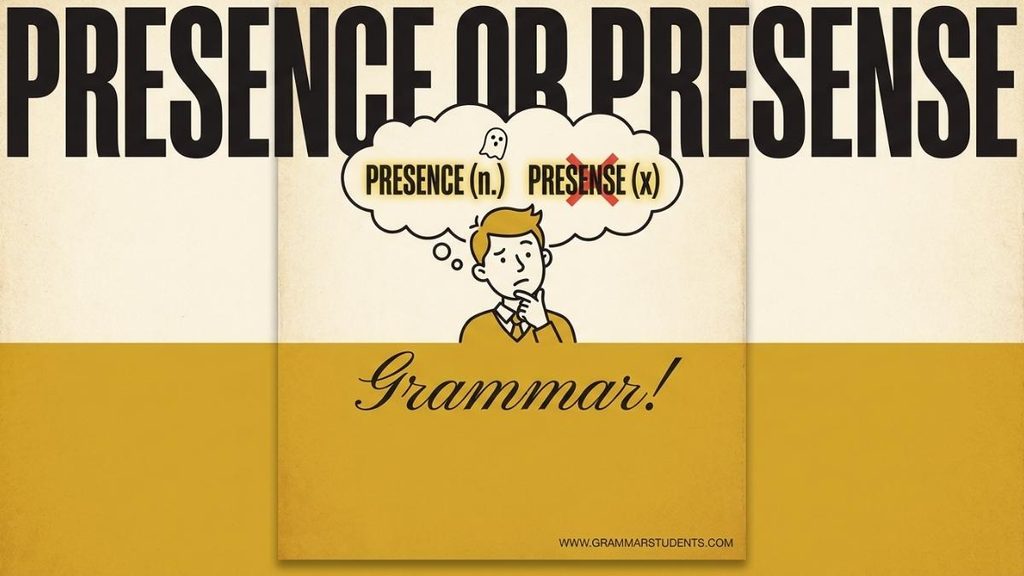
The correct spelling is presence.
The incorrect form is presense.
| Form | Correct? | Meaning |
| presence | Yes | The state of being present existing attending or having a noticeable influence |
| presense | No | A common misspelling of presence |
So if you’re asking presence or presense which spelling is correct use presence every time in standard English writing.
Correct examples
- Your presence made the meeting more enjoyable.
- The presence of water was confirmed during the test.
- She has a strong presence on stage.
- The manager noticed my presence in the office.
- The company has expanded its online presence.
The correction is simple replace presense with presence.
Cambridge Dictionary lists presence as a noun and gives meanings connected with being in a place existence a noticeable quality and other specialized uses. Its UK and US pronunciation entries also use the same spelling.
Presence vs Presense at a Glance
The presence vs presense question is really a spelling question rather than a difference between two words with separate meanings.
| Feature | Presence | Presense |
| Standard English word | Yes | No |
| Correct spelling | Yes | No |
| Part of speech | Noun | — |
| Refers to being present | Yes | — |
| Can describe existence | Yes | — |
| Can describe personal impact | Yes | — |
| Used in American English | Yes | No |
| Used in British English | Yes | No |
| Commonly seen as a typo | No | Yes |
This distinction is important because a frequent spelling mistake can sometimes look like a legitimate alternative. In this case presense doesn’t have a separate dictionary meaning that competes with presence. It is simply the wrong spelling of the intended word.
What Does Presence Mean?
The simplest presence meaning is the state or fact of being present.
In other words presence can describe the fact that a person or thing is somewhere. Cambridge gives this as one of the central meanings of the word.
For example:
The presence of several students changed the atmosphere in the room.
Here presence means that the students were there.
However the word has several related meanings. Understanding them helps you recognize when presence is the right choice.
Presence as Being in a Place
The most direct use refers to someone or something being physically present.
Consider these examples:
- I was grateful for her presence at the ceremony.
- His presence in the room was immediately noticed.
- The document was signed in the presence of two witnesses.
In each case presence describes someone’s being there.
This is closely related to attendance but the words aren’t always interchangeable. Attendance usually focuses on taking part in or being present at an event class or meeting.
Presence as Existence
For example:
- The presence of bacteria was detected in the sample.
- Researchers investigated the presence of pollutants in the water.
- The presence of cracks made the structure unsafe.
Here the word doesn’t mean that something has a personality or physical appearance. It means that the thing exists or occurs in the relevant place or situation.
Learn the difference between tricky more English words
Lader or Ladder Which One Is Correct
Presence as Personal Impact

There is another important presence definition a quality that makes someone noticeable or impressive.
You may hear expressions such as:
- a strong presence
- a commanding presence
- a confident presence
- stage presence
- a powerful presence
For example:
The speaker had an impressive stage presence.
The speaker’s presence isn’t simply about standing on a stage. It refers to the way that person’s manner confidence and behavior affect an audience.
Cambridge specifically describes this sense as a quality that makes people notice or admire someone while Dictionary.com includes meanings related to personal bearing poise and appearance.
Why Is Presense Incorrect?
The easiest explanation is that presense is a spelling error created by confusion over the word’s ending.
The correct word ends in:
ence
So the spelling is:
pres + ence = presence
It isn’t:
pres + ense = presense
The mistake becomes understandable when you hear the word aloud. The final syllable is relatively weak, so someone learning English may try to spell the word according to its sound rather than its established written form.
This is a broader problem in English. Pronunciation can help with spelling but it doesn’t always provide a perfect guide. English contains many words whose written forms preserve historical spellings that aren’t obvious from modern pronunciation.
Why People Spell Presence as Presense
Several factors can contribute to the mistake:
- The ence ending isn’t strongly pronounced.
- The word resembles words containing sense.
- People sometimes spell unfamiliar words phonetically.
- Fast typing can produce accidental substitutions.
- Repeated exposure to an incorrect spelling can make it look familiar.
The key point is that familiarity doesn’t make a spelling correct. Presense may look reasonable at first glance, but standard English uses presence.
Where Does the Spelling Presence Come From?
The history of the word provides a useful clue.
Presence entered English in the Middle English period. Etymonline traces it through Old French presence to Latin praesentia meaning a state or fact of being present. The word is historically connected with present.
Dictionary.com similarly traces presence to Middle French and Latin praesentia.
That history explains why presence belongs to the same broader word family as present.
A useful way to remember the relationship is:
present or presence

The connection isn’t just useful as a memory trick. It reflects the historical relationship between the words.
Presence and Present
Compare these examples:
- She is present at the meeting.
- Her presence at the meeting is appreciated.
In the first sentence present describes someone’s state.
In the second presence names the fact or condition of being there.
Another example makes the distinction clearer:
The students were present during the experiment. Their presence allowed the teacher to begin the discussion.
The adjective present describes the students. The noun presence describes their being there.
Avoid everyday grammar mistakes with simple tips
Persuing or Pursuing Meaning Difference and Correct Spelling
British English vs American English Spelling
One common question is whether presense might be acceptable in one English-speaking country.
It isn’t.
Presence is the standard spelling in both American and British English.
| English variety | Correct form | Incorrect form |
| American English | presence | presense |
| British English | presence | presense |
Cambridge provides both UK and US pronunciation information for presence and uses the same spelling in both varieties.
This is worth emphasizing because English really does have regional spelling differences. Words such as color/colour center/centre and organize/organise can vary by variety or style. Presence/presense isn’t one of those cases.
So if you’re writing for an American audience use presence. If you’re writing for a British audience use presence.
How to Use Presence in a Sentence
Understanding presence usage becomes easier when you group examples according to meaning.
Physical Presence
When someone or something is actually somewhere:
- Her presence at the event was important.
- The doctor requested his patient’s presence at the appointment.
- I noticed the presence of several unfamiliar people.
Existence
When something exists or occurs:
- The test confirmed the presence of iron.
- Scientists measured the presence of carbon dioxide.
- The presence of moisture can damage certain materials.
Personal Influence
When someone has a noticeable effect:
- The actor has a powerful stage presence.
- She has a calm presence that puts people at ease.
- The coach has a strong presence in the locker room.
Online and Digital Use
Modern English also commonly uses presence for someone’s activity or visibility online:
- The company is improving its online presence.
- The brand has a growing social media presence.
- A strong digital presence can help a business reach more customers.
These examples show why the word has become useful far beyond its basic meaning of simply being somewhere.
Presence in a Sentence Practical Examples
If you’re searching for a presence example or trying to learn how to use the word naturally the following examples cover several contexts.
| Context | Example |
| Everyday English | I appreciated your presence. |
| Meeting | Your presence at the meeting is requested. |
| Event | Her presence made the celebration special. |
| Science | The test detected the presence of oxygen. |
| Business | The company wants to strengthen its online presence. |
| Performance | The singer has excellent stage presence. |
| Formal writing | The document was signed in the presence of two witnesses. |
| Emergency | A police presence was visible outside the building. |
Cambridge’s examples include uses involving witnesses police managers and a person’s effect or visibility.
Common Spelling Mistakes With Presence
Spelling by Sound
The biggest problem is often spelling by sound.
When people hear presence they may not immediately identify whether the ending should be written ence or ense. The pronunciation doesn’t clearly announce the letter that belongs on the page.
Cambridge gives the pronunciation as /ˈprez.əns/ in both UK and US English.
That’s one reason pronunciation and spelling don’t always match perfectly.
Confusing Presence With Sense
Another source of confusion is the word sense.
Because presence contains a sound that can resemble the beginning of sense writers may mentally divide it incorrectly.
However presence isn’t simply pre + sense.
Its spelling belongs to the historical word family connected with present and praesentia.
Typing Too Quickly
Sometimes there’s no linguistic mystery at all.
Someone knows the correct spelling but types presense by accident. This can happen especially when writing quickly or switching between several tasks.
A quick proofreading pass can catch this kind of spelling error.
Assuming It’s a Regional Spelling
As discussed earlier presense isn’t a British alternative to American presence.
Both major varieties use presence.
Repeating the Mistake
An incorrect spelling can become surprisingly familiar when it appears repeatedly in informal writing.
That makes proofreading particularly valuable. A word can look right simply because the brain has seen it often.
Presence vs Related Words
The presence word belongs to a larger group of related English forms. Knowing the differences can prevent another type of confusion.
Presence vs Present
Present has several grammatical roles including adjective noun and verb.
Presence is a noun.
Compare:
- She is present.
- She has a strong presence.
The first sentence describes her state. The second describes the fact that she is there or the impression she creates.
Learn how to use confusing more words correctly
Trialled or Trialed Meaning Difference and Usage
Presence vs Attendance
These words overlap but they’re not identical.
Attendance commonly refers to being present at a class meeting event or other organized activity.
Presence has a wider range of meanings. It can refer to:
- physical existence
- attendance
- proximity
- personal influence
- an organization’s activity in a place
- a noticeable quality
- certain specialized or figurative meanings
Dictionary.com lists both attendance and proximity among the meanings associated with presence.
Presence vs Presentness
Presentness exists in specialized contexts, but it isn’t the ordinary replacement for presence.
For everyday English phrases such as the presence of evidence her presence at the meeting, or his stage presence require presence.
Presence as a Noun
The question Is presence a noun has a simple answer is yes.
Presence functions as a noun because it names a state condition quality or instance.
Examples include:
- His presence was reassuring.
- The presence of dust affected the results.
- She has excellent stage presence.
The plural form is presences although the singular is much more common in everyday usage.
Common Forms and Related Words
| Word | Role | Example |
| present | Adjective | She is present. |
| present | Verb | They will present the report. |
| present | Noun | He received a present. |
| presence | Noun | Her presence helped. |
| presently | Adverb | The issue is presently under review. |
Understanding this word family makes the correct spelling of presence easier to retain.
Common Expressions With Presence
Some phrases are especially useful because they show how flexible the word can be.
Physical Presence
Refers to someone’s actual location.
Example:
The project requires a physical presence on site.
Online Presence
Refers to visibility or activity on the internet.
Example:
The business has built a strong online presence.
Social Media Presence
Describes activity and visibility on social platforms.
Example:
The organization is developing its social media presence.
Stage Presence
Describes the ability to command attention while performing.
Example:
The performer has remarkable stage presence.
Presence of Mind
This phrase refers to the ability to remain calm and think clearly during a difficult or unexpected situation.
Example:
She had the presence of mind to call for help.
In the Presence of
This means while someone or something is present.
Example:
The agreement was signed in the presence of witnesses.
Cambridge includes presence of mind and make your presence felt among its established expressions.
Fix common more word mistakes in English
Slushy or Slushie Correct Spelling Meaning and Usage
Presence Synonyms and Similar Words
If you’re looking for a presence synonym the best choice depends on the sentence because presence has several meanings.
| Meaning of presence | Possible related word |
| Being somewhere | attendance |
| Existing somewhere | existence |
| Being nearby | proximity |
| Being with someone | company |
| Personal impression | bearing |
| Impressive quality | charisma |
| Visibility online | visibility |
| Participation | involvement |
These aren’t perfect substitutes in every sentence.
For example attendance works well for a meeting:
Her attendance at the meeting was recorded.
But replacing presence with attendance in every situation would change the meaning. You wouldn’t normally say
The attendance of bacteria was detected.
In that scientific context presence is the natural choice:
The presence of bacteria was detected.
That distinction is important when choosing synonyms for presence.
How to Remember the Correct Spelling of Presence
If presense keeps tempting you use a simple memory connection:
present or presence
Think about the related word present when you write presence. Both contain the central pres structure and the correct noun ends in ence.
Another useful reminder is:
Presence = present + ence
This isn’t meant as a literal rule for constructing every word. It’s simply a practical spelling cue.
You can also memorize the pair:
presence is not correct
presense is correct
After seeing the correct form several times in meaningful sentences the right spelling becomes much more automatic.
Is Presense Ever Correct?
In standard English presense isn’t the correct spelling of the noun presence.
If you encounter presense in an email article social media post school assignment website or other English text it should normally be treated as a spelling error when the writer intended presence.
The important distinction is between usage frequency and standard spelling. Seeing a misspelling online doesn’t turn it into an accepted variant.
For formal academic professional and published writing use presence.
A Simple Case Study Choosing the Right Word
Imagine that a student wants to write:
The presense of several experts improved the discussion.
The sentence has the right idea but the spelling needs correction.
Step 1 Identify the intended meaning
The student means that several experts were there.
Step 2 Identify the noun
The word needed is the noun presence.
Step 3 Check the spelling
The correct form is
The presence of several experts improved the discussion.
The same process works whether you’re writing an assignment email report website article or social media post.
How to Proofread Presence in Professional Writing
A single spelling mistake usually doesn’t destroy a piece of writing. Still repeated errors can distract readers and make otherwise polished content look careless.
When proofreading, watch for these forms:
- presence is correct
- presense is incorrect
- present is different word
- presently is related but different form
A useful proofreading technique is to search the document for presense before publishing. If your writing software supports spellcheck it may flag the error. However automated tools shouldn’t replace human review because spelling software can miss errors or fail to understand context.
Presence in Formal and Professional Writing
The word appears naturally in many types of serious writing.
Academic Writing
The study examined the presence of contaminants in groundwater.
Here presence describes whether something exists in a particular sample.
Business Writing
The company is expanding its presence in international markets.
Here presence describes the company’s activity or established position in those markets.
Legal or Formal Writing
The agreement was signed in the presence of two witnesses.
Here presence refers to people being there when an action took place.
Digital Writing
The organization is strengthening its digital presence.
Here presence describes visibility and activity across digital channels.
These examples demonstrate why the word appears across many fields. Its basic concept remains the same: being there existing there or having an identifiable influence or visibility.
Practice Session Presence and Presense
Fill in the Blanks
- Her ________ at the ceremony made the occasion more special.
- The teacher appreciated everyone’s ________ in class.
- His calm ________ helped reduce the tension in the room.
- Please confirm your ________ at the meeting.
- The doctor noticed the ________ of a small infection.
- The manager’s ________ made the employees feel more confident.
- I was grateful for your ________ during the event.
- The correct spelling of the word is ________.
- The opposite of presence is ________.
- The speaker had a strong ________ on stage.
- We were happy to have her ________ at the celebration.
- The word ________ is a noun related to the adjective present.
- His ________ was immediately noticed when he entered the room.
- The report confirmed the ________ of several important details.
- She felt comfortable in the ________ of her family.
- Your ________ at the conference would be greatly appreciated.
- The actor’s powerful stage ________ impressed the audience.
- The scientist confirmed the ________ of water in the sample.
- The phrase in the ________ of means while someone is there.
- Her warm ________ made everyone feel welcome.
- The student recorded his ________ for the entire semester.
- Always check the spelling of ________ before submitting your article.
- The leader’s ________ brought confidence to the team.
- We noticed his ________ even though he didn’t say anything.
- The invitation formally requested her ________ at the ceremony.
Answer Key
- presence
- presence
- presence
- presence
- presence
- presence
- presence
- presence
- absence
- presence
- presence
- presence
- presence
- presence
- presence
- presence
- presence
- presence
- presence
- presence
- presence
- presence
- presence
- presence
- presence
Here’s a trusted source for clear more words Comparison:
Grammar Update
Frequently Asked Questions
What does presence mean?
Presence means being in a particular place or being noticeable to others. It can also describe the impression, influence or effect someone has on the people around them.
How do you spell presence like you’re there?
The correct spelling is presence P-R-E-S-E-N-C-E. When you mean the state of being somewhere presence is the correct noun. For example Her presence was noticed immediately.
Is the word presence correct?
Yes. Presence is the correct standard English spelling. Presense and prescence are common misspellings and should not be used in standard English writing.
How do you spell a person’s presence?
A person’s presence is spelled presence P-R-E-S-E-N-C-E. The correct ending is ence not ense. For example I appreciated his presence at the meeting.
Which word is correct prescence or presence?
Presence is correct. Prescence is an incorrect spelling that adds an unnecessary c before the final e.
What is a person’s presence?
A person’s presence means their being physically or socially present in a particular place. It can also refer to the impression they make through their personality confidence behavior or influence.
What is a better word for presence?
The best synonym depends on the context. Possible alternatives include attendance existence influence appearance aura and bearing. For example attendance is appropriate when referring to someone’s participation at an event.
Does present have two meanings?
Yes. Present can mean being in a particular place as in She is present in class. It can also mean a gift as in He received a birthday present. As a verb present can mean to show introduce or give something.
How do you use presence in a sentence?
Use presence as a noun when referring to someone’s being somewhere or the effect they have. For example Her presence made the room feel more welcoming.
Conclusion
When it comes to presence or presense there’s really no need to let one tricky spelling steal your confidence. Presence is the correct spelling, while presense and prescence are common mistakes. The confusion usually comes from how the word sounds which can make the incorrect versions look surprisingly convincing. Think of it this way presence has ence at the end just like several other English words. Once you remember that pattern the spelling becomes much easier to recognize. Whether you’re writing an email article school assignment or professional document choose presence. Your spelling will be present and thankfully the extra letters won’t be.

Jacob AJS is an experienced blogger and English language enthusiast dedicated to making grammar and vocabulary simple, clear, and practical. As a writer for Grammarstudent, he creates insightful word comparisons, easy-to-follow explanations, and useful examples that help learners avoid common mistakes. His passion is to make English easier to understand while helping readers communicate with confidence, clarity, and accuracy.