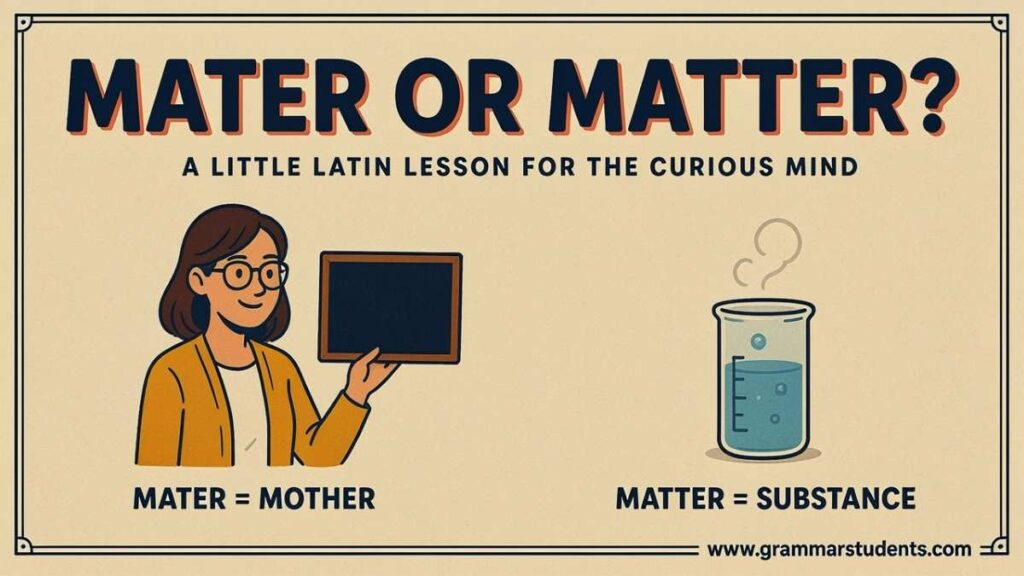
Have you ever written a sentence and wondered whether mater or matter is the correct word? Youre not alone! These two words look almost identical but confusing them can turn a meaningful sentence into a grammatical head-scratcher. Matter refers to a subject problem physical substance or something important while mater is an oldfashioned word for mother and appears in the familiar phrase alma mater. One tiny spelling difference can make a surprisingly big difference in meaning. In this guide youll discover the difference between mater and matter explore clear examples avoid common spelling mistakes and test your knowledge with a fun fill-in-the-blank exercise.
Mater or Matter The Quick Answer
Matter is the correct word in most everyday situations when you mean an issue a subject a physical substance or something important. Mater is also a real word but it has a much narrower use. It is an old-fashioned British English term for mother and appears in expressions such as alma mater which refers to the school college or university someone attended.
Consider these examples:
- Correct: It doesnt matter whether we arrive five minutes early.
- Correct: She returned to her alma mater to give a speech.
The key distinction is simple: use matter in ordinary conversations schoolwork emails professional communication and scientific discussions. Choose mater only when its specific meaning or an established expression calls for it.
What Is the Difference Between Mater and Matter?
The main difference between mater and matter lies in their meaning and usage not in a regional spelling rule. Although the words look similar they arent interchangeable.
| Feature | Matter | Mater |
| Main meaning | An issue substance subject or something important | Mother in an old fashioned expression |
| Part of speech | Noun and verb | Noun |
| Everyday use | Very common | Uncommon |
| Scientific use | Refers to physical substance | Not normally used for this meaning |
| Common expression | It doesnt matter | Alma mater |
| Word origin | From Latin materia through historical language forms | From Latin mater meaning mother |
| Standard use | Ordinary English sentences | Specific limited contexts |
The difference becomes clearer when you look at each word in context.
- This is a serious matter. Here matter means an important issue.
- My mater attended the ceremony. In an old-fashioned British context mater can mean my mother.
- Water is a form of matter. In science the word refers to physical substance.
- He visited his alma mater. The phrase refers to an educational institution he previously attended.
Matter Meaning Definition Uses and Examples
The word matter has several meanings in English. Its exact meaning depends on the context so understanding the surrounding sentence is just as important as remembering a dictionary definition.
The most common meanings include an issue or subject physical substance importance and a situation that needs attention. The word can also function as a verb when you want to express that something is important.
Matter as a Noun
A noun names a person place thing idea or concept. As a noun matter can describe a topic a problem a physical substance or an issue that needs attention.
Examples:
- We need to discuss an important matter before the meeting.
- The police are investigating the matter.
- Climate change is a serious environmental matter.
- I have a personal matter to discuss with you.
- The newspaper reported the matter in detail.
In these sentences matter refers to an issue subject or concern. It doesnt refer to a mother or an educational institution.
Matter as an Issue or Subject
One of the most common meanings of matter is something that needs attention discussion or consideration.
For example:
We should settle this matter before Friday.
The speaker means that an issue needs to be resolved before a deadline.
Youll encounter this usage in business emails legal documents school discussions and everyday conversations. Expressions such as a serious matter a personal matter a financial matter and a matter of concern all use the word in this sense.
Common expressions include:
- A private matter: Something personal that may not be appropriate to discuss publicly.
- A serious matter: An issue with significant consequences.
- A matter of opinion: Something people may reasonably disagree about.
- A matter of time: Something expected to happen eventually.
- A matter of fact: Something presented as factual rather than emotional or speculative.
These expressions demonstrate how widely matter appears in English vocabulary.
Matter as Physical Substance
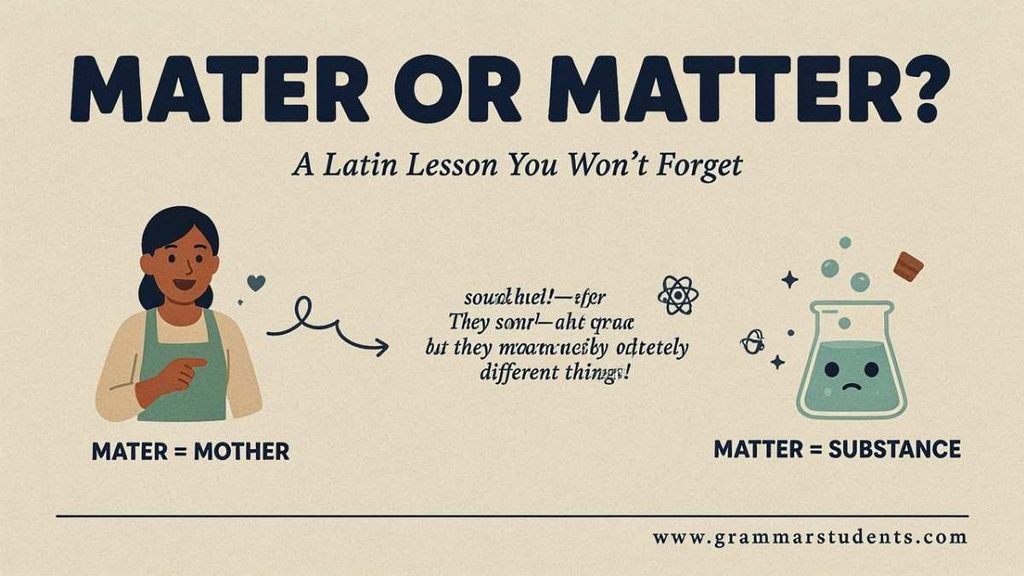
In science matter refers to physical substance that has mass and occupies space. This scientific definition differs from the everyday meaning of an issue or concern.
Examples of matter include:
- Water
- Air
- Wood
- Rocks
- Iron
- Human tissue
Matter commonly exists in three familiar states: solid liquid and gas. Plasma is another state found in environments such as stars and lightning.
For example:
- Ice is solid matter.
- Liquid water is matter.
- Air contains gases that are forms of matter.
Matter and energy are closely related concepts in physics but the terms dont mean the same thing. In basic scientific explanations matter is commonly distinguished by its mass and spatial extent.
This scientific usage explains why matter appears in textbooks laboratory reports and academic writing. Mater cannot replace matter when youre discussing physical substances.
Matter as a Verb
The word matter also functions as a verb. In this form it means to be important or to have an effect on a situation.
Examples include:
- Your opinion matters to me.
- Every minute matters during an emergency.
- It doesnt matter which color you choose.
- Small details can matter more than you expect.
- What matters most is that everyone feels safe.
Notice the grammar in these examples. When the subject is singular and the sentence uses the simple present tense the verb usually takes an -s ending: matters. With I you we and they the base form matter is generally used.
| Subject | Correct example |
| I | I matter. |
| You | You matter. |
| He | He matters. |
| She | She matters. |
| It | It matters. |
| We | We matter. |
| They | They matter. |
Matter Meaning Importance
Another common meaning of matter relates to importance significance or consequence.
Consider this sentence:
Your hard work matters even when nobody notices it immediately.
Here matters means that the hard work has value or significance.
Similarly Does it matter? asks whether something is important enough to make a difference. The phrase doesnt necessarily refer to a physical object or a specific problem.
Examples:
- Does it matter if the report is one page longer?
- It matters that you tell the truth.
- Her support made a real difference because it mattered to the team.
- The final result matters more than a minor formatting error.
In these sentences matter expresses importance rather than referring to a person or place.
Mater Meaning Definition Origin and Usage
Unlike matter mater has a limited role in modern English. It comes from the Latin word mater meaning mother. English dictionaries identify it as an old-fashioned British English expression for mother sometimes used humorously or informally.
You might encounter mater in older books British cultural references or conversations that deliberately use traditional language. Most English speakers however simply say mother mom or mum.
What Does Mater Mean in English?
The mater meaning in English is generally mother when the word appears as an old-fashioned British expression. Its meaning comes from Latin where mater is the word for mother.
For example:
- I must write to my mater. Or An old-fashioned way to say I must write to my mother.
- His mater was waiting at home. Or A dated or humorous way to refer to his mother.
- She returned to her alma mater. Or Here mater appears as part of a Latin phrase associated with an educational institution.
These examples show why context matters. In the first two sentences mater means mother. In the third it is part of a familiar expression with an established meaning.
For a modern email essay or conversation mother is usually the clearest choice when referring to a parent.
Is Mater a Real English Word?
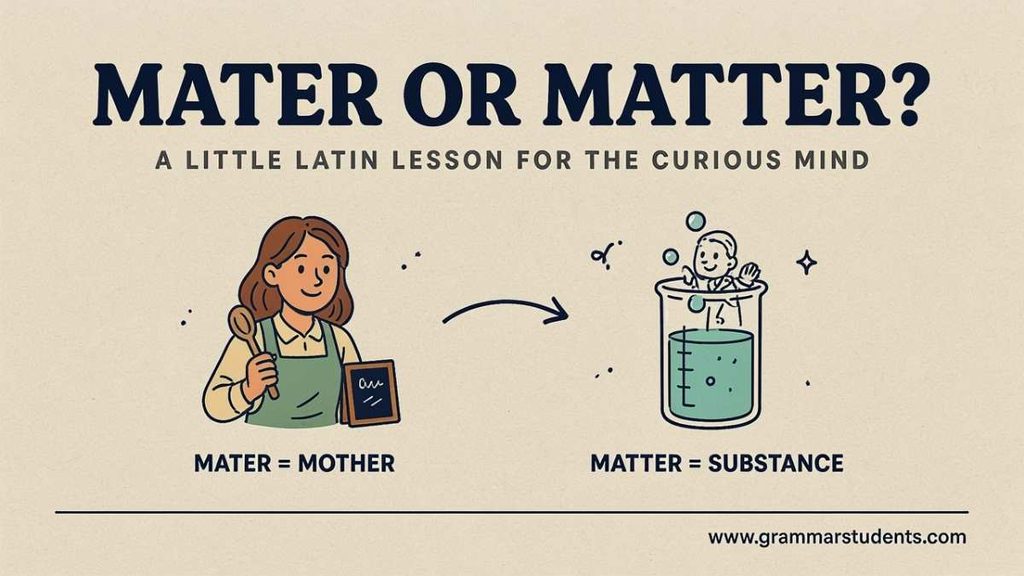
Yes it is a real word although it isnt common in everyday English. Its presence in dictionaries doesnt mean you can use it as a replacement for matter.
For instance:
- I spoke to my mater may work in a deliberately old-fashioned British context.
- We discussed an important mater is incorrect if you mean an important issue.
- This scientific mater has mass is incorrect if youre referring to physical substance.
The important lesson is that dictionary recognition and correct word choice are two different things. A word can be legitimate yet unsuitable for the meaning you intend.
Alma Mater Meaning What Does the Phrase Mean?
One of the best-known uses of mater is the Latin phrase alma mater. In modern English it usually means the school college or university someone attended particularly an institution from which they graduated.
Examples include:
- She returned to her alma after ten years.
- The university invited its alumni to celebrate their alma mater.
- He donated money to the college that served as his alma mater.
- Our former teacher received an award from her alma mater.
The phrase has Latin roots. Alma is commonly translated as nourishing or kind while mater means mother. The expression is traditionally associated with the idea of a nurturing institution that provides education and helps students develop.
In the United States alma mater can also refer to a schools official song particularly in a college or university setting.
Remember: Alma mater is a recognized phrase. That doesnt make mater an acceptable spelling of matter in an ordinary sentence.
What Is the Difference Between Mater and Maternal?
Both words relate to motherhood but they serve different grammatical purposes.
- Mater: An old fashioned British noun meaning mother.
- Maternal: An adjective meaning related to a mother or motherhood.
Examples:
- His mater sent him a letter. (Old-fashioned usage)
- She received maternal support from her family.
- The child shares a close bond with his maternal grandmother.
The word maternal appears much more naturally in modern formal writing medical discussions and everyday descriptions. For example maternal health refers to health associated with pregnancy childbirth and the period after birth.
Mater vs Matter Word Origin and Etymology
Understanding the origins of these words can make the difference easier to remember.
Although mater and matter look similar they have different historical backgrounds and developed different meanings.
The Origin of Matter
The English word matter developed through historical forms associated with Latin materia a word connected with material substance or the matter from which something is made. The word entered English through earlier European language forms.
Over time matter developed several related uses. It could describe physical a subject under discussion or something important enough to deserve attention.
These meanings remain in modern English:
- Material: Matter used to make something.
- Subject matter: The topic or content being discussed.
- A matter of concern: An issue that deserves attention.
- It matters: It is important.
The meanings may appear different at first but they share a broad idea of substance content or significance.
The Origin of Mater
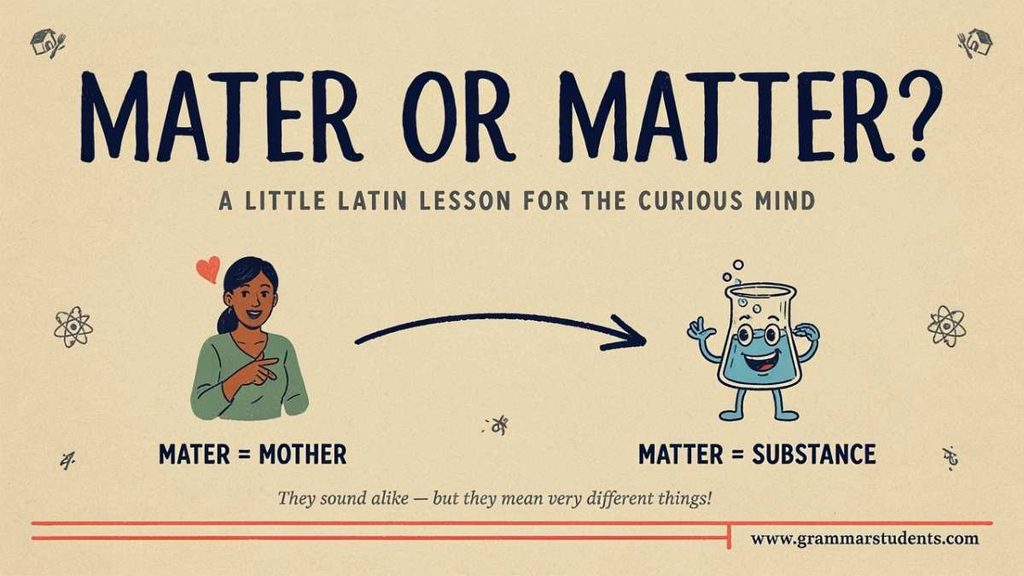
The word mater comes from Latin mater meaning mother. The same Latin root appears in words connected to motherhood and family relationships.
For example:
- Maternal: Relating to a mother.
- Maternity: The state or experience of motherhood or services related to pregnancy and childbirth.
- Alma mater: A school or university someone attended.
These related words can help you recognize the maternal root. However they dont share the same meaning as matter.
Are Mater and Matter Different Because of British and American English?
No Mater is not the British spelling of matter and matter isnt exclusively American English.
Both American and British English use matter in standard sentences about issues importance and physical substances. The word has a separate limited use particularly as an old-fashioned British term for mother.
| Intended meaning | American English | British English |
| An important issue | This is an important matter. | This is an important matter. |
| Something is important | Your opinion matters. | Your opinion matters. |
| Physical substance | Matter has mass. | Matter has mass. |
| Mother in ordinary usage | My mother is here. | My mother is here. |
| Mother in old-fashioned usage | Mater may be understood in context. | Mater may be used in an old-fashioned or humorous context. |
American and British English do have spelling differences such as color/colour and center/centre. Mater versus matter is a difference in word meaning and usage not a standard US versus UK spelling variation.
Mater or Matter Common Mistakes and Correct Spelling
Spelling errors often happen when a writer leaves out a letter while typing quickly. Since mater is a real word spell-checking tools may not always identify it as an error.
The best way to avoid confusion is to consider what the sentence means before choosing a spelling.
It Doesn’t Mater or Matter Which Is Correct?
If you mean that something is unimportant or wont change the outcome the correct sentence is:
It doesnt matter.
The phrase it doesnt mater is incorrect for that meaning because mater doesnt mean be important.
| Incorrect spelling | Correct spelling |
| It doesnt mater to me. | It doesnt matter to me. |
| Does it mater what I wear? | Does it matter what I wear? |
| Your opinion maters. | Your opinion matters. |
| We need to discuss this mater. | We need to discuss this matter. |
| This is a serious mater. | This is a serious matter. |
| The subject mater is interesting. | The subject matter is interesting. |
Each correction adds the second t where required. That small change helps preserve the intended meaning.
Why Do People Confuse Mater and Matter?
Several factors make these commonly confused words easy to mix up.
Similar appearance: The two words share the letters m a t e and r. The only spelling difference is an additional t in matter.
Typing quickly: When people write messages emails or school assignments in a hurry they may accidentally omit a repeated letter.
Limited familiarity with mater: Most readers encounter matter frequently but rarely use mater. They may assume that both spellings are interchangeable.
Autocorrect limitations: A spell-checker may accept because it is a legitimate word even when the sentence requires matter. Grammar tools can also miss errors if the sentence remains technically possible.
Unclear proofreading: Writers often focus on whether a sentence sounds natural and overlook individual letters.
For example a proofreading tool might not flag I wrote to my because the sentence could be grammatically valid in a special context. Proofreading requires more than checking whether a word exists.
Is Important Mater Correct?
Usually no. If you mean a subject or issue that deserves attention write important matter.
- Incorrect: We need to resolve this important mater.
- Correct: We need to resolve this important matter.
Likewise use serious matter personal matter financial matter and legal matter when referring to issues or concerns.
The word is appropriate only when you intend its specific meaning such as mother or when it appears in a recognized phrase such as alma.
Is Maters or Matters Correct?
Both forms exist in certain contexts but they arent interchangeable.
- Matters is the plural of the noun matter or the third-person singular form of the verb matter.
- Maters is the plural form of mater where that uncommon noun is being used.
Examples:
- Several important matters remain unresolved.
- Your choices matter to the team.
- The university celebrated its alma mater at the ceremony.
Youre unlikely to need maters in ordinary writing. When you want to refer to multiple issues use matters.
Mater and Matter Examples in Everyday English
The easiest way to learn the difference is to see both words in realistic contexts. The following examples show how the intended meaning determines the correct word choice.
Matter in a Sentence
Use matter when discussing a topic problem physical substance or importance.
- Everyday conversation: It doesnt matter which restaurant we choose.
- Professional communication: We should discuss this matter during tomorrows meeting.
- Academic writing: The research examines how matter responds to changes in temperature.
- Personal relationships: You matter to me more than you realize.
- News reporting: Officials are investigating the matter.
- Schoolwork: The teacher explained the difference between matter and energy.
- Formal writing: The committee will review the matter before reaching a decision.
- Problem solving: We need to address this matter before it becomes more serious.
Each example uses the standard spelling because the sentence refers to an issue substance or something important.
Mater in a Sentence
The word mater appears less frequently. Its use generally depends on a traditional British expression or a phrase with Latin roots.
- He wrote a letter to his mater. Or An old-fashioned way of referring to his mother.
- She returned to her alma mater for a reunion. Or She visited the educational institution she attended.
- The graduate thanked his alma mater for its support. Or He expressed appreciation for his former institution.
- The old novel uses mater as a familiar term for mother. Or The sentence describes the word itself.
These examples demonstrate the limited mater word usage found in English. In ordinary conversation mother mom or mum will usually sound more natural.
Mater or Matter Examples by Context
| Context | Example | Correct choice |
| A problem | This is a complicated ___. | Matter |
| Importance | Your effort really ___. | Matters |
| Science | Air contains gaseous ___. | Matter |
| Business | Please address this ___ promptly. | Matter |
| Family | His ___ called him home. | Mater in an old fashioned context |
| Education | She visited her alma ___. | Mater |
| Personal concern | Its a private ___. | Matter |
| Opinion | Does my choice ___? | Matter |
The table offers a practical test: identify the meaning first then select the word that expresses it.
Case Study How One Missing Letter Changes a Sentence
Imagine that Ayesha is preparing a formal email to her manager. She writes:
I would like to discuss an important mater regarding the project.
The reader can probably guess her intention but the sentence contains a spelling mistake. The word mater doesnt mean an issue or subject.
A better version would be:
I would like to discuss an important matter regarding the project.
Now imagine that Ayesha writes:
I am proud to support my alma matter.
This sentence also contains an error. The established phrase is alma mater not alma matter.
What Can We Learn From These Examples?
The correct spelling depends on the expression you intend to use.
- Write important matter when referring to an issue.
- Write it matters when something is important.
- Write alma mater when referring to a school college or university someone attended.
- Use mater to mean mother only when the context supports that uncommon old-fashioned usage.
This distinction is especially important in professional emails applications academic assignments and published articles. A single incorrect letter can make otherwise polished writing look careless.
How to Remember the Correct Spelling of Matter
You dont need a complicated grammar rule to remember this difference. A few simple techniques can help you choose the correct spelling quickly.
Use the Matters to Me Memory Trick
Remember this phrase:
What matters to me has two ts.
When youre writing about importance an issue or physical substance think of matter with its double t.
Examples:
- Your success matters to me.
- This matter needs attention.
- The scientist studied matter.
The trick wont cover every possible meaning but it helps with the most common uses.
Connect Matter With Important Matters
Associate matter with familiar phrases you already know:
- Important matter
- Serious matter
- Personal matter
- Subject matter
- It doesnt matter
- What matters most
Repeated exposure to these expressions makes the correct spelling easier to recognize. You can also keep a short list of frequently confused words while proofreading your writing.
Memorize Alma Mater as a Complete Phrase
Rather than trying to use mater on its own remember the full phrase alma mater.
Think of a graduate returning to a former university for a reunion. The phrase refers to that educational institution not to an issue or physical substance.
This approach helps you remember the specialized expression without mistakenly using mater elsewhere.
Proofread for Meaning Not Just Spelling
A spelling checker is useful but it cannot always understand what you intended to say.
When reviewing a sentence ask yourself:
- Am I talking about an issue or problem?
- Do I mean that something is important?
- Am I referring to physical substance?
- Am I talking about a mother in an old-fashioned context?
Your answers will usually reveal which word belongs in the sentence.
A Simple Guide to Matter Word Usage
The word matter appears in many familiar expressions. Learning these combinations will help you use the word confidently in both formal and informal writing.
| Expression | Meaning | Example |
| It doesn’t matter | Something isn’t important in the situation | It doesn’t matter who arrives first. |
| A matter of time | Something expected to happen eventually | Its only a matter of time before the results arrive. |
| Subject matter | The topic or content being discussed | The subject matter of the essay is climate change. |
| A personal matter | A private issue | She left early to handle a personal matter. |
| A serious matter | An issue with significant consequences | Safety is a serious matter. |
| As a matter of fact | Used to introduce or emphasize a fact | As a matter of fact I already finished the report. |
| What matters most | The most important consideration | What matters most is your effort. |
| No matter what | Regardless of the circumstances | Ill support you no matter what. |
These expressions are useful in everyday conversations professional emails academic assignments and formal writing.
Pay attention to the grammar as well. For example matter appears after doesnt as in It doesnt matter. The auxiliary verb does already carries the third-person singular form so the main verb stays in its base form. Write It doesnt matter not It doesnt matters.
That rule applies to many English verbs She doesnt know he doesnt agree and it doesnt work.
Practice session about Mater or Matter
Fill in the Blanks
- Your opinion really __________ to me.
- Water is a form of physical __________.
- She returned to her __________ mater to give a speech.
- We need to discuss an important __________ today.
- My grandmother affectionately called her mother __________.
- Does it __________ which color we choose?
- Scientists study how __________ behaves under different conditions.
- He visited his alma __________ after many years.
- This is a serious __________ that requires immediate attention.
- Your hard work will __________ in the long run.
- Air is an example of __________.
- She wrote a letter to her __________.
- The teacher explained the subject __________ clearly.
- My father attended the same alma __________ for four years.
- It doesnt __________ whether you win or lose; what matters is that you try.
- The court will consider the __________ carefully.
- The human body is made of different forms of physical __________.
- He proudly spoke about his alma __________ during the interview.
- We have more important __________ to discuss.
- In Latin the word mater means __________.
- Does your vote __________ in this election?
- Wood iron and water are examples of __________.
- The students visited their alma __________ during the reunion.
- Please explain the __________ in greater detail.
- Remember your choices __________ and can affect your future.
Answer Key
- matter
- matter
- alma
- matter
- mater
- matter
- matter
- mater
- matter
- matter
- matter
- mater
- matter
- mater
- matter
- matter
- matter
- mater
- matters
- mother
- matter
- matter
- mater
- matter
- matter
Here’s a trusted source for clear word meanings:
Frequently Asked Questions About Mater or Matter
What Is the Difference Between Mater and Matter?
Matter refers to a subject problem physical substance or something important. Mater is an oldfashioned term for mother and also appears in the phrase alma mater which refers to the school or university someone attended.
What Does Mater Mean in Slang?
Mater is not widely used in modern slang. In British English it has traditionally served as an informal or humorous word for mother.
What Do You Mean by Mater?
Mater comes from the Latin word for mother. Today English speakers most commonly encounter it in alma mater meaning a school college or university someone attended or graduated from.
What Are the Two Meanings of Matter?
Matter has two common meanings as a noun a physical substance and a subject or issue under discussion. As a verb it can also mean to be important as in Your opinion matters.
What Are Five Examples of Matter?
Five examples of physical matter are water air wood iron and rock. Each consists of physical material with mass and occupies space.
What Is Another Word for Matter?
The best synonym depends on the context. Words such as issue subject concern problem and material can replace matter in different sentences. When used as a verb matter can mean count or be important.
How Do You Use Mater in a Sentence?
You can use mater as an old-fashioned word for mother. For example He wrote a letter to his mater. It also appears in this sentence: She returned to her alma mater to speak to students.
What Is Another Word for Mater?
Depending on the context alternatives include mother mom mum or parent. However when mater appears in alma mater replacing it with one of these words changes the established expression.
What Does Matter Mean?
Matter can mean a physical substance a topic a problem or a concern. As a verb it means to be important or have an effect. For example Small details matter when you proofread an article.
Where Does the Term Mater Come From?
The word mater comes from Latin where it means mother. It is related to English words such as maternal maternity and matriarch.
Can You Use Alma Mater in a Sentence?
Yes. For example: After becoming a successful writer Aisha returned to her alma mater to encourage new students. The phrase refers to the educational institution someone attended.
What Is the Root Word for Mater?
The Latin word mater meaning mother is the root of the English word mater. It also appears in related words such as maternal and maternity.
What Is the Real Meaning of Matter?
In science matter is physical substance that has mass and occupies space. In everyday English it can refer to a subject situation or problem. As a verb it describes something that is important or significant.
Why Does Definition Matter?
A clear definition helps you understand a words intended meaning and use it correctly. This is especially important when two words look similar but have different meanings such as mater and matter.
Why Is It Called Matter?
The English word matter developed from Latin materia which referred to material or substance. Its modern meanings include physical substance and a subject or issue being considered.
What Does the Word Mater Mean?
Mater is a Latin-derived term meaning mother. In modern English it is uncommon outside historical or humorous usage and familiar expressions such as alma mater.
What Does Matter Mean in Hebrew?
The Hebrew translation depends on the context. Inyan (עניין) can mean a matter issue or subject while chomer (חומר) means material or substance. Neither word is a universal translation for every use of matter.
What Is the Biblical Meaning of Matter?
In a biblical context matter generally refers to an issue concern subject or situation depending on the passage and Bible translation. The word does not have one special biblical meaning in every instance.
What Is Another Meaning of Matter?
Besides physical substance matter can mean an issue to discuss a problem to resolve or something of importance. For example The deadline is a serious matter describes a situation that deserves attention.
Does Matter Have Two Meanings?
Yes. As a noun matter commonly means either physical substance or a subject or issue. It also functions as a verb meaning to be important as in Every vote matters.
Where Did Matter Come From?
The word matter traces back to Latin materia meaning material or substance. It entered English through historical language changes and developed several related meanings.
What Are the Different Types of Matter?
Matter can be classified by its physical state or chemical composition. The familiar states are solid liquid gas and plasma. Scientists also classify matter as pure substances including elements and compounds or mixtures.
What Are the Four Kinds of Matter?
The four commonly taught states of matter are solid liquid gas and plasma. Each has different properties. Scientists recognize additional states under specialized conditions.
What Type of Matter Is a Human Being?
A human being is made of ordinary physical matter including water proteins fats carbohydrates and minerals. These materials form cells tissues organs and the rest of the body.
What Is the Definition of Matter?
In science matter is anything that has mass and occupies space. In everyday language the word can also describe a subject issue or concern. As a verb it means to be important.
Conclusion:
Understanding mater or matter doesnt have to be a matter of confusion! Although these words differ by just one letter their meanings are quite different. Matter refers to a subject problem physical substance or something important while mater is an old-fashioned word for mother that also appears in alma mater. Mixing them up might not cause a grammatical disaster but it could leave your readers scratching their heads. Remember the difference review the examples and practice using both words correctly. After all good grammar matters and knowing when to use mater matters even more when youre writing about mothers or your alma mater!

Jacob AJS is an experienced blogger and English language enthusiast dedicated to making grammar and vocabulary simple, clear, and practical. As a writer for Grammarstudent, he creates insightful word comparisons, easy-to-follow explanations, and useful examples that help learners avoid common mistakes. His passion is to make English easier to understand while helping readers communicate with confidence, clarity, and accuracy.