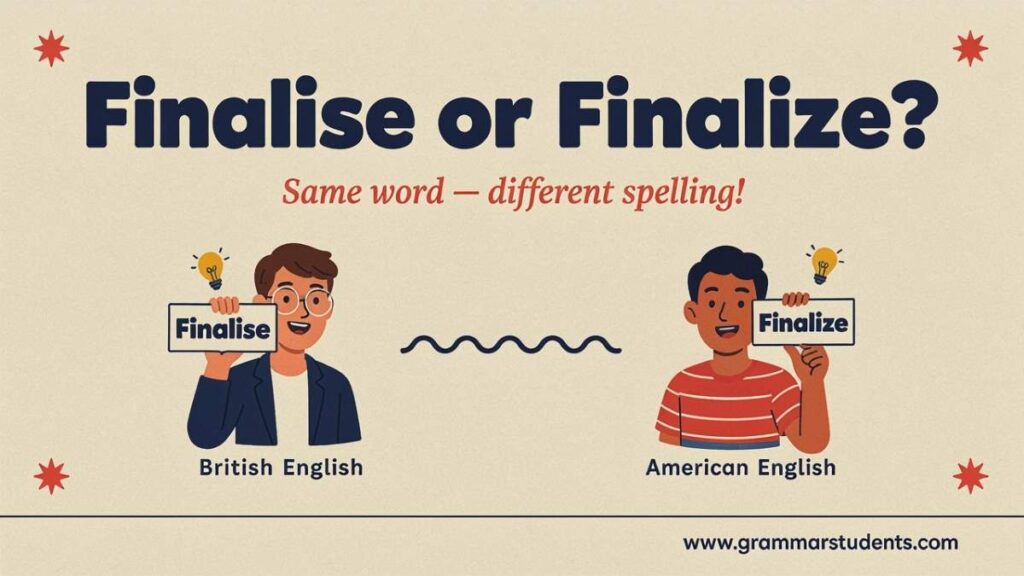
Have you ever paused while writing an email wondering whether to use finalise or finalize? Youre not alone! These two spellings often confuse writers students and professionals who want their English to look polished. The good news is that neither spelling is wrong. The difference comes down to regional spelling preferences not meaning. American English favors finalize while British English commonly uses finalise. Choosing the right form can feel like a tiny spelling puzzle but its easy once you know the rules. In this guide youll learn their meanings differences examples and correct usage without second guessing every sentence.
Finalise or Finalize Which Spelling Is Correct?
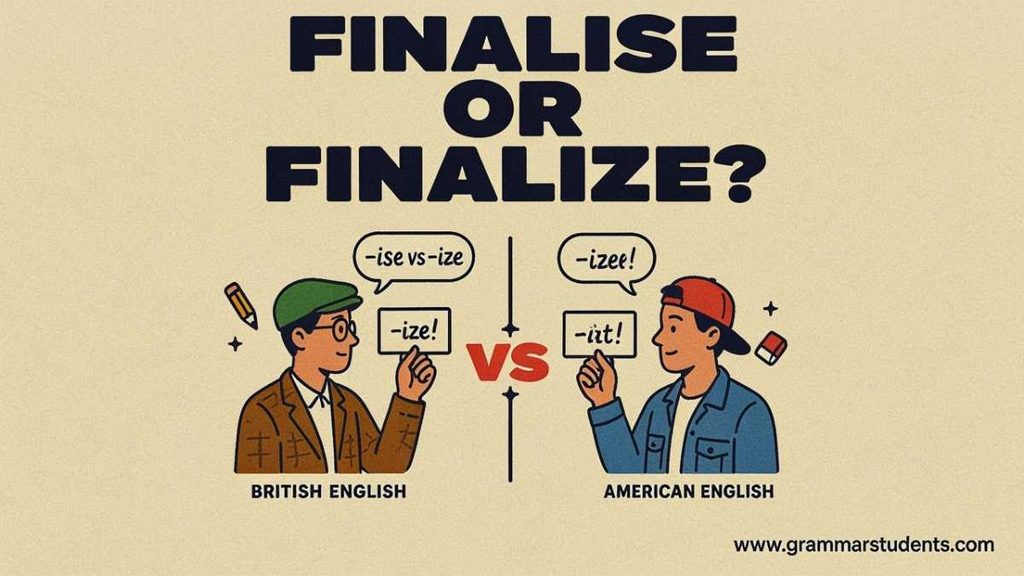
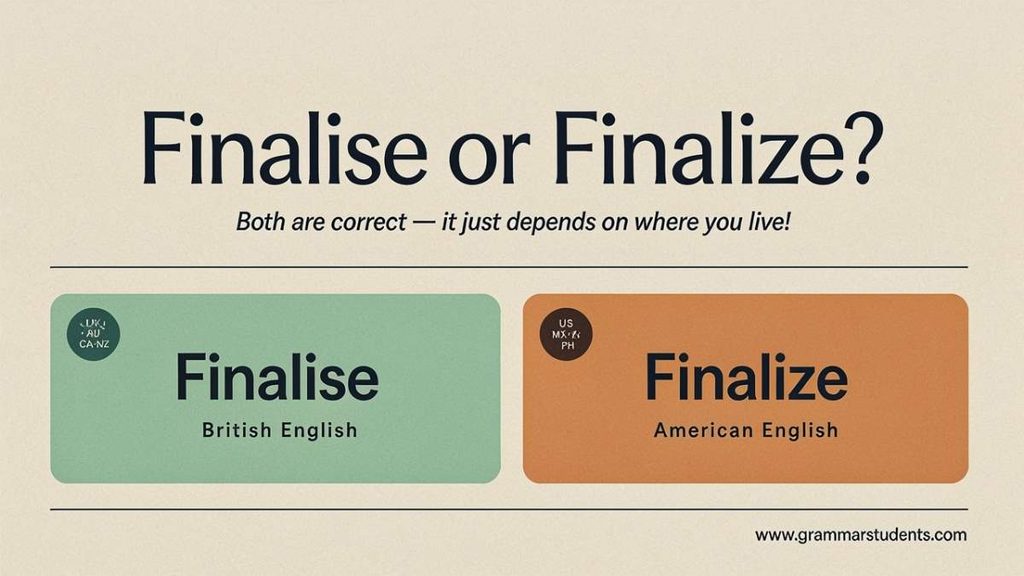
Both finalise and finalize are correct English spellings. Neither changes the word’s meaning or grammatical function. Your choice usually depends on the English variety you follow and the style guide you’re expected to use.
Here’s a simple way to remember the difference:
- Finalize: The standard preference in American English.
- Finalise: A common spelling in British English and other varieties that favor -ise endings.
- Finalize in British English: Also accepted by many British dictionaries and style guides.
Consider these examples:
- American English: We need to finalize the project proposal by Friday.
- British English: We need to finalise the project proposal by Friday.
Both sentences communicate the same message. Only the spelling changes.
You may encounter finalize in American business documents and finalise in publications that follow British spelling conventions. Neither form is inherently more formal or professional than the other.
Finalise vs Finalize Meaning and Definition
Before comparing spelling conventions it’s worth understanding what the word means. Both forms function as verbs and describe the process of bringing something to its final state.
Learn the difference between tricky more English words
To or Too Which One Belongs in Your Sentence?
What Does Finalize Mean?
The finalize meaning is to complete the remaining details of something settle an arrangement or establish the final form of a plan or decision.
Imagine a team that has spent several weeks discussing a project. The members have chosen a deadline reviewed the budget and assigned responsibilities. Once they settle those details they can finalize the project plan.
In everyday English finalize often refers to:
- Plans: Finalize a travel itinerary before booking tickets.
- Agreements: Finalize the terms of a business deal.
- Projects: Finalize a report before submitting it.
- Decisions: Finalize a choice after considering the available options.
- Transactions: Finalize a purchase after completing the required steps.
- Documents: Finalize a contract after reviewing its wording.
The word often signals that something has reached its last important stage. It doesn’t necessarily mean every related task has ended. Instead it means the particular plan document or decision has reached its intended final form.
For example a company can finalize its marketing strategy while employees continue working on the campaign.
What Does Finalise Mean?
The finalise meaning is identical to the meaning of finalize: to complete something settle its remaining details or bring it into its final form.
The difference lies in spelling not definition.
Examples include:
- The committee will finalise the schedule tomorrow.
- Please finalise your application before the deadline.
- The two companies hope to finalise their agreement this week.
- Our editor has finalised the article for publication.
These sentences follow the same grammatical patterns as their American English counterparts.
The spelling finalise is common in British English and appears in other varieties that favor -ise endings. However British spelling conventions aren’t entirely uniform. Some dictionaries and style guides accept or prefer ize in words where both forms are established.
Avoid everyday grammar mistakes with simple tips
Boxes or Boxs Correct Spelling Meaning and Usage
Finalise Definition vs Finalize Definition
If you’re searching for a finalise definition or a finalize definition you don’t need two separate explanations.
| Word | Definition | Example |
| Finalize | To complete or settle the remaining details of something | We will finalize the schedule today. |
| Finalise | To complete or settle the remaining details of something | We will finalise the schedule today. |
Both words are verbs and can take a direct object. You can finalize the agreement or finalise the agreement without changing the meaning.
Finalise or Finalize Meaning in Simple English
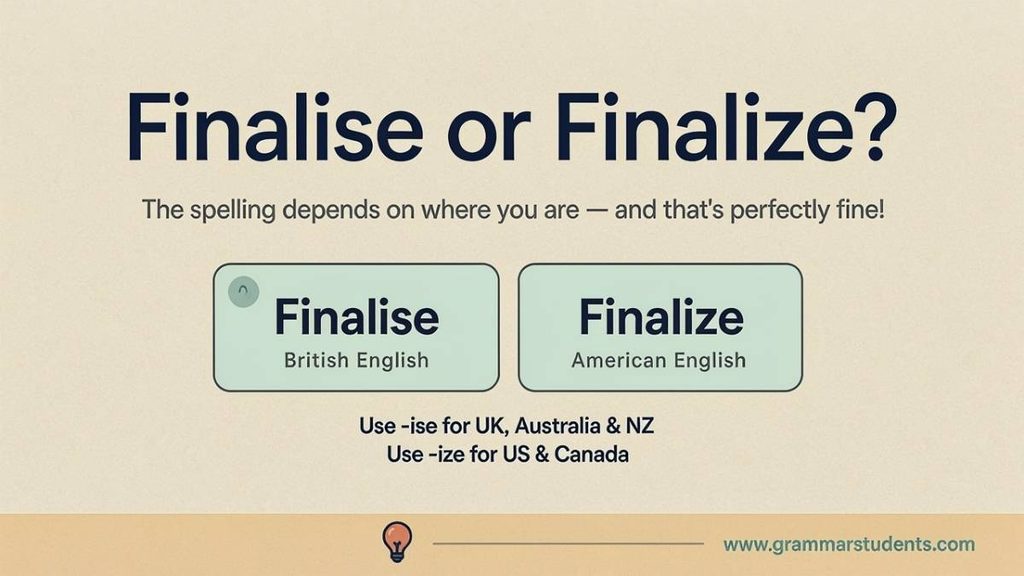
In simple terms to finalize something means to settle its remaining details so that it’s ready or officially decided.
Imagine you’re organizing a school event. You’ve selected the venue but you still need to confirm the date approve the budget and arrange transportation. Once you settle those details you’ve finalized or finalised the arrangements.
The word can also describe making a decision definitive. Its precise meaning depends on the context.
Compare these examples:
- We finished writing the report. This emphasizes completing the writing.
- We finalized the report. This suggests that we settled the remaining details and approved the final version.
The meanings overlap but finalize often emphasizes the last steps that make something ready for approval use or implementation.
Finalise or Finalize What Is the Main Difference?
The main difference between finalise and finalize is regional spelling preference. Both words share the same meaning grammatical function and standard pronunciation.
English spelling conventions vary across countries publishers and institutions. Understanding those conventions helps you choose the form that best suits your readers.
Learn how to use confusing more words correctly
Classes or Class’s Meaning Difference and Usage
British English vs American English Spelling
American English generally favors finalize while British English commonly uses finalise. This reflects broader spelling preferences rather than a strict division between the two varieties.
American English typically favors -ize in words such as organize recognize and finalize. British English uses both ize and ise spellings depending on the word and the style guide.
| American English | Common British English form |
| Finalize | Finalise |
| Organize | Organise |
| Recognize | Recognise |
| Realize | Realise |
| Finalization | Finalisation |
| Organizing | Organising |
These pairs generally retain the same meanings. Their spelling differences don’t change the underlying grammar.
One detail is worth remembering British English doesn’t always require ise. The ize ending has a long history in English and remains acceptable in many British publications. Some style guides prefer ise while others use ize for words that permit both spellings.
The safest approach is to follow the spelling standard used by your intended audience or publication.
Finalize in American English
If you’re writing for readers in the United States finalize is the natural choice.
Examples include:
- The manager will finalize the hiring decision tomorrow.
- We need to finalize our budget before the end of the month.
- The company finalized the contract after reviewing the terms.
- Please finalize your presentation before sending it to the client.
American English generally uses finalize and its related forms including finalized finalizing and finalization.
For an American English website using these forms consistently creates a more cohesive reading experience.
Finalise in British English
When writing for a British English audience that follows -ise spellings use finalise.
Examples include:
- The director will finalise the arrangements next week.
- We have finalised the meeting agenda.
- Please finalise the document before submitting it.
- The team is finalising the details of the agreement.
These forms are suitable for professional emails reports articles and other formal documents.
Remember that finalize can also be acceptable in British English. Check your organization’s editorial policy if it specifies a preferred spelling.
Fix common more word mistakes in English
Emigrate or Immigrate Difference Meaning and Usage
Which Spelling Do Other English Speaking Countries Use?
Regional spelling preferences extend beyond the United States and the United Kingdom. Australia New Zealand Canada and South Africa have their own conventions although individual publishers and organizations may make different choices.
| Region | Practical guidance |
| United States | Prefer finalize. |
| United Kingdom | Finalise is common; finalize is also accepted in many contexts. |
| Australia | Finalise is common in general usage. |
| New Zealand | Finalise is commonly used. |
| South Africa | Finalise is commonly used. |
| Canada | Check the relevant dictionary or house style because conventions can vary. |
| International business | Follow the organization’s established English style. |
This table provides general guidance rather than an absolute rule for every publication. English-speaking countries don’t always follow one uniform spelling system.
For instance an Australian company might use finalise in its internal reports but follow an international client’s preferred style in a joint document. The goal is to use a recognized spelling consistently.
Finalise vs Finalize Comparison Table
A side-by-side comparison makes the distinction easier to remember.
| Feature | Finalise | Finalize |
| Part of speech | Verb | Verb |
| Meaning | Complete or settle something | Complete or settle something |
| American English | Less common | Standard preference |
| British English | Commonly used | Also accepted |
| Pronunciation | Same standard pronunciation | Same standard pronunciation |
| Third-person singular | Finalises | Finalizes |
| Past tense | Finalised | Finalized |
| Past participle | Finalised | Finalized |
| Present participle | Finalising | Finalizing |
| Noun form | Finalisation | Finalization |
The central distinction is spelling. You don’t need to learn a different definition or grammatical rule when switching between the two forms.
Understand confusing English more words simply
Fair or Fare Difference Meaning Usage and Examples
Finalise vs Finalized Are They Different?
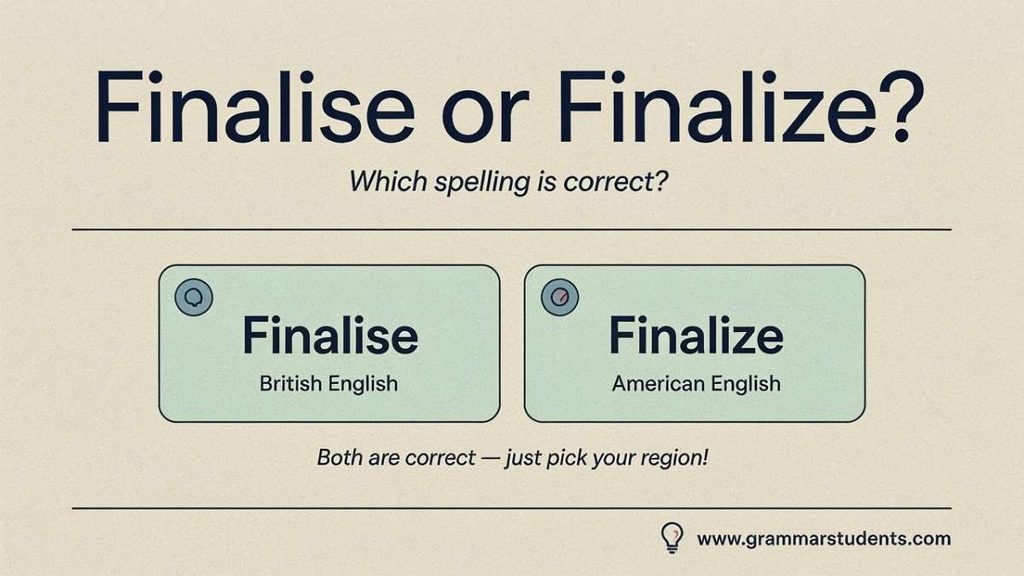
Yes but this comparison involves both spelling and grammar.
Finalise is the base form of the verb. Finalized is the American English past-tense and past-participle form.
Compare these sentences:
- We will finalise the agreement tomorrow. British style base form.
- We finalized the agreement yesterday. American style past tense.
- We have finalized the agreement. American style past participle.
In British spelling conventions that favor ise the corresponding past forms are finalised.
The distinction between finalise and finalized isn’t simply regional because the words also serve different grammatical roles. The base form and past form can’t always replace each other.
Finalization or Finalisation?
Both finalization and finalisation are nouns. They describe the process or act of bringing something to its final state.
Examples:
- American English: The finalization of the deal took two weeks.
- British English: The finalisation of the deal took two weeks.
Both sentences describe the same process.
Use finalization when following American spelling conventions. Choose finalisation when following a style that prefers the corresponding British ise form.
Learn the difference between confusing more English words
Stabilise or Stabilize Difference in Usage Meaning and Examples
Finalise or Finalize in a Sentence Examples and Usage
A definition is helpful but examples show how the word works in real situations. The following sentences cover everyday conversations professional communication academic writing and formal documents.
Finalize in a Sentence
Here are several examples of finalize in American English:
- We need to finalize the travel plans before booking our flights.
- The manager will finalize the budget on Monday.
- The team finalized the design after three rounds of revisions.
- Please finalize your application before the deadline.
- The company expects to finalize the agreement this week.
- She finalized the report and sent it to her supervisor.
- The committee has finalized its list of candidates.
Each sentence describes completing confirming or settling the remaining details of something.
Finalise in a Sentence
These examples use finalise in the same way:
- We need to finalise the travel plans before booking our flights.
- The manager will finalise the budget on Monday.
- The team finalised the design after three rounds of revisions.
- Please finalise your application before the deadline.
- The company expects to finalise the agreement this week.
- She finalised the report and sent it to her supervisor.
- The committee has finalised its list of candidates.
The meaning and sentence structure remain unchanged. Only the spelling convention differs.
Learn the difference between commonly mixed-up more words
Tie or Tye Meaning Difference Correct Spelling and Usage
Examples in Everyday Conversations of Finalise or Finalize
People often use finalize or finalise when discussing arrangements plans and decisions.
Example Planning a trip
Have you finalized our travel itinerary yet?
The speaker wants to know whether the remaining travel details have been settled.
Example Arranging a meeting
Let’s finalise the meeting time before we invite everyone.
The speaker wants to agree on the time before sending invitations.
Example Making a decision
We haven’t finalized our decision yet.
The group hasn’t reached a settled conclusion.
These examples show that the verb often appears when a process is close to completion but still needs confirmation or approval.
Examples in Business and Workplace Writing
Professional writing frequently uses the word because companies need to settle plans documents budgets and agreements.
| Context | Example sentence |
| Project management | We will finalize the project timeline after reviewing the team’s availability. |
| Finance | The finance department has finalized the annual budget. |
| Human resources | The company plans to finalize its hiring decision next week. |
| Marketing | Our team is finalizing the campaign proposal. |
| Meetings | Please finalise the agenda before distributing it to attendees. |
| Contracts | Both parties must review the terms before they finalize the agreement. |
In workplace communication finalize can signal that a document or decision has reached the stage where no major changes are expected. However it doesn’t automatically mean every related business or legal process is complete.
Examples in Academic Writing
Students and researchers can use the word when discussing reports research plans presentations and submissions.
- I need to finalize my research question before collecting data.
- The professor finalized the examination schedule.
- Our group has finalised the outline for its presentation.
- The researchers finalized the questionnaire after testing the initial version.
- Please finalize your references before submitting the paper.
For academic writing choose the spelling expected by your institution and use it consistently.
Examples in Emails and Professional Messages
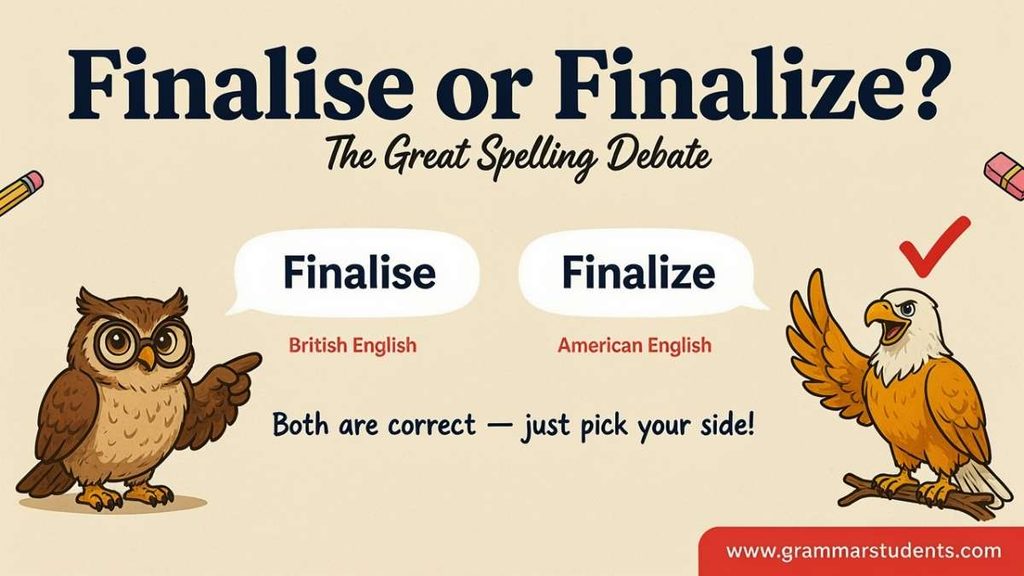
Should you use finalise or finalize in a business email? Either can work but the spelling should suit your recipient and your organization’s style guide.
American English email
Subject: Finalizing the Project Schedule
Hi Jordan
I’m reviewing the remaining details and expect to finalize the project schedule by Thursday. I’ll send you the approved version once everything is confirmed.
British English email
Subject: Finalising the Project Schedule
Hi Jordan
I’m reviewing the remaining details and expect to finalise the project schedule by Thursday. I’ll send you the approved version once everything is confirmed.
The wording and tone are nearly identical. The spelling choice reflects the style being followed.
Learn the difference between similar English words
Synched or Synced Correct Spelling Meaning and Usage
Examples in Legal and Official Documents
The verb also appears in writing about contracts policies settlements and official decisions.
- The parties are working to finalize the terms of the contract.
- The committee finalized its recommendation after reviewing the evidence.
- The organization will finalise the policy after consulting its legal team.
One caution matters here finalizing a document doesn’t necessarily make an agreement legally binding. The legal effect depends on the relevant law the document’s terms and any required approval or execution steps.
Use the word to describe the process accurately rather than as a substitute for a precise legal term.
The Origin and History of Finalise and Finalize
The two spellings reflect a long standing feature of English words can retain different written forms while sharing the same meaning.
Where Does the Word Finalize Come From?
The verb finalize comes from final which relates to an end conclusion or last stage. The suffix -ize helps form verbs that express making something a particular way or bringing about a state.
In this case finalize means to make something final or bring it into its final form.
The same basic idea appears in related words such as modernize which means to make something modern and formalize which means to give something a formal structure or status.
The spelling finalise follows the same word-building pattern but uses -ise instead of -ize.
Why Are There Two Spellings?
English developed through centuries of contact among languages and regional writing traditions. As spelling conventions became more established dictionaries publishers schools and editors helped preserve different forms.
The endings ize and ise are a familiar example of this variation. In some words the endings are interchangeable under recognized spelling conventions. In others only one spelling is standard.
For finalize and finalise both forms are accepted. Regional preferences and editorial policies usually determine which one a writer chooses.
Is Ize Always American and Ise Always British?
No. This is one of the most common misconceptions about British vs. American English.
American English strongly favors ize in words such as finalize and organize. British English commonly uses ise in those words but it also accepts ize spellings. Some British dictionaries and style guides prefer ize in words where that ending is an established option.
Word Forms of Finalise and Finalize
Knowing the related word forms helps you avoid common spelling and grammar mistakes. Although the two spellings differ they follow the same basic English verb rules.
Finalize Finalizes Finalized and Finalizing
American English uses these forms:
| Word form | Grammatical use | Example |
| Finalize | Base form | We need to finalize the report. |
| Finalizes | Third person singular present | She finalizes the schedule every Friday. |
| Finalized | Past tense | They finalized the budget yesterday. |
| Finalized | Past participle | The budget has been finalized. |
| Finalizing | Present participle or gerund | We are finalizing the proposal. |
| Finalization | Noun | Finalization of the contract took several days. |
The form you choose depends on the sentence not just the spelling preference.
For example she finalize the report is incorrect in standard English because a third-person singular subject in the simple present tense requires finalizes.
Likewise they has finalized the plan is incorrect because they takes have not has.
Learn the difference between tricky grammar words
Incurable or Uncurable Meaning Difference and Examples
Finalise Finalises Finalised and Finalising
The corresponding forms with s follow the same grammar.
| Word form | Example |
| Finalise | We need to finalise the report. |
| Finalises | She finalises the schedule every Friday. |
| Finalised | They finalised the budget yesterday. |
| Finalised | The budget has been finalised. |
| Finalising | We are finalising the proposal. |
| Finalisation | Finalisation of the contract took several days. |
The only change is the spelling convention. Subject-verb agreement tense and sentence structure remain the same.
Finalized or Finalised Which Is Correct?
Both are correct. Use finalized in American English and finalised when following a spelling style that prefers -ise.
Compare:
- The team finalized the proposal yesterday.
- The team finalised the proposal yesterday.
Each sentence describes a completed action.
The same distinction applies to the past participle:
- The proposal has been finalized.
- The proposal has been finalised.
These forms commonly appear in reports project updates emails and official communications.
What Is the Noun Form of Finalize?
The main noun forms are finalization and finalisation. Both refer to the act or process of making something final.
Examples:
- The finalization of the project took longer than expected.
- The finalisation of the project took longer than expected.
The related adjective final describes something that represents the last stage or settled version of a process. For example the final draft refers to the version intended to be complete while the finalization process refers to the steps taken to reach that stage.
Common Mistakes When Using Finalise or Finalize
Even though the difference is straightforward writers sometimes make avoidable mistakes. A little attention to context and spelling conventions can prevent them.
Assuming One Spelling Is Incorrect
A common mistake is treating finalise as wrong because American English uses finalize or treating finalize as incorrect because a writer learned British English.
Neither assumption is accurate.
Both forms are accepted English spellings. The correct choice depends on the relevant spelling convention not on whether one version is universally right.
Incorrect claim: Finalize is always wrong in British English.
Accurate explanation: British English accepts finalize in many contexts although finalise is common and may be preferred by a particular style guide.
Mixing British and American Spellings
Switching spelling conventions within the same document can distract readers.
For example:
We will finalize the budget today. The team will finalise the schedule tomorrow.
Neither sentence is grammatically wrong. However the mixed spelling may look inconsistent if both appear in a document intended to follow one style.
A consistent American English version would use finalize and finalized. A document following an -ise preference would use finalise and finalised.
Consistency makes writing easier to edit and gives professional documents a more polished appearance.
Thinking Ise Is Informal
The spelling finalise isn’t inherently casual or unprofessional. It appears in formal documents business correspondence and published writing.
Similarly finalize isn’t automatically more formal because it uses a z.
Tone depends on word choice sentence structure context and audience. Spelling convention is a separate matter.
Learn the difference between confusing word pairs
Unattentive or Inattentive Meaning Difference and Usage
Confusing Finalize With Finish or Complete
These words have related meanings but they don’t always communicate exactly the same thing.
- Finalize: Settle the last details or establish the final version.
- Finish: Bring an activity or task to an end.
- Complete: Make sure all required parts or steps are done.
- Confirm: Verify that something is correct or agreed upon.
- Approve: Give permission or official acceptance.
- Settle: Resolve a question disagreement or arrangement.
Consider these examples:
- I finished writing the report. Or The writing activity has ended.
- I finalized the report. Or The final details or version have been settled.
- I approved the report. Or Someone with the appropriate authority accepted it.
- I confirmed the report’s figures. Or The figures were checked and verified.
These verbs overlap but replacing one with another can change the meaning. Choose the word that describes the action you actually performed.
Using the Wrong Word Form
A spelling preference doesn’t remove the need to use the correct tense.
Incorrect: We are finalized the contract.
Correct: We are finalizing the contract.
The first sentence incorrectly combines are with a past-tense form. The second uses the present progressive construction correctly.
Another example:
Incorrect: She will finalised the schedule tomorrow.
Correct: She will finalise the schedule tomorrow.
After the modal verb will use the base form of the verb.
Finalise or Finalize Synonyms and Related Words
If you want to avoid repeating finalize throughout an article several alternatives may fit. However a synonym should preserve the meaning you intend.
Common Synonyms for Finalize
| Synonym | Meaning | Example |
| Complete | Finish all required parts | We completed the report. |
| Finish | Bring a task to an end | She finished the presentation. |
| Confirm | Establish that something is correct or agreed | We confirmed the meeting date. |
| Approve | Accept or authorize something | The director approved the proposal. |
| Settle | Resolve an issue or arrangement | They settled the terms of the deal. |
| Conclude | Bring an activity or discussion to an end | The committee concluded its review. |
| Formalize | Give an arrangement or decision a formal structure | The partners formalized their agreement. |
These words aren’t perfect substitutes in every sentence.
For instance confirming a meeting date doesn’t necessarily finalize every detail of the meeting. Similarly approving a contract isn’t always the same as executing it or completing all legal formalities.
When Should You Use Finalize Instead of a Synonym?
Choose finalize when you want to emphasize settling the remaining details or reaching the intended final form.
Use complete when all required parts of a task are done. Choose confirm when you verify information or establish an arrangement. Use approve when someone grants formal acceptance.
This distinction is especially useful in business writing where a single verb can describe a specific stage of a process.
Which Spelling Should You Use Finalise or Finalize?
The best spelling is the one that fits your audience and follows your chosen style guide. You don’t need to memorize every regional spelling rule to make a sound choice.
Use Finalise When
Choose finalise when:
- You’re writing for a British English audience that prefers -ise spellings.
- Your employer school publisher or client follows an -ise style.
- You’re maintaining consistency with words such as organise recognise and finalisation.
- You’re editing a document that already follows this spelling convention.
For example a British English report might say The committee will finalise the recommendations before publication.
Use Finalize When
Choose finalize when:
- You’re writing for an American English audience.
- Your organization’s style guide prefers ize spellings.
- You’re maintaining consistency with words such as organize recognize and finalization.
- You’re preparing a document for an American publisher or client.
For example an American English report might say The committee will finalize the recommendations before publication.
Which Spelling Should You Use in Formal Writing?
Formal writing doesn’t require one spelling everywhere. Instead it requires a recognized spelling that suits the document’s conventions.
If you’re writing an academic paper check your institution’s requirements. For a business report follow your organization’s editorial style. When preparing a document for a client use the client’s preferred English variety if one is specified.
A consistent document matters more than choosing -ise or -ize as a matter of personal preference.
Finalise or Finalize for International and SEO Content
For international or SEO focused content start by identifying your audience.
If your website targets readers in the United States finalize is usually the best primary spelling. For a British or Australian audience finalise may be more appropriate.
A few practical guidelines can help:
- Use the primary spelling consistently in headings and body text.
- Include the alternative form when it helps explain the spelling difference.
- Write naturally rather than repeating both variations in every paragraph.
- Use the same spelling conventions across related articles and website pages.
- Prioritize accurate definitions clear examples and useful answers to readers’ questions.
Practice Session Finalise or Finalize
Fill in the Blanks
- We need to ______ the contract before Friday’s meeting.
- The manager ______ the project plan yesterday.
- Our team is ______ the budget for next month.
- Please ______ your application before submitting it.
- The agreement has been ______ by both parties.
- The company hopes to ______ the negotiations this week.
- They are ______ the arrangements for the annual conference.
- Once we ______ the schedule we will notify everyone.
- The documents were ______ before the deadline.
- We haven’t ______ the meeting agenda yet.
- The ______ of the contract took longer than expected.
- The team is working toward the ______ of the project plan.
- She is responsible for ______ the details of the event.
- The proposal was ______ before the client arrived.
- We must ______ our plans before booking the venue.
- The final arrangements are being ______ by the organizing committee.
- Once they ______ the deal they celebrated their success.
- The director wants to ______ the report by the end of the day.
- The project has not been ______ because several details remain unresolved.
- The parties agreed to discuss the ______ details before signing the contract.
- The company ______ the transaction last week.
- We will send the documents once the agreement is ______.
- He has been ______ the presentation all morning.
- The ______ version of the proposal is ready for approval.
- Before the meeting begins please ______ the list of participants.
Answer Key
- Finalize
- Finalized
- Finalizing
- Finalize
- Finalized
- Finalize
- Finalizing
- Finalize
- Finalized
- Finalized
- Finalization
- Finalization
- Finalizing
- Finalized
- Finalize
- Finalized
- Finalized
- Finalize
- Finalized
- Final
- Finalized
- Finalized
- Finalizing
- Final
- Finalize
Here’s a trusted source for clear more words Comparison:
Grammar Update
Frequently Asked Questions About Finalise or Finalize
Which is correct finalize or finalise?
Both finalize and finalise are correct spellings. Finalize is standard in American English while finalise is commonly preferred in British English. Both words mean to complete or settle something.
Which spelling is preferred in the UK finalize or finalise?
Finalise is the common British English preference. However finalize is also used in the UK. Follow your organizations style guide and use one spelling consistently.
Is finalize a real word?
Yes finalize is a standard English verb. It means to complete the final steps of a process settle the details of an arrangement or make a decision official.
What does finalise mean?
Finalise means to complete or settle something after reviewing its details. For example We need to finalise the contract before Friday. The American spelling is finalize.
What does finalized mean?
Finalized is the past tense and past participle of finalize. It describes something that has been completed confirmed or settled. For example The manager finalized the schedule yesterday.
Is finalised the correct spelling?
Yes finalised is the standard British English spelling of the past tense and past participle of finalise. American English generally uses finalized.
Which is correct finalizing or finalising?
Both are correct. Finalizing is the standard American English spelling while finalising is commonly used in British English. Both describe the process of completing or settling something.
Is it correct to say once we finalize or once we finalized?
Both phrases can be correct depending on the tense and context. Use once we finalize for a future action or a condition that has not yet occurred. Use once we finalized when describing a completed action in the past.
Examples:
- Once we finalize the proposal well send it to the client.
- Once we finalized the proposal we sent it to the client.
Which is correct to finalize or to finalized?
To finalize is correct because the word to in an infinitive phrase takes the base form of the verb. Finalized is a past tense or past participle form.
Correct: We need to finalize the report.
Incorrect: We need to finalized the report.
How do you pronounce finalise?
Finalise is pronounced /ˈfaɪnəlaɪz/. The first syllable carries the main stress. Finalize has the same pronunciation.
How can you use finalise in a sentence?
You can use finalise when discussing plans contracts schedules decisions or other matters that need completion.
Examples:
- We need to finalise the budget before the meeting.
- The company hopes to finalise the agreement this week.
- Please finalise your application before submitting it.
- They met to finalise the details of the event.
What is a synonym for finalise?
Common synonyms for finalise include complete finish settle conclude confirm and approve. The best choice depends on the context. For example complete emphasizes finishing a task while approve means formally accepting something.
Is finalisation a word?
Yes finalisation is a noun commonly used in British English. It refers to the process of completing or settling something. The usual American English spelling is finalization.
Example: The finalisation of the contract took two days.
What is another word for finalized?
Depending on the context alternatives to finalized include completed settled confirmed approved concluded and finished. For example The deal was finalized could become The deal was completed or The deal was confirmed.
What does has been finalised mean?
Has been finalised means that something has been completed or settled. It uses the present perfect passive construction and often emphasizes the current result of a completed action.
Example: The meeting schedule has been finalised means the schedule is now complete and settled.
What is the UK spelling of finalise?
Finalise is itself a common British English spelling. Its American English equivalent is finalize. The related British forms include finalised finalising and finalisation.
What is the opposite of finalised?
The opposite of finalised depends on the intended meaning. Possible alternatives include unfinished incomplete unresolved pending and unconfirmed. For example an agreement that has not been finalized may be described as pending or unconfirmed.
What does are being finalised mean?
Are being finalised means that several things are currently undergoing the process of completion or settlement. It uses the present continuous passive construction.
Example: The arrangements are being finalised means someone is still working on the arrangements and they are not necessarily complete yet.
Which is correct: to finalise or to finalize?
Both are correct. To finalise follows British English spelling conventions while to finalize follows American English conventions. Both mean to complete or settle something.
What is another word for finalizing?
Depending on the sentence alternatives to finalizing include completing finishing settling confirming and concluding.
Example: We are finalizing the agreement could become We are completing the agreement or We are settling the agreements final details.
Conclusion
Choosing between finalise and finalize doesnt have to become an endless spelling debate. Both words mean the same thing and neither deserves a red pen simply because it follows a different regional convention. American English generally prefers finalize while British English commonly uses finalise. The same pattern applies to related forms such as finalized and finalised.
The real trick is consistency. Choose the spelling that suits your audience follow the appropriate style guide and stick with it throughout your writing. After all your goal is to finalize your sentence not spend your entire afternoon fighting over its last letter!

Jacob AJS is an experienced blogger and English language enthusiast dedicated to making grammar and vocabulary simple, clear, and practical. As a writer for Grammarstudent, he creates insightful word comparisons, easy-to-follow explanations, and useful examples that help learners avoid common mistakes. His passion is to make English easier to understand while helping readers communicate with confidence, clarity, and accuracy.