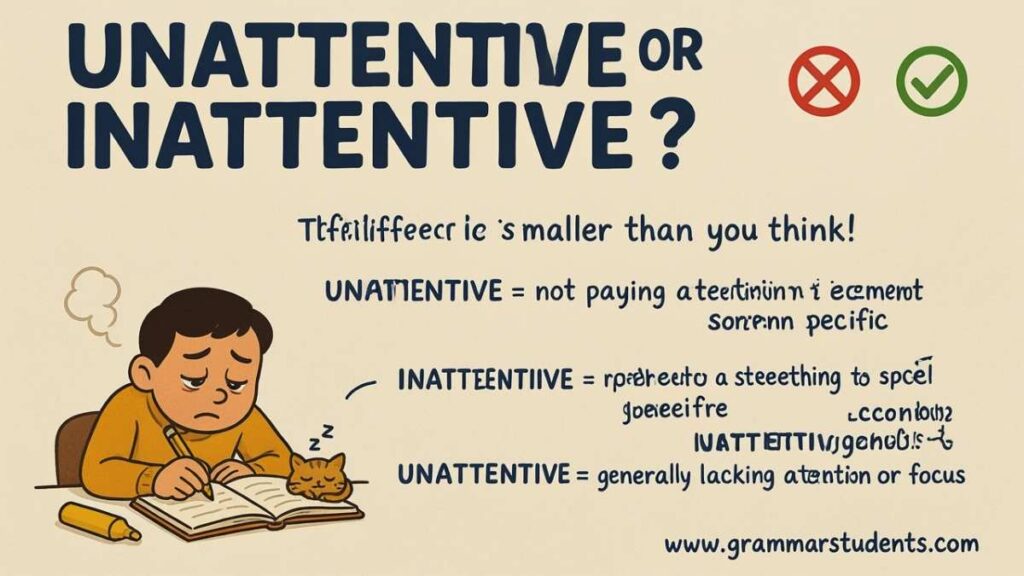
Choosing between unattentive or inattentive can feel like a grammar test you never signed up for. Both words describe a lack of attention so why does one sound more natural than the other? English loves these little puzzles keeping even confident writers on their toes. Fortunately you dont need a detectives magnifying glass to solve this one. In this guide youll discover the meanings differences and correct usage of both words along with practical examples and common mistakes. By the end youll know which word to choose and avoid turning a simple spelling question into a grammar mystery.
Quick Answer Unattentive or Inattentive?
Inattentive is generally the better choice when you mean not paying attention or failing to notice something. Unattentive has a similar meaning but it is less common.
Both words are formed by adding a negative prefix to attentive. However they dont appear equally often in everyday English. If youre unsure which one to use in an essay email report or conversation choose inattentive.
Examples:
- Correct and natural: The inattentive student missed the teachers instructions.
- Also understandable: The unattentive student missed the teachers instructions.
- More natural in most contexts: The manager was inattentive during the meeting.
Remember this simple rule Use inattentive as your default choice and recognize unattentive as a less common alternative.
Learn the difference between tricky more English words
To or Too Which One Belongs in Your Sentence?
What Does Inattentive Mean?
Inattentive is an adjective that describes someone who does not pay enough attention to a person activity task or situation. An inattentive person may become distracted overlook important details or fail to notice something happening nearby.
The word doesnt necessarily mean that someone is careless on purpose. A person might be tired preoccupied distracted or simply having difficulty concentrating.
Inattentive Definition
Examples of Inattentive in Sentences
- The inattentive driver failed to notice the red light.
- An inattentive student may miss important information during a lesson.
- My colleague seemed inattentive during the presentation.
- The customer complained about the inattentive service at the restaurant.
- She became inattentive while reading because she was worried about an upcoming exam.
- An inattentive reader might overlook a small but important detail.
In each example inattentive describes a lack of attention. It doesnt automatically explain why the person failed to concentrate.
Avoid everyday grammar mistakes with simple tips
Boxes or Boxs Correct Spelling Meaning and Usage
Inattentive Pronunciation
The word inattentive is commonly pronounced:
in-uh-TEN-tiv
Its International Phonetic Alphabet (IPA) pronunciation is approximately /ˌɪn.əˈten.tɪv/.
The main stress falls on the third syllable ten. Practicing the word aloud can help you use it confidently in conversation.
What Does Unattentive Mean?
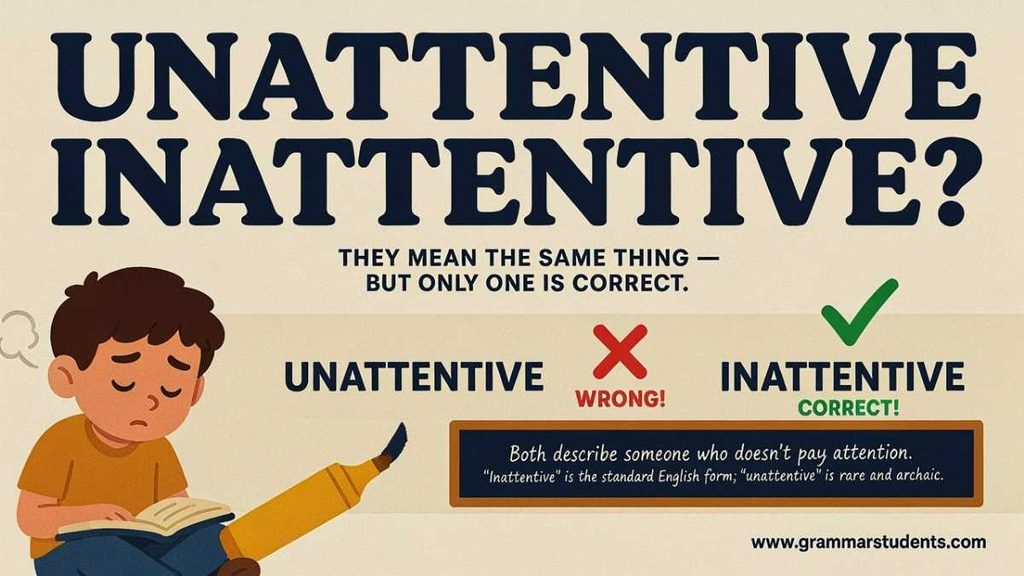
Unattentive is also an adjective that describes someone who does not pay attention or fails to give something the attention it needs. Its meaning is very similar to that of inattentive.
Although unattentive is a recognized English word it is less common in general usage. Readers will usually understand it but inattentive often sounds more natural in everyday and formal writing.
Unattentive Definition
Unattentive (adjective): Not attentive; failing to pay attention or give adequate consideration to someone or something.
Examples of Unattentive in Sentences
- The unattentive listener missed several important points.
- An unattentive employee may overlook details in a report.
- The teacher noticed that a few students were unattentive during the lesson.
- His unattentive behavior made the conversation difficult.
- The reviewer described the service as unattentive to customers needs.
These examples illustrate the words meaning but some sentences would sound more natural with inattentive instead. For instance The teacher noticed that a few students were inattentive during the lesson is the more conventional choice.
Is Unattentive a Real Word?
Yes. Unattentive is used in English with the meaning of not paying attention. However it is considerably less common than inattentive.
That distinction matters when youre choosing words for an academic assignment professional email website article or formal report. A word can be understandable without being the most natural option in a particular sentence.
If you want to avoid uncertainty use inattentive unless your context gives you a specific reason to choose unattentive.
Learn how to use confusing more words correctly
Classes or Class’s Meaning Difference and Usage
Unattentive vs Inattentive Whats the Difference?
The main difference between unattentive and inattentive is their frequency and conventional usage not their basic meaning. Both describe a failure to pay attention but inattentive is the more familiar and widely preferred option.
| Feature | Inattentive | Unattentive |
| Part of speech | Adjective | Adjective |
| Basic meaning | Not paying attention | Not paying attention |
| Common usage | More common | Less common |
| Formal writing | Generally preferred | Acceptable in suitable contexts |
| Everyday conversation | Natural and familiar | Understandable but less usual |
| Example | The inattentive driver missed the sign. | The unattentive driver missed the sign. |
| General recommendation | Preferred choice | Less common alternative |
The two words can communicate essentially the same idea. Nevertheless frequency matters because readers tend to recognize and process familiar wording more easily.
Which Is Correct Unattentive or Inattentive?
Both words are used in English but inattentive is the safer and more natural choice for most situations.
Consider these examples:
- Preferred: The manager was inattentive to the teams concerns.
- Less common: The manager was unattentive to the teams concerns.
The first sentence sounds more conventional in contemporary English. If your goal is clear natural writing inattentive is usually the better option.
Fix common more word mistakes in English
Emigrate or Immigrate Difference Meaning and Usage
Is Inattentive More Formal Than Unattentive?
Inattentive isnt necessarily more formal because of its meaning. Rather it is more established and common in both everyday and professional contexts.
You can use it in an academic essay workplace report school assignment or casual conversation. The word fits many situations without sounding unusually technical.
Unattentive can also appear in formal writing but its lower frequency may make it a less natural choice for some readers.
Why Do People Confuse Unattentive and Inattentive?
The confusion comes largely from English word formation. Both words begin with a negative prefix attached to attentive which already means paying attention or showing consideration.
English uses several prefixes to create words with negative or opposite meanings. Examples include unhappy incorrect impossible and inattentive.
Because both un- and in- can express negation it seems reasonable to assume that either prefix will work equally well with every adjective. Unfortunately English doesnt follow one simple rule for all negative prefixes.
For example:
- Happy or unhappy
- Correct or incorrect
- Possible or impossible
- Attentive or inattentive
The existence of unattentive doesnt make it the most common form. English usage depends on convention and some word combinations become much more established than others.
Think of word formation like choosing the right key for a lock. Two keys might look similar but only one may fit the situation naturally.
Understand confusing English more words simply
Fair or Fare Difference Meaning Usage and Examples
Attentive vs Inattentive vs Unattentive
Understanding the positive form attentive makes the comparison easier.
Attentive describes someone who pays close attention listens carefully or considers another persons needs. Its negative counterparts inattentive and unattentive describe a lack of attention.
Examples:
- Attentive: The attentive student listened carefully to the instructions.
- Inattentive: The inattentive student missed the instructions.
- Unattentive: The unattentive student missed the instructions.
The first example describes careful attention. The other two communicate the opposite although inattentive is the more common wording.
You can also use attentive to describe thoughtful service or personal behavior.
For instance The attentive nurse listened to the patients concerns emphasizes care and consideration. By contrast The nurse seemed inattentive during the conversation suggests that the nurse did not give the conversation enough attention.
Learn the difference between tricky grammar words
Incurable or Uncurable Meaning Difference and Examples
How to Use Inattentive in Different Contexts
The meaning of inattentive remains consistent across different situations but the reason for the lack of attention can vary.
Inattentive in Education
Teachers often use inattentive to describe students who struggle to focus on lessons miss instructions or overlook important information.
Examples:
- The inattentive student forgot to write down the homework assignment.
- Several pupils became inattentive near the end of the long lecture.
- An inattentive reader may misunderstand a question by overlooking a key word.
However an inattentive moment doesnt necessarily mean that a student is lazy or uninterested. The lesson may be difficult the student may be tired or something else may be distracting them.
Inattentive in the Workplace
In professional settings inattentive can describe someone who overlooks details fails to listen carefully or misses important instructions.
Examples:
- The inattentive employee entered the wrong figures in the spreadsheet.
- An inattentive manager may overlook concerns raised by team members.
- The reviewer found several errors in the report because the writer had been inattentive.
When writing workplace feedback consider describing the specific behavior rather than labeling a person.
For example The report contains several overlooked details may be more constructive than You are inattentive. The first statement identifies a problem that the employee can address.
Inattentive in Relationships
Attention also plays an important role in personal relationships. People may describe someone as inattentive when that person appears distracted forgets important details or doesnt listen during conversations.
Examples:
- He seemed inattentive when his friend explained the problem.
- She felt hurt because her partner was inattentive during their conversation.
- An inattentive listener might forget details that matter to the speaker.
Still one distracted conversation doesnt tell the whole story. Someone might be dealing with stress or thinking about an unrelated problem. Context helps you describe behavior fairly.
Inattentive in Driving
Driving requires attention to road signs pedestrians traffic signals and other vehicles. An inattentive driver may fail to notice a hazard or react too slowly to changing conditions.
Examples:
- The inattentive driver failed to see the pedestrian crossing.
- Inattentive driving can increase the risk of an accident.
- Drivers should avoid distractions that take their attention away from the road.
In this context inattentive describes a serious safety concern rather than a minor language preference.
Learn the difference between confusing more English words
Stabilise or Stabilize Difference in Usage Meaning and Examples
Inattentive in Formal and Academic Writing
Inattentive works well in reports essays research discussions and other formal documents.
Examples:
- The study examined how inattentive reading affected comprehension.
- The report identified inattentive supervision as a potential concern.
- Researchers observed that participants became inattentive during repetitive tasks.
For formal writing precise descriptions are often better than broad judgments. If possible explain what the person failed to notice or which task received insufficient attention.
Is Inattentive American or British English?
Inattentive is used in both American and British English. It is not an American-versus-British spelling difference like color and colour.
The same general preference applies across both varieties: inattentive is the more common choice while unattentive is less frequent.
Examples in American English:
- The student was inattentive during class.
- The employee seemed inattentive during the meeting.
Examples in British English:
- The student was inattentive during the lesson.
- The employee seemed inattentive during the meeting.
The vocabulary in these sentences works in both varieties. Differences such as class versus lesson may reflect local preferences or context but they dont change the spelling of inattentive.
Common Mistakes When Using Inattentive and Unattentive
Writers sometimes assume that similar word forms are interchangeable in every context. That assumption can lead to awkward sentences or misleading explanations.
Mistake 1 Assuming Unattentive Is Always Incorrect
Incorrect claim: Unattentive is not a real English word.
Better explanation: Unattentive is used in English but inattentive is much more common.
Dont confuse a less frequent word with an invalid one. Usage and frequency are different questions.
Mistake 2 Treating Both Words as Equally Common
Although the words have similar meanings they dont appear equally often in contemporary English.
Preferred: The inattentive listener missed the announcement.
Less common: The unattentive listener missed the announcement.
Choose the first sentence when you want the most conventional wording.
Mistake 3 Confusing Inattentive With Uninterested
An inattentive person fails to pay enough attention. An uninterested person lacks interest in something.
Compare these examples:
- Inattentive: Maya missed the explanation because she was thinking about another task.
- Uninterested: Maya didnt want to learn about the topic.
Someone can be interested but distracted. Likewise a person may listen carefully to a subject that doesnt particularly interest them.
Learn the difference between commonly mixed-up more words
Tie or Tye Meaning Difference Correct Spelling and Usage
Mistake 4 Using Inattentive as a Synonym for Careless in Every Situation
The words overlap in some contexts but they dont mean exactly the same thing.
An inattentive person may miss information because they arent paying attention. A careless person may fail to take enough care when completing a task.
For example an employee who misses an announcement is inattentive at that moment. An employee who repeatedly submits work without checking obvious errors may be described as careless.
The best word depends on what actually happened.
Mistake 5 Assuming Inattentiveness Always Means a Lack of Effort
People may become inattentive for many reasons including fatigue stress distractions or difficulty concentrating. The word describes observable behavior; it doesnt automatically reveal someones intentions.
When discussing a student or colleague focus on the specific behavior before drawing conclusions about motivation.
Inattentive and ADHD Are They the Same?
No. Inattentive is an ordinary descriptive adjective whereas attention-deficit/hyperactivity disorder (ADHD) is a clinical condition.
The word inattentive may describe behaviors associated with difficulties sustaining attention. However being inattentive occasionally does not mean that someone has ADHD.
ADHD involves a persistent pattern of symptoms that can affect functioning in daily life. Diagnosis requires an appropriate assessment by a qualified health professional not a single observation or a casual description.
When writing about ADHD use language carefully. Rather than labeling a person as inattentive based on one incident describe the behavior or refer to a documented clinical assessment when relevant.
Learn the difference between similar English words
Synched or Synced Correct Spelling Meaning and Usage
Synonyms for Inattentive
The best synonym depends on the sentence and the type of attention involved.
| Synonym | Meaning or emphasis | Example |
| Distracted | Attention is pulled away | The distracted student missed the question. |
| Unfocused | Unable to maintain concentration | He felt unfocused after a long day. |
| Absent-minded | Forgetful or mentally preoccupied | She was absent-minded and left her notebook behind. |
| Unobservant | Failing to notice details | The unobservant visitor missed the sign. |
| Unmindful | Not sufficiently aware or considerate | He was unmindful of the noise he made. |
| Careless | Not taking enough care | A careless review allowed several errors to remain. |
| Inattentive | Not paying sufficient attention | The inattentive listener missed the explanation. |
These words arent perfect substitutes for one another. For example distracted often suggests that something has drawn attention away while careless emphasizes insufficient care.
Antonyms of Inattentive
An antonym expresses the opposite meaning. The most direct opposite of inattentive is attentive.
Other useful antonyms include:
- Attentive: Paying close attention.
- Alert: Ready to notice or respond to something.
- Observant: Quick to notice details.
- Focused: Giving attention to a particular task.
- Mindful: Aware of something and considering it carefully.
- Vigilant: Watchful for possible danger or problems.
Examples:
- The attentive student followed every instruction.
- An alert driver noticed the hazard in time.
- The observant editor caught a small spelling mistake.
- A focused employee completed the report without unnecessary distractions.
Practice Session of Unattentive or Inattentive
Fill in the Blanks
- The __________ student missed the teachers important instructions.
- An __________ driver may fail to notice a traffic signal.
- The nurse was __________ and listened carefully to the patients concerns.
- My colleague seemed __________ during the business meeting.
- An __________ reader might overlook an important detail in a passage.
- The opposite of inattentive is __________.
- The employee made several mistakes because of __________ to detail.
- The child became __________ after studying for several hours.
- The teacher reminded the __________ students to focus on the lesson.
- Someone who pays close attention to others is described as __________.
- The manager appeared __________ because he missed several important points.
- A person who struggles to concentrate may feel __________.
- The reviewer found errors that an __________ editor had overlooked.
- The driver remained __________ and watched the road carefully.
- The word __________ is generally preferred over unattentive in modern English.
- The student was __________ by the noise coming from outside the classroom.
- An __________ listener may forget important information from a conversation.
- The customer complained about the __________ service at the restaurant.
- A person who fails to notice small details may be described as __________.
- Being inattentive occasionally does not automatically mean someone has __________.
- The employee remained __________ throughout the presentation and took detailed notes.
- A lack of attention can also be described as __________.
- The teacher encouraged the class to remain __________ during the explanation.
- Instead of calling the employee inattentive the manager explained that the report contained several __________ details.
- When youre unsure whether to use unattentive or inattentive choose __________ as the more common option.
Answer Key
- Inattentive
- Inattentive
- Attentive
- Inattentive
- Inattentive
- Attentive
- Inattention
- Unfocused
- Inattentive
- Attentive
- Inattentive
- Unfocused
- Inattentive
- Attentive
- Inattentive
- Distracted
- Inattentive
- Inattentive
- Unobservant
- ADHD
- Attentive
- Inattention
- Attentive
- Overlooked
- Inattentive
Here’s a trusted source for clear more words Comparison:
Grammar Update
Frequently Asked Questions
Is Unattentive a Correct Word?
Yes unattentive is a recognized English word meaning not paying attention. However inattentive is more common and is generally the preferred choice in modern English.
What Does It Mean to Be Inattentive?
Being inattentive means failing to pay enough attention to a person task or situation. For example an inattentive student might miss an important instruction because they arent listening carefully.
What Does Unattentive Mean?
Unattentive describes someone who doesnt give enough attention to something or someone. It has a meaning similar to inattentive but it is less common in everyday English.
What Is Another Word for Unattentive?
Common alternatives include distracted unfocused absent minded and unobservant. The best synonym depends on whether the person is distracted forgetful or failing to notice details.
What Is Another Word for Inattentive?
Synonyms for inattentive include distracted unfocused unmindful and unobservant. Use distracted when something interrupts concentration and unobservant when someone fails to notice important details.
Do You Say Unattentive or Inattentive?
Both words are used in English but inattentive is more common and generally sounds more natural. Choose inattentive for most academic professional and everyday writing.
What Is the Difference Between Inattentive and Uninterested?
Inattentive means not paying enough attention while uninterested means lacking interest in something. Someone can be interested in a topic but become inattentive because of stress fatigue or distractions.
What Is the Opposite of Inattentive?
The direct opposite of inattentive is attentive. Other suitable antonyms include focused alert observant and mindful depending on the context.
What Is a Word for Not Paying Attention?
Inattention is the noun that describes a failure to pay attention. Other expressions include lack of focus distraction and lack of concentration. For example The mistake resulted from inattention to detail.
Is Inattentive ADHD a Disability?
ADHD can qualify as a disability under certain laws and circumstances. In the United States eligibility depends on the applicable legal requirements and the conditions impact on major life activities. For further information consult the
Does Being Inattentive Mean You Have ADHD?
No. Occasional inattentiveness doesnt automatically indicate ADHD. Stress fatigue and everyday distractions can also affect concentration. A qualified health professional can assess persistent symptoms and determine whether ADHD or another condition may be involved.
What Are the Symptoms of Inattentive ADHD?
Symptoms associated with inattentive ADHD can include difficulty sustaining attention overlooking details trouble following instructions disorganization losing necessary items forgetfulness avoiding tasks that require sustained mental effort and becoming easily distracted. A qualified professional must assess symptoms to determine whether someone has ADHD.
How Do People With Inattentive ADHD Act?
People with inattentive ADHD may struggle to organize tasks maintain focus remember appointments or keep track of belongings. Experiences vary and these difficulties dont automatically indicate laziness or a lack of intelligence.
What Jobs Suit People With Inattentive ADHD?
There is no single best job for everyone with inattentive ADHD. Suitable careers depend on individual interests strengths skills and support needs. Some people prefer creative or hands-on work while others thrive in structured roles with clear routines and reminders.
What Is a Nicer Word for Attention?
Depending on the context alternatives include focus concentration consideration care and awareness. In professional communication Thank you for your consideration may sound more appropriate than Thank you for your attention when asking someone to review a request.
What Is a Word for Purposely Ignoring Someone?
Snubbing ignoring and deliberately disregarding can describe intentionally paying no attention to someone. Snubbing usually suggests a deliberate social slight while disregarding can also refer to ignoring instructions or concerns.
How Do You Say Not Important Professionally?
Professional alternatives include nonessential of limited importance less significant and not a current priority. For example This item is not a current priority communicates the point more diplomatically than This is not important.
What Is a Sophisticated Word for Lack?
Suitable alternatives include absence shortage deficiency scarcity and insufficiency. Use absence when something is missing shortage when there isnt enough of something and deficiency when something falls below the required level.
Is Inattentive the Same as Distracted?
Not exactly. Inattentive describes a lack of attention while distracted suggests that something has diverted a persons attention. A distracted person may become inattentive but the terms emphasize different aspects of the situation.
Can You Use Inattentive in Formal Writing?
Yes. Inattentive is appropriate for academic essays workplace reports and professional communication. For clearer writing explain the specific behavior whenever possible instead of relying on a general label.
Conclusion:
Choosing between unattentive or inattentive doesnt have to steal your attention! Although both words describe a lack of attention inattentive is the more common and generally preferred choice in modern English. Use it when describing a student who misses instructions a colleague who overlooks details or a driver who fails to notice a warning sign. Remember unattentive isnt automatically incorrect; its simply less common. English has enough grammar puzzles without turning every word into a courtroom drama! Keep this simple rule in mind choose your words carefully and let your writing shine with clarity and confidence.
Unattentive or inattentive? Solve this tricky grammar puzzle discover the difference and choose the right word with confidence.

Jacob AJS is an experienced blogger and English language enthusiast dedicated to making grammar and vocabulary simple, clear, and practical. As a writer for Grammarstudent, he creates insightful word comparisons, easy-to-follow explanations, and useful examples that help learners avoid common mistakes. His passion is to make English easier to understand while helping readers communicate with confidence, clarity, and accuracy.