Have you ever paused while writing and wondered whether incurable or uncurable is the correct spelling Youre not alone! English loves to keep writers guessing and this word pair is another little spelling puzzle. One version is widely accepted while the other rarely appears in standard writing. Choosing the wrong word can make an otherwise polished sentence look like it needs a grammar checkup. Fortunately you dont need a medical degree to solve this language mystery. In this guide youll learn the meanings differences examples and correct usage of incurable and uncurable plus practice questions to test your knowledge.
Incurable or Uncurable The Quick Answer
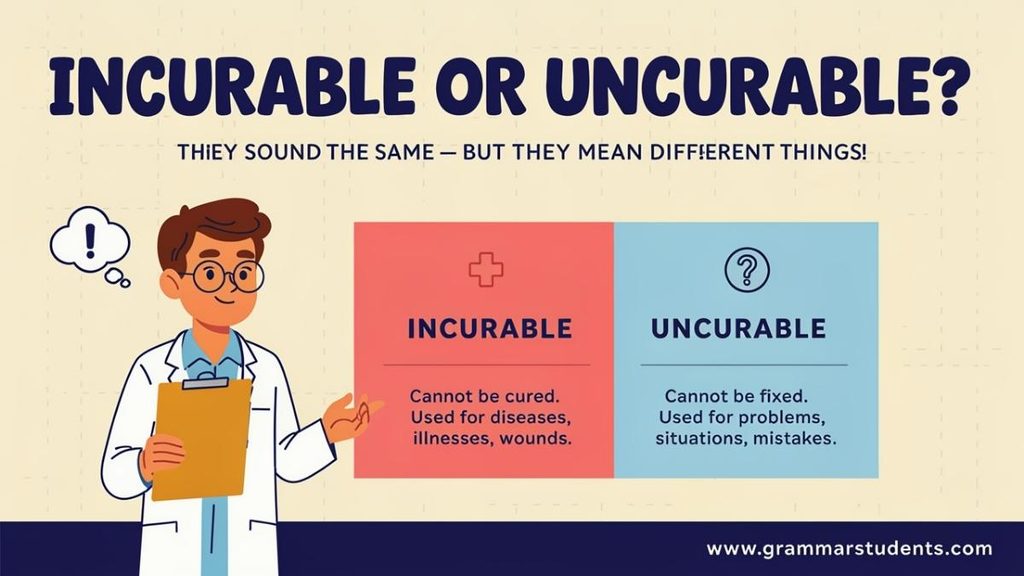
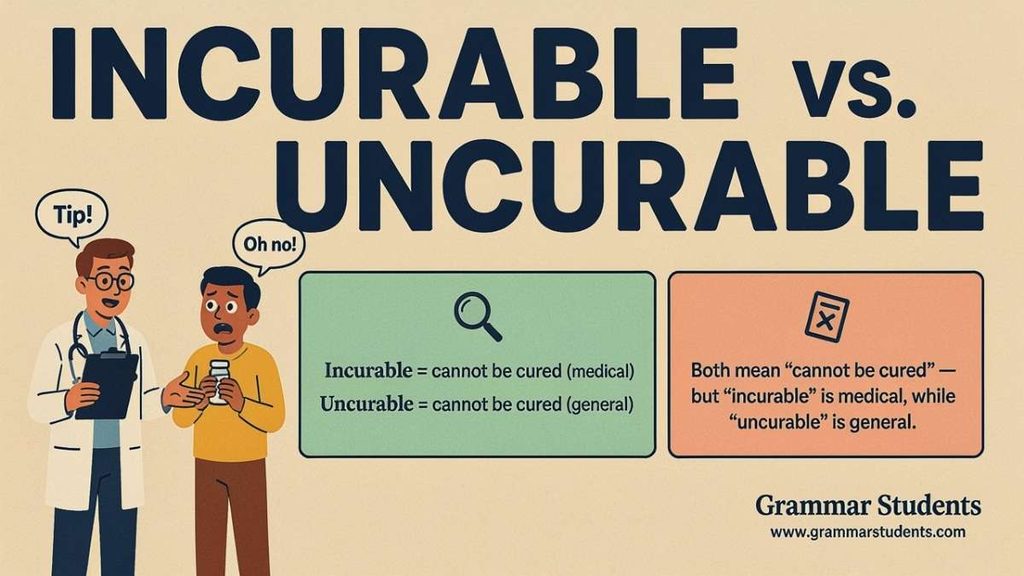
Incurable is the standard spelling in modern English. Uncurable may be understandable but it is uncommon and generally not recommended in formal writing.
| Word | Meaning | Standard usage | Example |
| Incurable | Unable to be cured or remedied | Standard and widely established | The patient has an incurable condition. |
| Uncurable | Intended to mean unable to be cured | Rare or generally nonstandard | Use incurable in formal writing. |
| Curable | Able to be cured | Standard | The infection is curable with appropriate treatment. |
Whether youre writing a school assignment blog post professional email or medical explanation incurable is the clearest and most widely accepted choice.
Is Uncurable a Word?
Uncurable can be understood as a combination of un- and curable and may occasionally appear in written English. However, it is not the established spelling for this meaning in modern standard usage. Therefore when choosing between these two forms it is important to consider conventional spelling rather than relying only on how a word is formed.
This is because English does not form every negative adjective with the same prefix. For example unclear unfair and unhealthy are all standard words. Thus although uncurable may seem logical, incurable remains the preferred choice in standard English.
What Does Incurable Mean?
The incurable meaning is simple something is unable to be cured. The word most often describes a disease or medical condition but it can also refer to a persistent habit or personality trait.
Incurable Definition
It has two main uses:
- Medical meaning: A disease or condition for which no cure is available.
- Figurative meaning: A characteristic habit or tendency that seems impossible to change.
For example an incurable disease refers to a medical condition while an incurable optimist describes someone who continues to look on the bright side.
An important distinction is that an incurable condition is not necessarily untreatable. Treatment may still relieve symptoms slow progression or improve quality of life even when a cure is unavailable.
Incurable Meaning in English With Examples
| Expression | Meaning |
| Incurable disease | A disease that cannot currently be cured |
| Incurable illness | An illness for which no cure is available |
| Incurable condition | A condition that cannot be cured |
| Incurable optimist | Someone who remains hopeful |
| Incurable romantic | Someone who strongly believes in romance |
| Incurable habit | A habit that seems very difficult to change |
In simple terms incurable describes something that cannot be cured or figuratively something that appears unlikely to change.
What Does Uncurable Mean?
The intended uncurable meaning is essentially the same as incurable unable to be cured. The main difference is established spelling and usage not the idea the writer wants to express.
Because un often creates negative adjectives uncurable may seem logical. Nevertheless English spelling follows historical conventions as well as modern patterns. The standard choice remains incurable.
Learn the difference between tricky more English words
To or Too Which One Belongs in Your Sentence?
Incurable vs Uncurable What Is the Difference?
The principal difference between incurable and uncurable is their status in standard English.
Uncurable is a rare or generally nonstandard alternative that readers may understand but should usually avoid in edited text.
| Feature | Incurable | Uncurable |
| Intended meaning | Unable to be cured | Unable to be cured |
| Grammatical role | Adjective | Intended as an adjective |
| Standard spelling | Yes | Generally nonstandard |
| Formal writing | Recommended | Avoid |
| Medical writing | Established | Not recommended |
| Everyday expressions | Common | Uncommon |
Incurable vs Uncurable Meaning Is There a Difference?
In everyday interpretation the two forms may communicate the same idea. If someone writes The disease is uncurable most readers will probably understand the intended meaning.
However a words meaning and its spelling convention are different matters. The standard form is incurable so that is the better choice for professional and academic writing.
Consider these examples:
- Standard: The doctor explained that the condition was incurable.
- Nonstandard: The doctor explained that the condition was uncurable.
- Standard: Despite several setbacks he remained an incurable optimist.
- Nonstandard: Despite several setbacks he remained an uncurable optimist.
The standard spelling works in both medical and figurative contexts.
Why Is Incurable Correct?
The word incurable has a long history in English and comes through French from Latin. Its spelling reflects the historical development of the word rather than a rule that every negative adjective must begin with un-.
The Latin form incurabilis combines in- meaning not with curabilis meaning curable. This explains the spelling used in modern English.
Avoid everyday grammar mistakes with simple tips
Boxes or Boxs Correct Spelling Meaning and Usage
Why Does Uncurable Sound Correct?
The form uncurable seems logical because English commonly uses un- to create opposites.
Examples include:
- Clear or unclear
- Fair or unfair
- Healthy or unhealthy
- Certain or uncertain
By analogy curable might appear to become uncurable. However English word formation is not always predictable. A formation can seem logical without being the conventional spelling.
Think of English spelling as a road system built over centuries. Many words follow recognizable patterns while others preserve older linguistic paths. Incurable belongs to the latter group.
Incurable vs Curable Understanding the Opposites
Understanding curable makes the meaning of incurable easier to remember.
Incurable means that a cure is unavailable or cannot eliminate the condition.
| Word | Meaning | Example |
| Curable | Able to be cured | The infection is curable with appropriate treatment. |
| Incurable | Unable to be cured | The disease was described as incurable. |
| Treatable | Able to receive treatment | The condition is treatable with medication. |
| Untreatable | Not treatable effectively with the methods being considered | The condition was considered untreatable at that time. |
| Remediable | Able to be corrected or improved | The problem is remediable with careful planning. |
| Irremediable | Impossible or extremely difficult to remedy | The damage was considered irremediable. |
Notice that curable and treatable do not mean exactly the same thing. A condition may be incurable but still treatable.
For example a medical team may be unable to eliminate a disease entirely but may still provide treatment to manage symptoms or slow its progression. Therefore incurable should not automatically be replaced with untreatable.
Does Incurable Mean Permanent?
Not necessarily in every context.
In medical language incurable means that a cure is unavailable or cannot eliminate the disease. Medical knowledge and treatment options may also change over time.
In figurative language the word suggests a persistent characteristic such as optimism or a love of romance.
- He is an incurable romantic describes someone whose romantic outlook seems unlikely to change.
The second example is figurative rather than medical.
Incurable Word Origin and Etymology
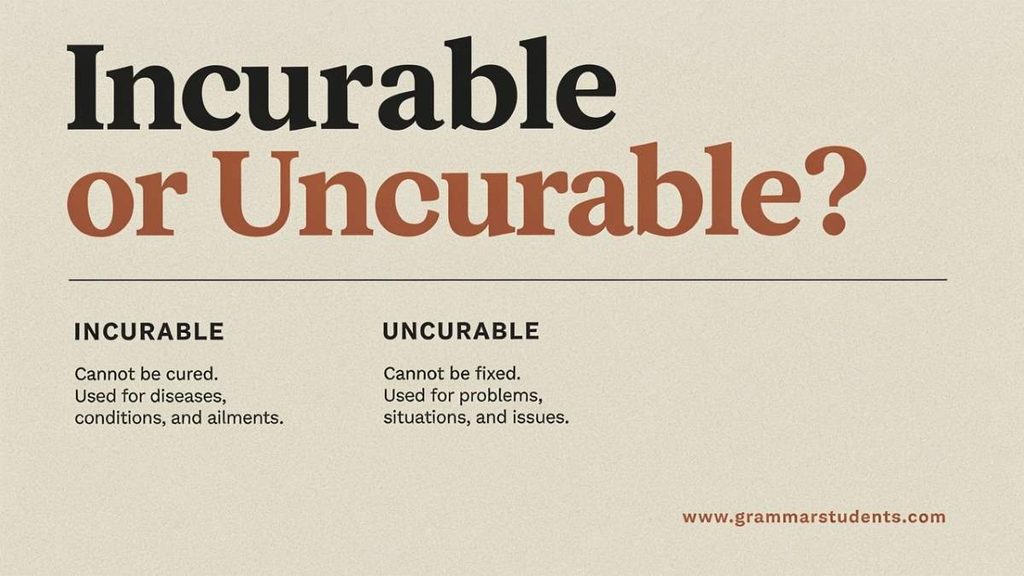
The incurable word origin helps explain both its meaning and spelling.
The word came into English through Middle English and Old French from Late Latin incurabilis. Its elements include in meaning not and curabilis meaning curable. The related Latin verb curare means to take care of while cura means care.
| Word element | Meaning or role |
| in | A negative prefix meaning not |
| curare | Latin verb meaning to take care of |
| curabilis | Related to being curable |
| incurabilis | Latin form meaning not curable |
| incurable | Modern English adjective |
This history explains why the standard spelling begins with in- rather than un-.
The Prefix In- Meaning
The prefix in- can express negation in words inherited from Latin. In incurable it reverses the meaning of curable.
Other examples include:
- Incorrect: Not correct.
- Inaccurate: Not accurate.
- Incomplete: Not complete.
- Incapable: Not capable.
- Incurable: Not curable.
These examples demonstrate a recurring pattern although the correct prefix depends on the words history and established usage.
The Prefix Un Meaning
The prefix un also creates negative meanings. It appears in many familiar words:
- Unhappy
- Unfair
- Unclear
- Uncertain
- Unhealthy
- Unhelpful
However this pattern does not mean that you can add un- to every adjective and produce the standard spelling.
The practical lesson: Learn common word forms as established vocabulary. Prefix rules can help you recognize patterns but dictionaries and conventional usage determine which forms are standard.
Learn how to use confusing more words correctly
Classes or Class’s Meaning Difference and Usage
Words Related to Cure
Understanding the word family can make incurable easier to remember.
| Word | Part of speech | Meaning |
| Cure | Noun or verb | A remedy to make a condition disappear |
| Curable | Adjective | Able to be cured |
| Incurable | Adjective | Unable to be cured |
| Cured | Verb form or adjective | Made free of a condition or treated successfully |
| Curing | Verb form or noun | The act or process of curing |
| Curability | Noun | The possibility or quality of being cured |
| Incurability | Noun | The state or quality of being incurable |
| Incurably | Adverb | In a way that cannot be cured or changed |
These words serve different grammatical purposes. Incurable describes a noun while incurability names a state or quality. Incurably modifies an adjective or describes the manner in which a characteristic appears.
American English and British English Spelling
Is incurable spelled differently in the United States and the United Kingdom? No. Both American English and British English use incurable.
| Variety | Standard spelling | Example |
| American English | Incurable | The doctor explained that the disease was incurable. |
| British English | Incurable | The doctor explained that the disease was incurable. |
| International English | Incurable | The report described the condition as incurable. |
Some English words have regional spelling variations such as color and colour. Incurable is not one of them.
Is Incurable the Same in American and British English?
Yes. The standard spelling and core meanings remain the same in both varieties.
Pronunciation may differ between American and British speakers. These differences depend on regional accents but they do not affect the spelling.
If you are writing for an American British or international audience use incurable.
Fix common more word mistakes in English
Emigrate or Immigrate Difference Meaning and Usage
Incurable Pronunciation and Grammar
Correct spelling is only part of using a word well. You should also know how to pronounce it and use it naturally in a sentence.
Incurable Pronunciation
The word incurable has four syllables:
in-CUR-a-ble
The main stress falls on the second syllable CUR.
For practice say these phrases aloud:
- An incurable illness
- An incurable optimist
- An incurable habit
- An incurable condition
Practicing the word in complete phrases can help you become more comfortable with its pronunciation and natural usage.
Is Incurable an Adjective Noun or Verb?
Incurable is an adjective. It describes a noun rather than naming an action.
Examples:
- Adjective: She has an incurable condition.
- Noun: The incurability of the disease worried the researchers.
- Verb: The treatment may cure the infection.
- Adverb: He is incurably optimistic.
Although incurable is an adjective, English sometimes uses adjectives as nouns in specific contexts. For example, the word incurables may refer to people who have incurable medical conditions. However, this usage can sound dated or insensitive because it reduces people to their medical conditions. Therefore in modern writing, it is better to describe people respectfully and focus on the person rather than the diagnosis. By doing so you can communicate clearly while using considerate and inclusive language.
Common Incurable Spelling Mistakes
Even experienced writers occasionally make spelling mistakes especially when a word seems to follow an obvious pattern. In this case the spelling of incurable can cause confusion because uncurable looks logical at first glance. However English spelling doesn’t always follow predictable patterns. Therefore, understanding conventional usage is essential to choosing the correct form and avoiding common spelling errors.
| Incorrect or less suitable form | Preferred form | Explanation |
| Uncurable disease | Incurable disease | Use the established adjective. |
| Uncurable illness | Incurable illness | The standard form begins with in-. |
| Incuribility | Incurability | The standard noun is incurability. |
| Incurablely | Incurably | The standard adverb is incurably. |
Mistake Assuming Every Negative Adjective Begins With Un
This is a common reason people write uncurable. They know that un- means not so they apply it to curable.
The logic makes sense but English contains many negative forms inherited from Latin and French. These words may use prefixes such as in- im- il- or ir-.
Compare these examples:
- Unfair not infair
- Incorrect not uncorrect
- Impossible not unpossible in standard modern usage
- Irregular not unregular in standard usage
- Incurable not usually uncurable in standard usage
The examples illustrate an important principle: prefixes are patterns not universal formulas.
Mistake Treating Incurable and Untreatable as Exact Synonyms
These words overlap in some contexts but they are not interchangeable in every sentence.
A condition may be incurable yet still respond to treatments that control symptoms or slow progression.
Choose the word that communicates your intended meaning.
Mistake Using Incurable Only for Diseases
Although incurable frequently appears in medical contexts its figurative meaning is also common.
For example Maya is an incurable optimist does not mean she has a disease. It means she tends to remain hopeful even when circumstances look discouraging.
You can use the word in literal and figurative contexts provided the meaning is clear.
Incurable Usage When and How to Use It
The word incurable works in medical writing general descriptions fiction conversation and figurative expressions. Its precise meaning depends on the noun it describes and the surrounding context.
Medical Usage
In medical contexts incurable describes a disease or condition that cannot be cured. It is important to distinguish the absence of a cure from the absence of treatment.
For example:
The specialist explained that the condition was incurable but treatment could still help manage the symptoms.
This sentence communicates two separate points: a cure is unavailable but care remains possible.
Writers should avoid using the term casually to make medical judgments. When discussing a real persons health rely on qualified medical guidance rather than assumptions.
Understand confusing English more words simply
Fair or Fare Difference Meaning Usage and Examples
Figurative Usage
The figurative meaning describes a persistent personality trait or tendency.
Examples include:
- An incurable optimist
- An incurable romantic
- An incurable pessimist
- An incurable dreamer
An incurable optimist continues to expect good outcomes even when the evidence looks discouraging. An incurable romantic tends to believe in love romance and idealized relationships.
These expressions are often affectionate or humorous. They do not suggest that the person needs medical treatment.
Can You Say an Incurable Habit?
Yes. You can describe a habit as incurable when you want to emphasize that it seems very difficult to change.
Examples:
- He has an incurable habit of arriving five minutes late.
- She is an incurable collector of old books.
- My brother is an incurable procrastinator.
These statements are usually informal or figurative. They express persistence rather than a literal medical condition.
Consider your tone though. Calling a habit incurable can sound playful in a friendly conversation but overly dramatic in a formal report.
Incurable Synonyms and the Opposite of Incurable
Choosing the right synonym helps you avoid repetition and express a more precise meaning. However no synonym works perfectly in every context.
Learn the difference between similar English words
Synched or Synced Correct Spelling Meaning and Usage
Incurable Synonyms
| Synonym | Best use | Example |
| Irremediable | A problem that cannot be corrected or remedied | The damage was irremediable. |
| Untreatable | A condition that cannot be treated effectively | The condition was considered untreatable with the available methods. |
| Unalterable | Something that cannot be changed | The decision was unalterable. |
| Intractable | A problem that is difficult to manage or resolve | The team faced an intractable problem. |
| Incorrigible | A person or habit that seems impossible to correct | He is an incorrigible joker. |
| Unchangeable | Something that cannot be changed | The rule was unchangeable. |
Important distinction: Intractable often means extremely difficult to manage not necessarily impossible to cure. Incorrigible is more suitable for persistent behavior than for describing a disease. Choose a synonym based on the intended meaning.
Learn the difference between confusing more English words
Stabilise or Stabilize Difference in Usage Meaning and Examples
What Is an Incurable Synonym for a Personality Trait?
When describing personality incorrigible may be a useful alternative.
- Incurable optimist or Incorrigible optimist
- Incurable joker or Incorrigible joker
- Incurable troublemaker or Incorrigible troublemaker
These expressions suggest that a persons characteristic is unlikely to change. Depending on the sentence persistent habitual or unrepentant may also work but each has a different shade of meaning.
What Is the Opposite of Incurable?
The clearest opposite of incurable is curable.
| Word | Relationship |
| Curable | Direct opposite in the medical sense |
| Treatable | Related but not a direct opposite |
| Remediable | Opposite like in some problem-solving contexts |
| Changeable | Useful when incurable describes a personality trait figuratively |
| Correctable | Suitable for mistakes behaviors or problems that can be corrected |
For example a curable disease means that a cure is possible. A changeable habit suggests that a habit can be altered.
The best opposite depends on the context because incurable can describe both medical conditions and figurative characteristics.
Incurable in a Sentence Examples and Explanations
The easiest way to understand correct word usage is to see it in context. These examples cover medical everyday formal and figurative situations.
Medical Examples
- The specialist explained that the patient had an incurable disease.
- Researchers continue to study treatments for incurable illnesses.
- The family needed clear information about the diagnosis and available treatment options.
- The report discussed the challenges associated with an incurable neurological condition.
These sentences use incurable to describe health conditions. None automatically suggests that treatment is useless.
Figurative Examples
- My sister is an incurable romantic who believes every love story deserves a happy ending.
- Despite several failed attempts he remains an incurable optimist.
- She has an incurable habit of buying books she doesnt have time to read.
- Their grandfather is an incurable storyteller who can turn a five-minute event into an hour-long adventure.
- Hes an incurable perfectionist who checks every detail twice.
In these examples incurable emphasizes a persistent characteristic. The word can make a description more expressive especially in informal writing.
Formal and Academic Examples
- The study examined the challenges associated with managing incurable diseases.
- The report distinguished between curable conditions and incurable conditions requiring long-term care.
- Researchers emphasized the need for continued symptom management.
- The author described the problem as seemingly incurable rather than offering an unsupported conclusion.
- The paper examined how medical advances can change the treatment options available to patients.
For academic writing use incurable carefully. A medical claim should reflect reliable evidence rather than the writers opinion.
How Do You Use Incurable in a Sentence?
Follow this simple pattern:
Subject + form of be + incurable + description.
Examples:
- The illness is incurable.
- Her condition was incurable.
- He is an incurable optimist.
- It became an incurable problem.
You can also place the adjective directly before a noun:
- An incurable disease
- An incurable condition
- An incurable romantic
- An incurable habit
When you use the word figuratively make sure readers can understand that you are describing a persistent tendency rather than a literal illness.
Learn the difference between commonly mixed-up more words
Tie or Tye Meaning Difference Correct Spelling and Usage
A Practical Case Study Choosing the Correct Word
Imagine that a student is writing an essay about medical vocabulary. The student writes:
The doctor explained that the disease was uncurable however the patient could still receive treatment. Although the sentence communicates a reasonable idea the spelling needs correction. More specifically uncurable should be replaced with incurable which is the conventional spelling in standard English. Therefore the corrected sentence reads: The doctor explained that the disease was incurable but the patient could still receive treatment.
Edited version:
The doctor explained that the disease was incurable but the patient could still receive treatment.
Why is the second version better?
- Correct spelling: Incurable is the established form in standard English.
- Clear meaning: The sentence states that a cure is unavailable.
- Medical accuracy: It recognizes that treatment may still be possible.
- Professional style: The revised wording suits an academic essay or informational article.
Now consider a different sentence:
Daniel is an uncurable optimist who always expects the best.
The intended meaning is figurative not medical. The standard revision is:
Daniel is an incurable optimist who always expects the best.
The same spelling rule applies in both contexts. Whether you are discussing an illness or a personality trait incurable is the preferred choice.
Practice Session Incurable or Uncurable
Fill in the Blanks
- The doctor explained that the disease was considered __________ with current medical knowledge.
- He is an __________ romantic who still believes in true love.
- Researchers continue to search for treatments for previously __________ conditions.
- Her __________ optimism helped her face every challenge with courage.
- The patient was diagnosed with an __________ disease.
- My grandfather has an __________ habit of telling funny stories.
- The specialist explained the challenges of treating the __________ condition.
- She has an __________ passion for learning new languages.
- The disease was once considered __________ but new treatments have improved patients lives.
- He is an __________ dreamer who never gives up on his goals.
- The doctor described the condition as __________ because no cure was currently available.
- Despite repeated reminders he has an __________ tendency to arrive late.
- Scientists are working to improve care for people with __________ diseases.
- Her __________ curiosity encourages her to explore new ideas.
- The family sought a second medical opinion about the __________ illness.
- He is an __________ optimist who always looks for the positive side of life.
- At the time doctors considered the condition __________ because no cure was known.
- My brother has an __________ habit of making jokes at serious moments.
- Medical researchers are developing better treatments for people with __________ diseases.
- She has an __________ love of books and reading.
- An __________ disease may still respond to treatments that manage its symptoms.
- His __________ laziness often prevents him from completing his work on time.
- The treatment may relieve symptoms even when a disease is considered __________.
- An __________ romantic may believe that love can overcome almost any obstacle.
- In standard English incurable means that a condition cannot be __________.
Answer Key
- Incurable
- Incurable
- Incurable
- Incurable
- Incurable
- Incurable
- Incurable
- Incurable
- Incurable
- Incurable
- Incurable
- Incurable
- Incurable
- Incurable
- Incurable
- Incurable
- Incurable
- Incurable
- Incurable
- Incurable
- Incurable
- Incurable
- Incurable
- Incurable
- Cured
Here’s a trusted source for clear more words Comparison:
Grammar Update
Frequently Asked Questions About Incurable or Uncurable
What Is Uncurable?
Uncurable is an uncommon generally nonstandard spelling intended to mean something that cannot be cured. In standard English incurable is the preferred form for describing a disease condition or persistent characteristic.
What Does Incurable Mean?
Incurable means unable to be cured. It commonly describes a disease or medical condition for which no cure is available. Figuratively it can describe a persistent characteristic as in an incurable optimist.
Do You Say Incurable or Uncurable?
You should use incurable in standard English. Although uncurable may seem logical because un- often forms negative adjectives incurable is the established spelling used in formal writing and everyday communication.
What Is the Word for Not Curable?
The word for not curable is incurable. Depending on the context untreatable or irremediable may also fit but these words have slightly different meanings.
Is Incurable the Same as Untreatable?
No. Incurable means that a condition cannot be cured while untreatable means that it cannot be treated effectively with the methods being considered. An incurable condition may still respond to treatment that manages symptoms or slows its progression.
What Is Another Word for Incurable?
Common alternatives include irremediable untreatable and in some contexts intractable. For a persistent personality trait incorrigible may be appropriate. The best synonym depends on whether you are describing a medical condition a problem or a persons behavior.
What Is the Opposite of Incurable?
The most direct opposite of incurable is curable which means able to be cured. For figurative uses words such as changeable or correctable may express the opposite idea more naturally.
Can an Incurable Disease Still Be Treated?
Yes. An incurable disease may still be treated to manage symptoms slow its progression or improve quality of life. The term incurable means that a cure is unavailable; it does not automatically mean that medical care cannot help.
Does Incurable Mean Permanent?
Not always in every sense. In medical contexts incurable means that a condition cannot currently be cured but its symptoms and progression may change with treatment. In figurative expressions it describes a characteristic that seems unlikely to change.
Is Incurable the Same in American and British English?
Yes. Incurable is the standard spelling in both American and British English. The pronunciation may vary by accent but the spelling and basic meaning remain the same.
How Do You Pronounce Incurable?
Incurable has four syllables: in-CUR-a-ble. The primary stress falls on the second syllable. American and British speakers may pronounce some sounds differently but they use the same spelling.
What Does Incurable Romantic Mean?
An incurable romantic is someone who strongly believes in love romance or idealized relationships. The phrase is figurative and often affectionate. It does not refer to a medical condition.
Can You Use Incurable to Describe a Habit?
Yes. Incurable can describe a habit that seems very difficult to change. For example He has an incurable habit of arriving late emphasizes that the behavior is persistent often with a humorous or informal tone.
What Is the Origin of the Word Incurable?
Incurable comes through Middle English and French from Late Latin incurabilis. The Latin prefix in- means not while curabilis relates to being curable. This history helps explain why incurable rather than uncurable is the established spelling.
How Do You Spell Incurable Disease?
The correct standard spelling is incurable disease. Use incurable rather than uncurable in formal writing schoolwork medical explanations and published articles.
Conclusion:
Choosing between incurable or uncurable doesnt have to be an incurable grammar problem! Although both words may seem logical incurable is the standard widely accepted spelling in modern English. You can use it to describe a disease that cannot currently be cured a hopeless romantic or a habit that refuses to disappear. Remember an incurable condition may still respond to treatment so the word doesnt mean that nothing can be done. Review the examples practice the fill-in-the-blank exercises and keep your spelling sharp. After all your grammar mistakes deserve a cure even if your love of learning is incurable!

Jacob AJS is an experienced blogger and English language enthusiast dedicated to making grammar and vocabulary simple, clear, and practical. As a writer for Grammarstudent, he creates insightful word comparisons, easy-to-follow explanations, and useful examples that help learners avoid common mistakes. His passion is to make English easier to understand while helping readers communicate with confidence, clarity, and accuracy.