Have you ever typed a word stared at it and thought That can’t be wrong Then Grammarly steps in like a strict teacher with a red pen. The spelling confusion behind amateur vs amatuer catches many writers because those last few letters seem determined to switch places. One tiny mix-up can turn a perfectly correct word into an obvious spelling mistake. But don’t worry. This confusion is easy to fix once you understand the pattern. In this guide, you’ll discover which spelling is correct, what the word actually means, why amatuer causes confusion, and how to remember the right spelling without giving Grammarly another reason to complain.
Quick Answer Amateur vs Amatuer
If you only need the answer, remember this:
| Word | Correct | Meaning |
|---|---|---|
| amateur | Yes | A person or activity associated with nonprofessional participation |
| amatuer | No | A common misspelling of amateur |
So, if you are asking amateur vs amatuer, choose amateur.
The Correct Spelling of Amateur
The correct spelling is:
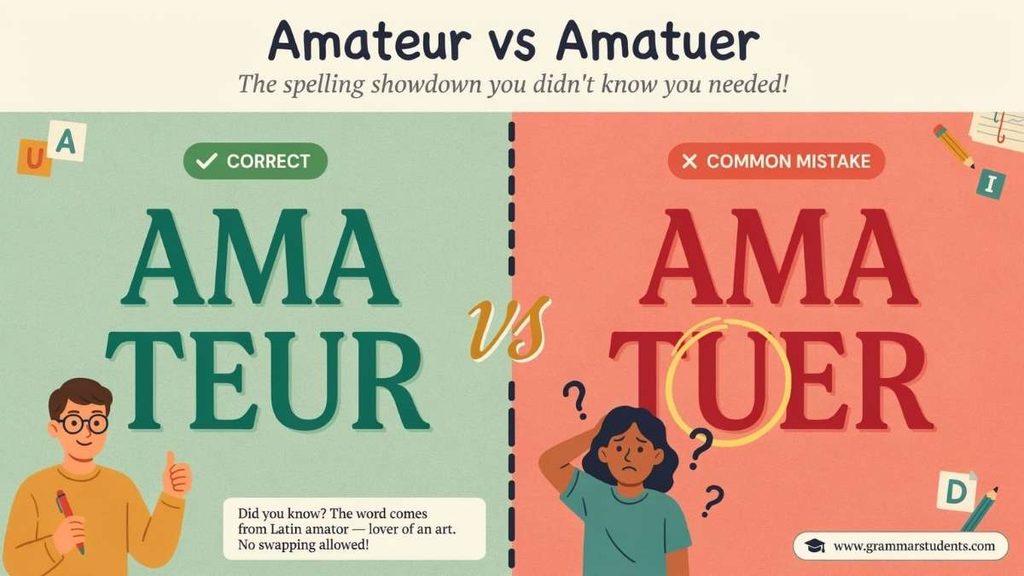
A-M-A-T-E-U-R
The incorrect version is
A-M-A-T-U-E-R
The main problem is the order of the final letters. The correct word contains eur, not uer.
This distinction answers searches such as is amatuer correct, is amatuer a correct spelling, what is the correct spelling amateur vs amatuer, and amateur vs amatuer which spelling is correct.
The answer remains the same: amateur is correct, while amatuer is a spelling mistake.
What Does Amateur Mean?
The amateur meaning is broader than simply beginner or unskilled person.
An amateur is generally someone who takes part in an activity for pleasure or interest rather than as a job. The word can also describe an activity associated with people who participate on a nonprofessional basis.
For example, someone might be an:
- amateur photographer
- amateur musician
- amateur writer
- amateur artist
- amateur athlete
- amateur astronomer
- amateur gardener
- amateur player
Amateur Does Not Automatically Mean Unskilled
An important point often gets lost: amateur does not automatically mean bad at something.
A person can spend ten years photographing wildlife as a hobby and still be an amateur photographer if photography isn’t their profession. Their skill level could be extremely high.
Dictionary.com also records senses involving someone who is inexperienced or unskilled. That meaning is usually clear from context rather than being built into every use of the word.
Amateur Noun Meaning
As an amateur noun, the word identifies a person.
For example:
She is an amateur photographer.
Here amateur refers to the person.
Another example:
The tournament is open to amateurs and professionals.
Again amateurs refers to people who participate on a nonprofessional basis.
Amateur Adjective Meaning
The amateur adjective describes an activity, organization, competition, or another noun connected with nonprofessional participation.
Examples include:
- amateur sports
- amateur competition
- amateur theater
- amateur photography
- amateur music
- amateur athletics
For example:
He joined an amateur football league.
Here, amateur describes the football league.
So, the word works as both a noun and an adjective.
Is Amatuer a Word?
No Amatuer is not the standard spelling of the English word.
If you are searching is amatuer a word, the practical answer is no: it is normally a misspelled version of amateur.
Likewise, amatuer meaning does not have a separate standard dictionary definition. When someone writes amatuer they almost always intend to write amateur.
Why Does Amatuer Appear Online?
The distinction matters because a spelling error can still appear thousands of times online.
Search engines, social media, forums, comments, and user-generated pages contain plenty of misspelled words. Frequent appearance does not turn an incorrect spelling into standard English.
The same principle applies to other common spelling errors. A misspelled word can be recognizable without being correct.
Amateur vs Amatuer Spelling
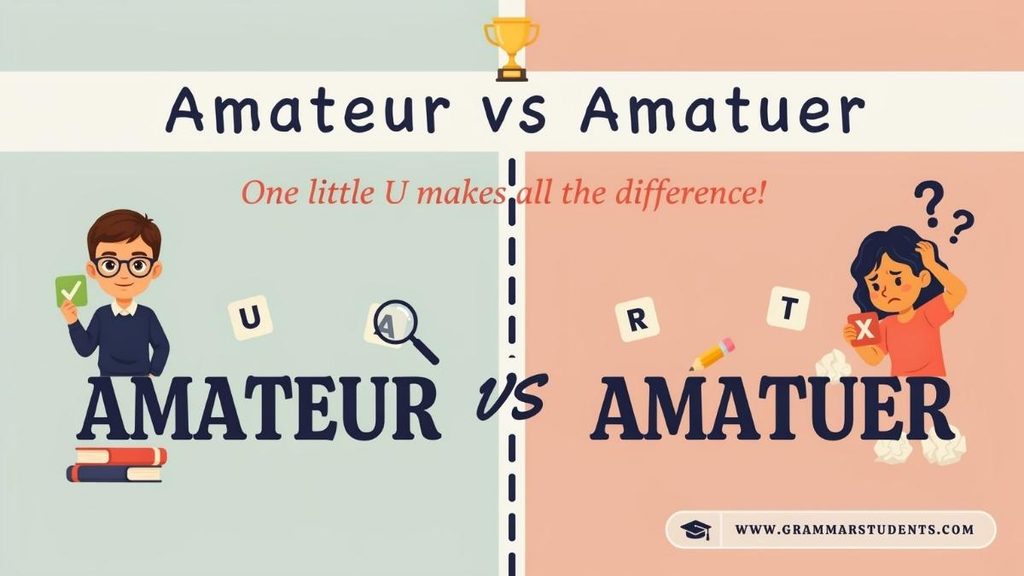
The difference is only a few letters, but the correct letter order matters:
amateur → correct
amatuer → incorrect
Think carefully about the ending:
teur
not:
tuer
That small visual pattern is one of the easiest ways to catch the amatuer spelling before you publish or submit something.
Amateur vs Amatuer What’s the Difference?

The amatuer vs amateur spelling question isn’t really a comparison between two words with different meanings.
There is only one standard word in this pair.
| Feature | Amateur | Amatuer |
|---|---|---|
| Standard English word | Yes | No |
| Correct spelling | Yes | No |
| Standard dictionary word | Yes | No |
| Can function as a noun | Yes | No |
| Can function as an adjective | Yes | No |
| Meaning | Nonprofessional participant or activity | No separate standard meaning |
| Use in formal writing | Appropriate | Avoid |
The Main Spelling Difference between Amateur vs Amatuer:
The confusion usually comes from switching eu into ue.
Correct:
amateur
amatuer
Incorrect:
Once you see the ending as eur the spelling becomes much easier to recognize.
Why Do People Misspell Amateur as Amatuer?
Why do people spell amateur as amatuer if the correct form is so established.
The answer is probably a mixture of pronunciation, unfamiliar letter patterns, memory, and ordinary typing errors.
The Letters Look Easy to Reverse
The most obvious explanation is letter order.
The sequence eur is less familiar to many English writers than combinations such as ue. When people write quickly, they may remember the general shape of the word without remembering exactly where the e and u belong.
That produces:
amatuer
instead of:
amateur
It’s a small transposition, but it changes a correct English word into a spelling error.
Pronunciation Can Add to the Confusion
English spelling and pronunciation don’t always match neatly.
Cambridge gives the American pronunciation of amateur and the British pronunciation.
That means the written ending isn’t necessarily obvious from the way the word sounds.
When people hear a word more often than they see it written, they may reconstruct the spelling from sound. That can create a pronunciation and spelling problem.
The Word Has a French and Latin History
The spelling also feels unusual because English didn’t create the word from scratch.
Dictionary.com traces amateur to French and Middle French and ultimately to Latin amātor, meaning lover Its English use dates to the late 18th century.
The original idea was connected with someone who loves or takes an interest in an activity. That history helps explain why the modern word refers to someone who participates because of interest or pleasure rather than simply because it is their occupation.
The French connection also helps explain why the spelling doesn’t behave exactly like a typical native English word.
Fast Typing Causes Simple Errors
Sometimes there is no complicated explanation at all.
People make typing mistakes.
When two neighboring letters are easy to reverse, a quick keyboard mistake can produce a familiar-looking misspelling. Because amatuer still looks close to amateur, the writer may not notice the error during a quick reread.
That’s why proofreading matters even when you know the word.
How to Spell Amateur Correctly

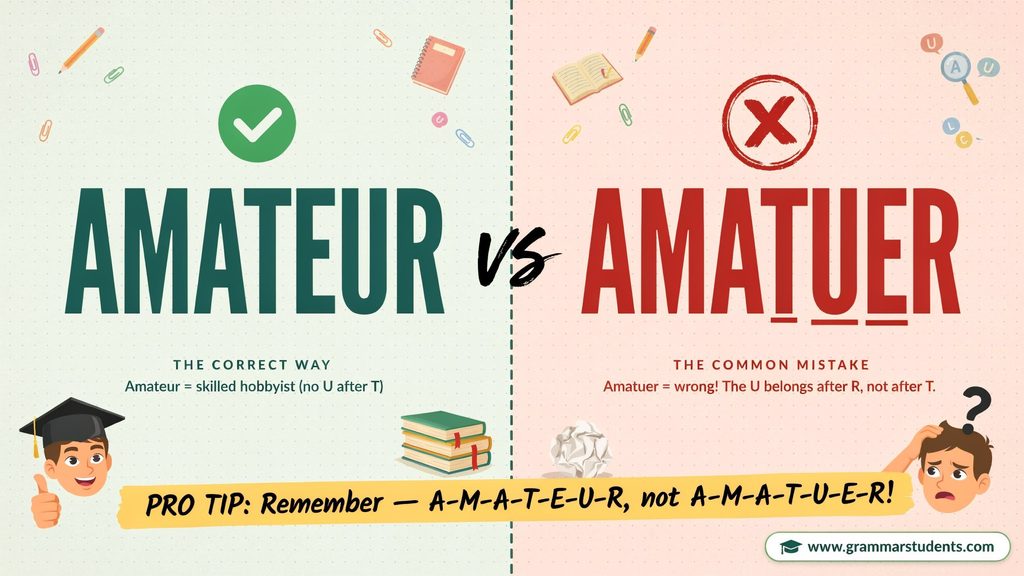
If you often forget how to spell amateur, focus on the final four letters.
Write it as:
ama + teur
The crucial part is:
teur
not:
tuer
A useful visual comparison is:
amateur
amatuer
You can also remember that the correct word ends with eur, a pattern found in several words influenced by French.
The goal isn’t to invent a complicated mnemonic. The simplest solution is to train your eyes to recognize the correct pattern.
How to Remember the Correct Spelling
Try this:
AMA-TEUR
Then remind yourself:
Amateur ends in -teur.
Write the correct form several times:
- amateur
- amateur photographer
- amateur athlete
- amateur writer
- amateur musician
Seeing the word in meaningful phrases is often more useful than memorizing a disconnected string of letters.
How to Pronounce Amateur
The amateur pronunciation differs slightly between major varieties of English.A simple approximation for American English is AM-uh-chur.
The British pronunciation can sound closer to “AM-uh-tuh.
Actual pronunciation varies by speaker and accent.
Does Pronunciation Change the Spelling?
Importantly, the spelling doesn’t change between American and British English.
You still write:
amateur
not amatuer or another regional variation.
So, if you search how to pronounce amateur, remember that pronunciation can vary while spelling remains stable.
Does Amateur Have Different Spellings in American and British English?
Unlike words such as color and colour the spelling of amateur does not normally change between American and British English.
| Variety | Spelling |
|---|---|
| American English | amateur |
| British English | amateur |
| Canadian English | amateur |
| Australian English | amateur |
The pronunciation can differ, but the written form remains amateur.
This is useful if you’re learning amateur English spelling because you don’t need to memorize separate US and UK versions.
How to Use Amateur in a Sentence
Understanding amateur usage requires more than memorizing the definition.
The word can describe a person’s professional status, an activity, or sometimes the quality of someone’s work. Context determines the intended meaning.
Amateur as a Person
Here are natural examples:
She is an amateur photographer who specializes in birds.
He became an amateur musician after retiring from teaching.
Several amateurs entered the local tennis competition.
My brother is an amateur gardener with an impressive vegetable patch.
In each example, the word identifies someone who participates in an activity without making that activity their professional occupation.
Amateur as a Description
The adjective appears before another noun:
- amateur competition
- amateur athlete
- amateur sports
- amateur theater
- amateur artist
- amateur writing
- amateur performance
For example:
The city hosted an amateur photography competition.
Here amateur describes the type of competition.
Amateur in Everyday Writing
The word is common in ordinary English.
You might write:
My uncle is an amateur photographer.
Or:
She joined an amateur theater group.
Or:
He plays amateur soccer on weekends.
These examples show amateur usage in a sentence without suggesting that the people involved lack talent.
Amateur in a Sentence More Examples
If you’re looking for an amateur example sentence, the best examples should show different contexts.
Sports
The club organizes amateur competitions for local players.
Photography
She is an amateur photographer who spends weekends photographing wildlife.
Music
He is an amateur musician who plays guitar after work.
Writing
The magazine accepts submissions from amateur writers.
Art
The exhibition featured paintings by several amateur artists.
Science
Amateur astronomers often observe the night sky with their own equipment.
These examples demonstrate that amateur can describe people across many different activities.
Is Amateur a Positive or Negative Word?
The answer depends on context.
The basic meaning is generally neutral: a person participates in an activity for pleasure rather than as a job. Cambridge also records a disapproving sense for someone who lacks much skill.
That creates three common tones.
Neutral Use
She is an amateur photographer.
This simply describes her status.
It doesn’t tell us whether she’s talented or untalented.
Positive Use
He is an amateur astronomer with decades of experience.
Here amateur can suggest someone who has a genuine interest and has pursued it seriously outside a professional career.
Negative Use
The repair work looked amateur.
Here, the word suggests poor quality or insufficient professionalism.
When the intended meaning is specifically poorly made or lacking polish amateurish is often more precise.
Amateur vs Amateurish
These words are related, but they shouldn’t be treated as synonyms.
| Word | Main idea | Typical tone |
|---|---|---|
| amateur | Nonprofessional participant or activity | Often neutral |
| amateurish | Lacking polish, skill, or professional quality | Usually negative |
Consider these sentences:
She is an amateur artist.
This tells us about her professional status.
Her website looks amateurish.
This criticizes the quality or appearance of the website.
An amateur can produce excellent work. Something can also look amateurish even when the person who created it is a professional.
That distinction prevents an important word-usage mistake.
Amateur vs Professional
The comparison between amateur vs professional is one of the most useful ways to understand the word.
A professional generally performs an activity as an occupation. An amateur generally participates outside professional employment.
| Amateur | Professional |
|---|---|
| Participates outside a professional occupation | Performs the activity professionally |
| May pursue the activity for pleasure | Usually performs it as part of a career |
| Can have advanced skills | Expected to have professional expertise |
| May have years of experience | May also have years of experience |
| Doesn’t automatically mean unskilled | Doesn’t automatically mean expert |
The key point is this:
Professional status and skill level aren’t the same thing.
An amateur photographer might produce outstanding images. A newly hired professional photographer might still be developing certain skills.
So, amateur vs professional meaning is mainly about the relationship between the activity and the person’s occupation rather than a simple bad versus good scale.
Amateur vs Beginner
The amateur vs beginner distinction is important.
A beginner is someone who is new to an activity.
An amateur is someone who participates without being a professional.
These concepts can overlap, but they aren’t identical.
| Word | Main focus |
|---|---|
| Amateur | Professional status |
| Beginner | Experience level |
| Novice | Limited experience |
| Hobbyist | Activity pursued as a hobby |
| Professional | Occupation |
For example, a person who has played guitar for 15 years but never earned money from it could still be an amateur.
That person isn’t necessarily a beginner.
So, if you ask can amateur mean beginner, the answer is: sometimes in casual or negative contexts, but the words don’t have the same core meaning.
Amateur vs Novice
A novice is generally someone with limited experience.
An amateur may have considerable experience.
For example:
She is an amateur astronomer.
This tells us that astronomy isn’t her profession.
She is a novice astronomer.
This tells us that she has limited experience.
Someone can therefore be an experienced amateur.
That’s why replacing amateur with novice can change the meaning of a sentence.
Amateur vs Hobbyist
A hobbyist is someone who enjoys an activity as a hobby.
That makes hobbyist close to amateur in many contexts.
However, the emphasis differs.
Amateur often contrasts with professional.
Hobbyist emphasizes personal interest and free-time activity.
For example:
He is an amateur photographer.
This can suggest that photography isn’t his profession.
He is a photography hobbyist.
This emphasizes his interest in photography as a hobby.
Neither word automatically tells you how skilled he is.
Common Misspellings of Amateur
The most relevant spelling errors include:
- amatuer
- amature
- ameteur
- amatour
However, two of these deserve special attention because they’re frequently confused.
Amatuer
Amatuer reverses the order of e and u.
Correct:
amateur
Incorrect:
amatuer
Amature
Amature is a different misspelling.
Correct:
amateur
Incorrect:
amature
Don’t treat amatuer and amature as interchangeable spellings. They are separate errors that happen to point toward the same intended word.
If you’re asking amateur vs amature, the answer is still amateur.
Amateur Spelling in English The Main Spelling Trap
The hardest part of amateur spelling in English is often the ending.
Focus on:
teur
The incorrect version:
tuer
This is a simple letter-order issue.
A quick proofreading technique is to pause whenever you type the word and check the final four letters.
amateur ✓
amatuer ✗
This takes only a second and can prevent an embarrassing spelling error in an article, email, assignment, résumé, or professional document.
What Is the Plural of Amateur?
The plural of amateur is:
amateurs
Examples:
The tournament attracted several amateurs.
The club welcomes both amateurs and professionals.
Many amateurs practice photography in their spare time.
The singular form is:
amateur
The plural form is:
amateurs
No unusual spelling change occurs.
Is Amateur Appropriate in Formal Writing?
Yes.
Amateur is a standard English word and can be used in formal writing when it accurately describes the subject.
For example:
The study examined the participation of amateur athletes in regional competitions.
Or:
The exhibition included work by professional and amateur artists.
Choose a More Precise Word When Necessary
Choose a more precise word if you mean something other than nonprofessional status.
- If you mean someone has little experience, novice or inexperienced may be better.
- If you mean something has poor quality, amateurish may be more accurate.
- If you simply mean someone does an activity as a hobby, hobbyist may fit better.
Good writing isn’t only about correct spelling. It’s also about selecting the word that expresses the exact idea.
Amateur Word Origin and Etymology
The amateur word origin is especially interesting because the modern meaning connects with the older idea of loving an activity.
Dictionary.com gives the etymology as French and Middle French from Latin amātor, meaning “lover.”
The basic historical path can be summarized as:
Latin amātor → French → English amateur
The Latin root is associated with the verb amāre “to love.”
How the Origin Connects to the Modern Meaning
That history fits the modern idea surprisingly well. An amateur may pursue photography, music, science, sport, writing, or art simply because they enjoy it.
This also explains why describing someone as an amateur doesn’t inherently mean describing them as incompetent.
The amatuer spelling has no separate word origin. It is simply a misspelling of the established word amateur.
Related Forms of Amateur
Several related forms are useful to know.
| Word | Meaning |
|---|---|
| amateur | A nonprofessional participant or activity |
| amateurs | Plural of amateur |
| amateurish | Lacking polish or professional quality |
| amateurism | The practice or status of being an amateur |
The distinction between amateur and amateurish is particularly useful because their meanings can move in different directions.
Someone can be an amateur and highly skilled.
Something can be amateurish because it appears poorly made.
Common Phrases With Amateur
The word appears in many everyday combinations:
- amateur athlete
- amateur photographer
- amateur musician
- amateur writer
- amateur artist
- amateur player
- amateur competition
- amateur sports
- amateur activity
- amateur work
- amateur performance
- amateur status
These phrases are useful because they show how flexible the word amateur is.
For example:
She competes as an amateur athlete.
Here, the word identifies her competitive status.
He enjoys amateur photography.
Here, it describes photography pursued outside professional work.
A Note on Amateur Sports
The term amateur sports can refer to sports participation that is organized separately from professional competition.
However, specific sports organizations can define amateur status according to their own rules. In regulated competitions, eligibility can depend on factors such as payment, contracts, prizes, or governing-body rules.
Therefore, it’s better not to assume that amateur always means completely unpaid in every technical context.
The everyday definition is broader: the activity is pursued as a nonprofessional interest or outside one’s occupation.
Amateur vs Immature
The phrases amateur vs immature can look similar because the words begin with related-looking letter patterns, but they have completely different meanings.
Amateur relates to participation, professional status, or skill depending on context.
Immature describes a lack of maturity or development.
For example:
She is an amateur photographer.
This says nothing negative about her maturity.
His behavior was immature.
This describes behavior that lacks maturity.
Don’t use one word as a substitute for the other.
Synonyms and Antonyms of Amateur
The best amateur synonyms depend on the intended meaning.
Possible alternatives include:
- nonprofessional
- hobbyist
- enthusiast
- novice
- beginner
- learner
- newcomer
But these words aren’t exact substitutes in every sentence.
For example, novice emphasizes limited experience, while nonprofessional emphasizes professional status.
What Is the Opposite of Amateur?
The most direct opposite of amateur is usually:
professional
That contrast works when amateur means someone who participates outside a professional occupation.
However, expert isn’t always the exact opposite.
Why
Because amateur and expert measure different things.
An amateur can be an expert.
A professional can be inexperienced.
That may sound strange at first, but the distinction becomes clear when you separate professional status from skill level.
Practice Session Amateur vs Amatuer
- My brother is an __________ chef who loves experimenting with new recipes.
- The photography club welcomes both professionals and __________ photographers.
- She realized that “__________” was an incorrect spelling.
- He started playing tennis as an __________ before entering professional competitions.
- The website explains the difference between __________ and professional athletes.
- I often see people spell __________ incorrectly online.
- Despite being an __________ painter, she has developed an impressive technique.
- The young __________ musician practiced the piano every evening.
- “Amatuer” is a common __________ of the word “amateur.”
- He joined an __________ theater group in his local community.
- The competition was open to __________ writers from across the country.
- She searched for the correct __________ of “amateur” before submitting her article.
- An __________ photographer may have excellent equipment and considerable experience.
- The coach encouraged every __________ player to keep practicing.
- He accidentally typed “__________” while writing his report.
- The museum hosted an exhibition featuring work by several __________ artists.
- Being an __________ doesn’t necessarily mean having poor skills.
- She wanted to know whether “amatuer” or “__________” was correct.
- Many __________ musicians perform simply because they enjoy making music.
- The article gives several examples of how to use __________ in a sentence.
- He began his career as an __________ athlete before becoming a professional.
- Always check the spelling of __________ when writing a formal article.
- The __________ photographer captured some remarkable landscape images.
- She corrected the word after noticing that “__________” was misspelled.
- An __________ can become highly skilled through years of practice and experience.
Answer Key
- amateur
- amateur
- amateur
- amatuer
- amateur
- amateur
- amateur
- amateur
- amateur
- misspelling
- amateur
- amateur
- spelling
- amateur
- amateur
- amatuer
- amateur
- amateur
- amateur
- amateur
- amateur
- amateur
- amateur
- amateur
- amatuer
Here’s a trusted source for clear more words Comparison:
Grammar Update
Frequently Asked Questions
Why do golfers say amater?
Some golfers may pronounce amateur in a way that sounds like amater especially in casual or fast speech. This is a matter of pronunciation, not spelling. The correct written form remains amateur.
Is amatuer a French word?
No Amatuer isn’t the standard French spelling of the word. It is a common misspelling of amateur. The English word amateur came through French and ultimately traces back to the Latin amator, meaning lover.
What does amatuer mean?
Amatuer doesn’t have a separate standard meaning in English. It is generally a misspelling of amateur. If you encounter amatuer in a sentence, the writer almost certainly intended to use the correctly spelled word amateur.
How is ameteur pronounced?
Ameteur is another misspelling of amateur, so it doesn’t have a standard pronunciation of its own. If you mean amateur, its pronunciation varies slightly between American and British English.
Did Tiger Woods play the Masters as an amatuer?
Yes Tiger Woods competed in the Masters Tournament as an amateur before turning professional in 1996. He won the 1997 Masters as a professional. In this context, amateur describes his competitive status at the time rather than his level of golfing ability.
Why is Bogey called Bogey?
The golf term bogey has a separate history from amateur. In late 19th-century British golf, Bogey was associated with an imaginary golfer whose score represented a standard to beat. Over time, bogey developed into the familiar golf term for a score of one over par on a hole.
Is “amatuer” spelled correctly?
No. Amatuer is a misspelling. The correct spelling is amateur. A useful way to remember it is to keep the letters -eur together at the end.
What’s another word for amatuer?
If you mean amateur, the best alternative depends on the context. Possible choices include hobbyist, enthusiast, novice, beginner, and nonprofessional. These words aren’t always interchangeable because each emphasizes a slightly different idea.
Where did the word amatuer come from?
Amatuer has no separate etymology because it is a misspelling. The correct word, amateur, entered English through French and ultimately comes from the Latin amator, meaning lover.
Which is correct, spelling or spelling?
If you’re comparing amateur with amatuer, the correct spelling is amateur. The two forms differ only in the order of the letters near the end, but that small difference makes amatuer incorrect in standard English.
What is the opposite of amateur?
Professional is usually the closest opposite of amateur when the word describes someone’s occupational status. However, expert isn’t necessarily the opposite. An amateur can be highly skilled, while a professional isn’t automatically an expert.
Does amatuer mean beginner?
No Amatuer is simply a misspelling of amateur. Even the correctly spelled word amateur doesn’t necessarily mean beginner. An amateur may have years of experience and excellent skills but participate in an activity outside a professional career.
Conclusion
The amateur vs amatuer confusion may look like a tiny spelling hiccup, but those two letters can certainly keep Grammarly busy. The correct spelling is amateur, while amatuer is a common misspelling. Once you remember the -eur ending, the word becomes much easier to write correctly.
More importantly, amateur doesn’t automatically mean someone is unskilled or inexperienced. It usually describes a person who takes part in an activity for pleasure rather than as a profession. An amateur can be a talented photographer, musician, writer, golfer, or athlete.
So, the next time you type amateur, keep those letters in the right order and give Grammarly a well-deserved day off.

Jacob AJS is an experienced blogger and English language enthusiast dedicated to making grammar and vocabulary simple, clear, and practical. As a writer for Grammarstudent, he creates insightful word comparisons, easy-to-follow explanations, and useful examples that help learners avoid common mistakes. His passion is to make English easier to understand while helping readers communicate with confidence, clarity, and accuracy.