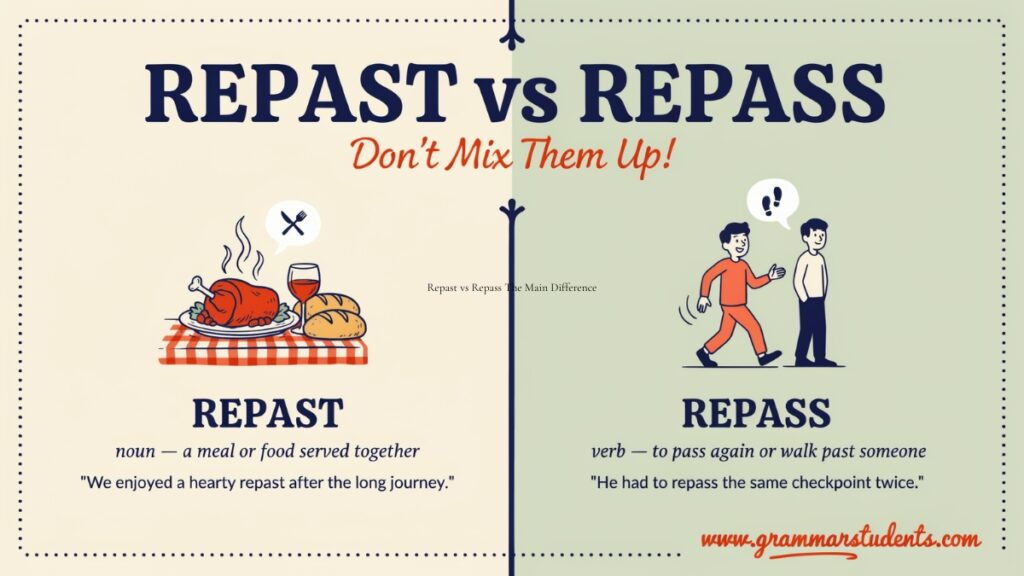
Some spelling mistakes are obvious. Others sneak into your sentence wearing a tiny disguise. Repast vs repass is one of those tricky pairs that can leave you staring at the screen and wondering which word actually belongs there. They look nearly identical, but their meanings aren’t twins. Repast refers to a meal, while repass generally means to pass or go through something again. The confusion becomes especially interesting when discussing funerals because some communities use repass to describe a meal held after a funeral. So, which spelling should you choose Let’s untangle these look-alike words and make their meanings, grammar, and proper usage easy to remember.
Quick Answer Repast vs Repass
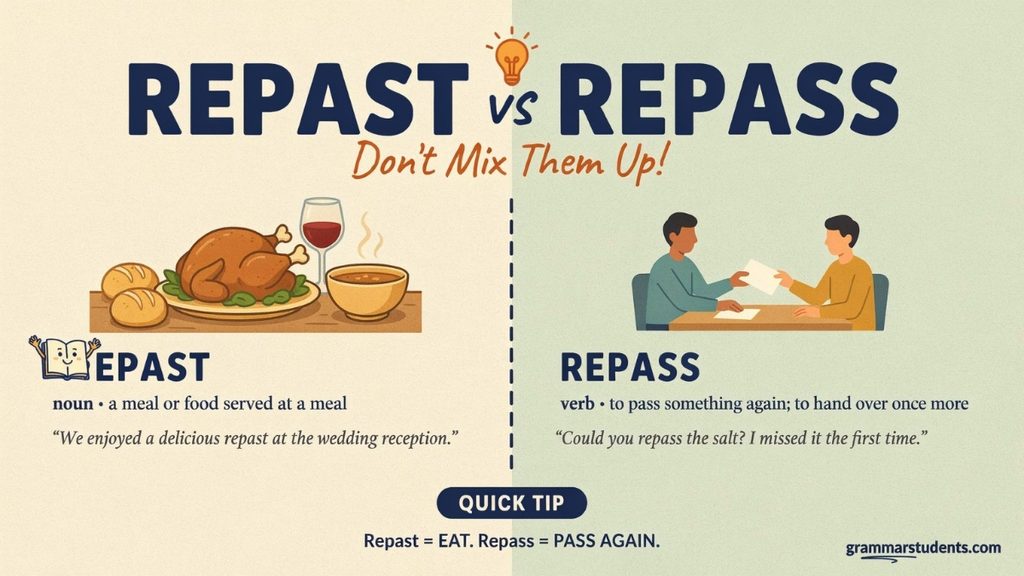
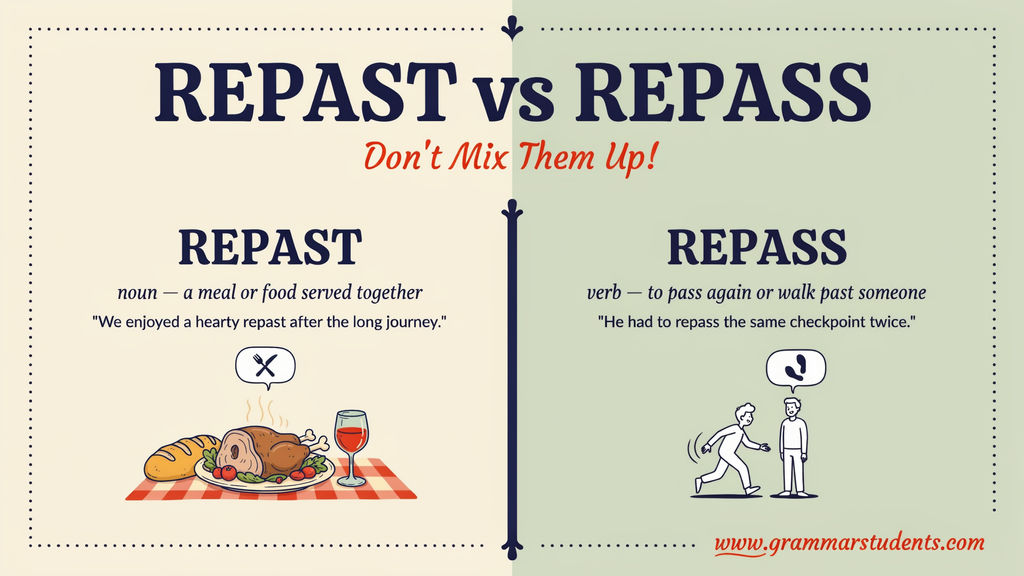
The simplest way to understand the repast vs repass difference is this:
| Word | Standard meaning | Part of speech | Common funeral use |
| Repast | A meal or the act/time of eating | Noun also a less-common verb | Yes |
| Repass | To pass again, return, or pass through again | Verb; archaic noun | Used in some communities for a post-funeral meal |
| Funeral repast | Meal or gathering after a funeral | Noun phrase | Standard choice |
| Funeral repass | Community term for a post-funeral gathering | Noun in this usage | Common in some communities |
Merriam Webster defines repast as something taken as food or a meal and also as the act or time of taking food.
Collins, meanwhile, defines repass primarily as a verb meaning to pass back or again. It also records an archaic noun meaning a passing again.
Therefore, if you’re writing a formal funeral program, invitation, obituary notice, or educational article, repast is generally the clearer choice.
What Does Repast Mean?
The repast meaning is straightforward a meal.
The word can refer to almost any meal, not only one connected with a funeral. Merriam-Webster defines repast as something taken as food and the act or time of taking food. Cambridge similarly defines it simply as a meal and labels the word literary.
Repast Definition in Simple English
A simple repast definition is:
Repast a meal or a period when people eat.
For example:
- We enjoyed a quiet repast after the long journey.
- The travelers stopped for a simple repast.
- A warm repast was waiting for the guests.
- The family shared a repast after the ceremony.
The word often sounds more formal or literary than meal. Cambridge’s examples show repast used for ordinary meals as well as more elaborate dining.
Is Repast a Word?
Yes Repast is a standard English word.
It appears in major dictionaries and has a long history in English. It can function as a noun and, much less commonly, as a verb. Merriam-Webster lists the noun meaning a meal and an older verb meaning to feed or feast.
So if you’re checking the repast correct spelling, the answer is:
R-E-P-A-S-T
Not repass when you mean the standard word for a meal.
What Is a Repast?
A repast is simply a meal. It might be a light meal, dinner, feast, or another shared eating occasion.
The word doesn’t automatically mean a funeral meal.
That’s an important point because people sometimes assume that repast specifically means the meal after a funeral. The funeral meaning comes from a particular use of the general word meal.
For example:
The travelers stopped for a brief repast before continuing their journey.
Nothing about that sentence involves a funeral.
Likewise:
The guests enjoyed an elegant repast in the garden.
Again, this simply means they enjoyed a meal.
The funeral meaning becomes clear from context:
The family invited friends to a repast following the funeral.
Here, repast refers to the meal or gathering after the service.
Learn the difference between confusing more English words
Amateur vs Amatuer Which Spelling Is Correct
Repast Meaning in English and Pronunciation

The repast pronunciation can contribute to the confusion.
Cambridge gives the U.S. pronunciation as approximately and the British pronunciation as approximately.
In practical terms, it sounds roughly like:
RI-PAST
The final t is part of the standard spelling and pronunciation.
How to Pronounce Repast
Think:
re + past → repast
The stress falls on the second syllable:
ri-PAST
That final t matters when you’re distinguishing the word from repass.
What Does Repass Mean?
The standard repass meaning is very different from repast.
Repass is primarily a verb meaning to pass again, pass back, return by the way you came, or pass over/through something again. Collins lists several related meanings, including passing a law again and, in literary use, returning or passing through something again.
Repass Definition in Simple English
A simple repass definition is:
Repass to pass again or go through something again.
For example:
- We had to repass the same checkpoint.
- The travelers repassed the old bridge.
- The committee voted to repass the amended law.
The word has a completely logical construction:
re- + pass pass again
That makes repass easy to understand once you separate it from repast.
Is Repass a Word?
Yes. Repass is a real English word.
But that doesn’t mean it has the standard meaning meal.
This distinction is crucial.
A word can be legitimate while still being the wrong word for a particular meaning.
For example, repass is a real word when you mean “pass again.” If someone writes:
We will repass after the funeral for dinner.
the intended meaning is probably understandable in some communities. Yet that sentence does not match the primary dictionary definition of repass. For standard edited English, repast is the safer choice when referring to the meal.
Repass Meaning in English and Pronunciation
The repass pronunciation can vary by dialect and dictionary tradition.
Collins gives American pronunciations including approximately.
The word can therefore sound close enough to repast in some speech patterns to create confusion.
That’s where the spelling problem gets interesting.
Someone may hear a word repeatedly without seeing it written. If the word isn’t part of everyday vocabulary, the listener may naturally create a spelling based on what they hear.
It’s a little like hearing an unfamiliar name on the phone and then discovering that the spelling looks nothing like the pronunciation.
Repast vs Repass The Main Difference
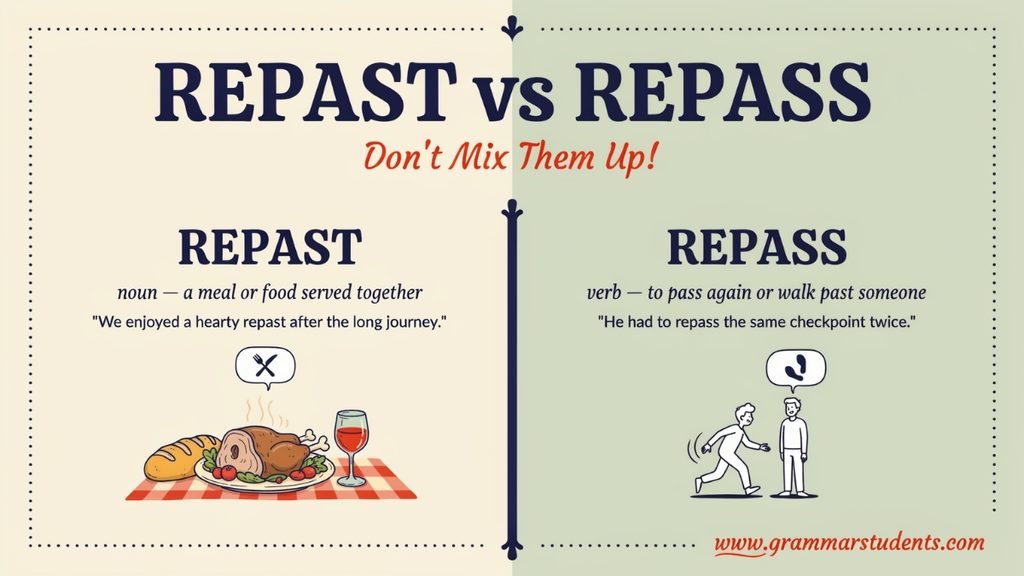
The biggest difference between repast and repass is their standard meaning and grammatical role.
Repast is connected with food and eating.
Repass is connected with passing again.
| Feature | Repast | Repass |
| Main meaning | Meal | Pass again |
| Standard part of speech | Noun | Verb |
| Food-related? | Yes | No, in standard dictionary usage |
| Funeral meal? | Yes | Used by some communities |
| Standard dictionary meaning | Meal/eating | Passing again |
| Example | We shared a repast. | We had to repass the checkpoint. |
This gives you an easy memory rule:
Repast has past at the end because it is the word for a meal. Repass has pass because something is being passed again.
Repast and Repass Difference in Grammar
The repast and repass difference becomes even clearer when you look at grammar.
Repast as a Noun
Most often, repast is a noun.
The family prepared a repast.
Here, repast is the thing being prepared.
You can replace it with meal:
The family prepared a meal.
Repass as a Verb
Repass is normally a verb.
We had to repass the bridge.
Here, repass describes an action.
You can replace it with:
We had to pass over the bridge again.
That is why the words aren’t interchangeable in standard English.
Repast vs Repass for Funeral Which Is Correct?
This is where most of the confusion appears.
If you’re asking repast or repass for funeral the standard written-English choice is repast.
A funeral repast is a meal or post-funeral gathering where family members, friends, and other mourners share food and spend time together after a funeral or memorial service.
Merriam-Webster’s current examples include repast in a funeral context, including a recent example involving a “funeral repast
Funeral planning sources also commonly use repast for the shared meal following a funeral.
What Is a Funeral Repast?
A funeral repast is generally a gathering held after a funeral, burial, or memorial service.
Depending on the family and tradition, it may include:
- A full meal
- Sandwiches
- Salads
- Main dishes
- Desserts
- Coffee and tea
- Soft drinks
- Catered food
- Food prepared by relatives or friends
- A church or community meal
The purpose isn’t simply to feed people.
A funeral repast can give mourners an opportunity to talk, remember, comfort one another, share stories, and spend time together after the formal service.
Funeral planning sources describe the repast as a more relaxed setting where people can continue remembering and supporting the deceased’s family.
Funeral Repast vs Funeral Repass
So what about funeral repass?
You’ll encounter the phrase.
In some communities, people use repass as the familiar name for the post-funeral meal. Funeral-related sources acknowledge that both terms can appear in real-world use.
However, there’s an important linguistic distinction:
The standard dictionary definition of repass is not funeral meal.
Major dictionary sources define it around the idea of passing again. Collins specifically lists repass as a verb and gives meanings such as passing back, returning, or passing through again.
Therefore:
- Funeral repast = standard dictionary-backed wording for the meal.
- Funeral repass = a real community usage found in some funeral and church contexts.
- Repass should not be presented as though all major dictionaries define it as a funeral meal.
That distinction makes the explanation more accurate.
Why Do People Say Repass Instead of Repast?
The answer likely involves sound, familiarity, and language change.
Repast isn’t a common everyday word for many English speakers. Someone may encounter it mainly by hearing it at a funeral or memorial gathering.
If they hear:
We’ll have the repast after the service.
they may never see the word written.
Because repass is already a recognizable English construction—re + pass—it can feel intuitive as a spelling.
In some communities, that pronunciation and spelling have become established enough that people use repass naturally in conversation and on funeral-related materials. Sources discussing funeral terminology document this community usage.
Language does this all the time.
A word can travel from speech → repeated community usage → familiar spelling.
That doesn’t automatically mean the newer form has replaced the older standard form in dictionaries. It simply shows how living language works.
Why Is a Funeral Meal Called a Repast?
The word repast has a long history connected to eating and meals.
The English word ultimately traces through French to Latin roots associated with feeding. Collins separately traces repass through French repasser, meaning to pass again.
The important distinction is this:
Repast belongs to the semantic field of food and eating.
That’s why a funeral meal can be called a repast.
The word itself isn’t inherently about death. The funeral association developed through usage.
Think of it like this:
Repast = meal
Funeral repast = meal connected with a funeral
The second meaning comes from the context rather than from a completely different dictionary definition.
What Is a Repast After a Funeral?
A repast after a funeral is a gathering where mourners share food and fellowship following the formal service.
It may happen:
- At a family home
- In a church fellowship hall
- At a community center
- At a restaurant
- At a funeral facility
- In another location chosen by the family
There isn’t one universal format.
Some families organize a large meal. Others serve simple refreshments.
The emotional purpose can be just as important as the food. People who have spent hours dealing with grief and ceremony often need a place to sit down, talk, and reconnect.
As one funeral planning source explains, a repast provides an opportunity to share memories and support one another after the formal services.
Repass After Funeral Why You May Hear It
The phrase repass after funeral appears in searches, conversations, funeral announcements, and community materials.
When someone says:
We’re having a repass after the funeral.
they may be using repass as the community term for the post-funeral meal.
The intended meaning is usually clear from context.
Still, if you’re writing for a broad audience and want standard English, repast after the funeral is the better choice.
For example:
Preferred in formal writing:
A repast will follow the funeral service.
Community usage you may encounter:
A repass will follow the funeral service.
The second sentence may be perfectly understandable to the intended community. The first is more closely aligned with the standard dictionary meaning of repast.
Repast vs Repass for Funeral Invitations
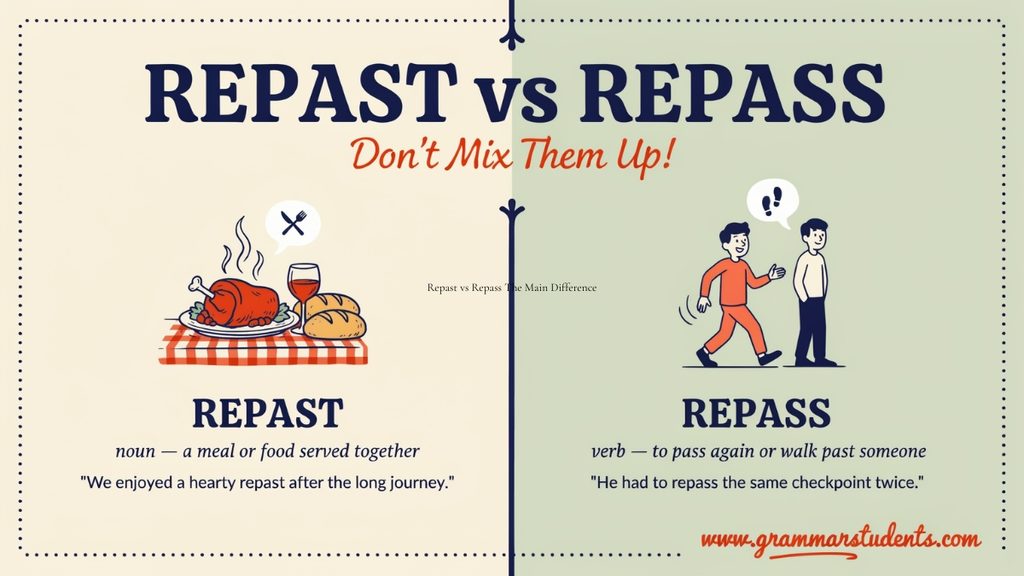
If you’re creating a funeral repast invitation, wording matters because invitations are formal documents.
A simple option is:
A repast will be held immediately following the funeral service.
Another:
Family and friends are invited to join us for a repast following the service.
Or
Please join the family for a repast after the memorial service.
Using repast avoids ambiguity for readers who may not recognize repass as a funeral term.
If a particular family, church, or community consistently uses repass, preserving that wording may also make sense. Language has a cultural dimension, especially around traditions involving grief and remembrance.
Funeral Repast Etiquette
There isn’t one universal rulebook for funeral repast etiquette.
Customs vary by family, religion, region, and culture.
Still, a few practical principles are broadly useful.
If You’re Attending
- Follow the family’s invitation.
- Don’t assume a private gathering is open to everyone.
- Offer condolences respectfully.
- Let the grieving family guide conversations.
- Avoid turning the gathering into a social event unrelated to the deceased.
- Be considerate of food restrictions.
- Don’t expect the family to entertain every guest.
- Help when appropriate instead of creating extra work.
If You’re Organizing
Keep the logistics simple.
A family dealing with bereavement may not have the energy to coordinate an elaborate event. Friends, relatives, church members, caterers, or community volunteers can often help.
Funeral Repast Food and Menu Ideas
A funeral repast menu doesn’t need to be extravagant.
The best menu depends on the number of guests, venue, budget, cultural traditions, and dietary needs.
Common options include:
- Chicken
- Sandwiches
- Pasta dishes
- Rice dishes
- Salads
- Vegetables
- Bread or rolls
- Fruit
- Cookies
- Cake
- Pudding
- Coffee
- Tea
- Water
- Soft drinks
A buffet often works well because guests can serve themselves without creating a complicated dining schedule.
A Simple Funeral Repast Menu
| Category | Examples |
| Main dish | Chicken, baked pasta, sandwiches |
| Side dishes | Potato salad, green salad, vegetables |
| Bread | Rolls, biscuits, cornbread |
| Dessert | Cake, cookies, pudding, fruit |
| Drinks | Water, tea, coffee, soft drinks |
The goal isn’t to impress guests with culinary fireworks.
The goal is to provide food, comfort, and fellowship.
Repast vs Wake Are They the Same?
No. A repast and a wake are not necessarily the same thing.
A wake or visitation generally refers to a gathering where people come to view or honor the deceased and offer condolences. A repast centers on a meal or shared food after the service.
They can happen close together, but they serve different purposes.
| Term | Main purpose |
| Wake | Visiting, mourning, viewing, remembrance |
| Funeral service | Formal ceremony honoring the deceased |
| Memorial service | Ceremony remembering the deceased |
| Repast | Shared meal after a service |
| Funeral reception | Gathering after a funeral, often involving food |
Some families may combine elements of these gatherings. Others keep them separate.
Repast vs Funeral Reception
A funeral reception and a funeral repast can overlap significantly.
In everyday use, people may use the terms almost interchangeably. Funeral sources commonly describe a repast as a reception or gathering involving food.
Still, there can be a subtle distinction.
Repast emphasizes the meal.
Reception emphasizes the gathering.
For example:
The family hosted a repast after the burial.
focuses more strongly on the meal.
The family hosted a reception after the burial.
focuses more broadly on the gathering.
Neither necessarily tells you exactly what food will be served.
Repast vs Celebration of Life
A celebration of life is generally a broader memorial event designed to remember and honor someone who has died.
A repast is specifically centered around food or a meal.
A celebration of life may include:
- Speeches
- Music
- Photos
- Stories
- Readings
- Videos
- Food
- Socializing
A repast can be part of such an event, but the terms aren’t synonyms.
Repast Synonyms and Repass Synonyms
Depending on context, useful repast synonyms include:
- Meal
- Food
- Dinner
- Feast
- Banquet
- Dining
- Refreshment
- Shared meal
- Formal meal
- Post-funeral meal
Not every synonym works in every sentence.
For example, banquet usually suggests a large or formal meal. Repast doesn’t necessarily imply something that elaborate.
Repass Synonyms
Because repass means pass again useful alternatives include:
- Pass again
- Return
- Go through again
- Cross again
- Travel through again
- Pass back
- Make another passage
For example:
The travelers repassed the village.
can become:
The travelers passed through the village again.
That substitution makes the meaning obvious.
Repast in a Sentence Examples
Here are several repast example sentences.
The guests enjoyed a simple repast after the ceremony.
The travelers stopped for a brief repast.
The church prepared a repast for the family and guests.
A light repast followed the memorial service.
The family invited close friends to share a repast.
Notice how repast consistently relates to food or eating.
Repass in a Sentence Examples
Here are some repass example sentences using the standard meaning:
The travelers repassed the same road the next morning.
We had to repass the checkpoint after returning from the village.
The committee voted to repass the amended legislation.
The horse repassed the gate several times.
These examples show why repass and repast are not simply two spellings of the same standard English word.
Repast vs Repass Common Mistakes
The most common mistake is assuming that the words are interchangeable everywhere.
Mistake Treating Repass as the Standard Word for Meal
We prepared a repass for the guests.
If you mean a meal, repast is the standard dictionary-backed choice.
Mistake: Assuming Repass Isn’t a Word
Repass isn’t a word.
That’s also too simplistic.
Repass is a real dictionary word. Its standard meaning is related to passing again.
Mistake: Assuming Repast Only Means Funeral Meal
It doesn’t.
A repast can be any meal.
Mistake Ignoring Community Usage
It is also inaccurate to pretend that nobody uses repass for a funeral gathering. Funeral sources document that usage.
The better explanation is:
Repast is the standard word for a meal, while repass is a standard word with a different meaning and is also used as a funeral-meal term in some communities.
That is both linguistically and culturally more precise.
How Can I Remember Repast vs Repass?
Try this simple memory trick:
REPAST = EAT
Both words contain the idea of food in this memory trick:
REPAS-T → think PAST the meal.
Or simply remember:
Repast = meal.
For repass, focus on the structure:
RE + PASS = PASS AGAIN
So:
Repast → food
Repass → pass again
That’s enough to solve most spelling questions.
Repast vs Repass A Practical Decision Guide
When you’re unsure whether to write repast or repass, ask yourself one question:
Are you talking about food or passing?
Food or eating?
Use repast.
We shared a repast after the funeral.
Passing again?
Use repass.
The travelers repassed the bridge.
Funeral gathering in a community where repass is customary?
You may encounter repass, but recognize that this is a community usage rather than the primary dictionary meaning of repass.
Formal funeral invitation or general-audience writing?
Use repast.
Practice Session Repast vs Repass
- The family invited friends to a ______ after the funeral service.
- The travelers had to ______ the same road to return home.
- A ______ is a meal or an occasion for eating.
- In standard English, ______ means to pass or go through something again.
- The church prepared a ______ for the mourners following the memorial service.
- The hikers had to ______ the narrow bridge before reaching the village.
- The funeral program stated that a ______ would follow the burial service.
- The word ______ is generally used as a noun when it means a meal.
- The word ______ is primarily used as a verb when it means “pass again.”
- The guests gathered for a shared ______ after the ceremony.
- If you mean “pass through again,” the correct word is ______.
- If you mean “a meal after a funeral,” the standard term is ______.
- The family decided to host a small ______ at the church fellowship hall.
- The travelers ______ the checkpoint after realizing they had left their luggage behind.
- The word repast is associated with food, eating, and a ______.
- The prefix re- in repass helps express the idea of doing something ______.
- A funeral ______ may provide an opportunity for family and friends to share food and memories.
- The hikers had to ______ the trail after taking the wrong path.
- “The family will host a ______ following the service” is an appropriate sentence for a funeral announcement.
- “The soldiers had to ______ the same route” uses the word correctly because they passed along it ______.
- A funeral repast is usually a meal or ______ held after a funeral or memorial service.
- The word repass should not normally be used as the standard dictionary word for a ______.
- In some communities, people use repass to refer to a post-funeral ______.
- When writing a formal funeral invitation for a broad audience, repast is generally the clearer ______.
- The easiest way to remember the difference is repast vs meal, repass vs pass ______.
Answer Key
- repast
- repass
- repast
- repass
- repast
- repass
- repast
- repast
- repass
- repast
- repass
- repast
- repast
- repassed
- meal
- again
- repast
- repass
- repast
- repass / again
- gathering
- meal
- meal
- choice
- again
Here’s a trusted source for clear more words Comparison:
Grammar Update
Frequently Asked Questions
What is the correct word, repass or repast?
Repast is the standard word when you mean a meal, including a meal held after a funeral. Repass is a separate English word that generally means to pass or go through something again. Some communities also use repass for a post-funeral meal, so you may see both terms in funeral-related settings.
Is repast still used today?
Yes Repast is still used today, particularly in formal, literary, and funeral-related language. Although meal is much more common in everyday conversation, repast continues to appear in funeral programs, obituaries, invitations, and descriptions of post-funeral gatherings.
How do you use repast in a sentence?
You can use repast as a noun when referring to a meal. For example The family invited everyone to a repast following the memorial service.” It can also describe an ordinary meal outside a funeral context, although the word sounds more formal than meal.
What do white people call a repast?
There isn’t one universal term used by white people. Funeral traditions vary according to family, religion, region, and cultural background, not simply race. People may call the gathering a repast, funeral reception, memorial meal, meal after the funeral, or another local term.
Is a repass a Black thing?
Repass is strongly associated with some Black American funeral traditions, particularly in communities where the term is commonly used for the meal or gathering following a funeral. However, it isn’t accurate to say that every Black person uses repass or that the practice belongs exclusively to Black people. Funeral terminology varies considerably between families and communities.
Is there another word for repass?
If repass means to pass again alternatives include pass again, return, go through again, cross again, or pass back, depending on the sentence. If you’re referring to a funeral gathering where a community uses repass to mean a meal, alternatives include repast, funeral reception, memorial meal, and post-funeral meal.
Why do they cover your face before closing the casket?
Covering the deceased’s face before closing the casket is a practice found in some funeral traditions. It can provide a final moment of privacy and dignity and may be part of a family’s religious or cultural customs. It isn’t a universal funeral requirement, so practices differ between families, funeral homes, and traditions.
Do white people have repasses?
Yes, people from many racial and cultural backgrounds may have a meal or gathering after a funeral. However, the terminology differs. Some people use repast, others use repass, while others simply say funeral reception, family gathering, or meal after the service. Race alone doesn’t determine which term a family uses.
How do you say no repast after a funeral?
If you’re informing guests that there won’t be a meal afterward, you can say There will be no repast following the funeral service. A softer option is the family will not be hosting a repast following the service. If the family wants to keep the wording brief No reception will follow is also clear.
What three colors should not be worn to a funeral?
There isn’t a universal rule that prohibits exactly three colors at every funeral. Black remains the most traditional choice in many Western funeral settings, while dark and subdued colors such as navy, gray, and brown are often considered appropriate. Bright or highly attention-grabbing colors may be inappropriate for some traditional services, but clothing customs depend on the family’s wishes and cultural or religious traditions.
Is it rude to take a picture of someone in a casket?
It can be considered disrespectful or intrusive, especially if you haven’t received permission from the immediate family. Funeral photography is a sensitive matter because the deceased and grieving relatives deserve privacy and dignity. If photography is permitted, follow the family’s instructions and avoid taking or sharing images without consent.
What color is associated with passing away?
Black is the color most strongly associated with mourning and death in many Western cultures. However, there is no universal color of death White is traditionally associated with mourning in several East and South Asian cultures, while other cultures use different colors. Funeral clothing therefore depends heavily on cultural, religious, and family traditions.
Conclusion
In the end, repast vs repass doesn’t have to remain a grammar headache. Although these words look almost identical, their meanings take very different paths. Repast means a meal, while repass generally means to pass or go through something again. The plot thickens at funerals because some communities use repass for the meal shared after a service. For formal or general-audience writing, however, repast is usually the safest and clearest choice. Once you connect repast with food and repass with passing again, the confusion starts to disappear. No more letter-swapping drama just the right word in the right place.

Jacob AJS is an experienced blogger and English language enthusiast dedicated to making grammar and vocabulary simple, clear, and practical. As a writer for Grammarstudent, he creates insightful word comparisons, easy-to-follow explanations, and useful examples that help learners avoid common mistakes. His passion is to make English easier to understand while helping readers communicate with confidence, clarity, and accuracy.