Have you ever packed two boxs and wondered why your grammar checker gives you the side eye You’re not alone! The confusion between boxes or boxs is a common spelling mistake that can trip up even confident English writers. After all we add s to words like book and chair so why does box get special treatment English loves keeping us on our toes! The good news is that the rule is simple boxes is the correct plural of box. In this guide you’ll learn why explore practical examples and master the spelling without second guessing yourself.
Boxes or Boxs Which Spelling Is Correct?
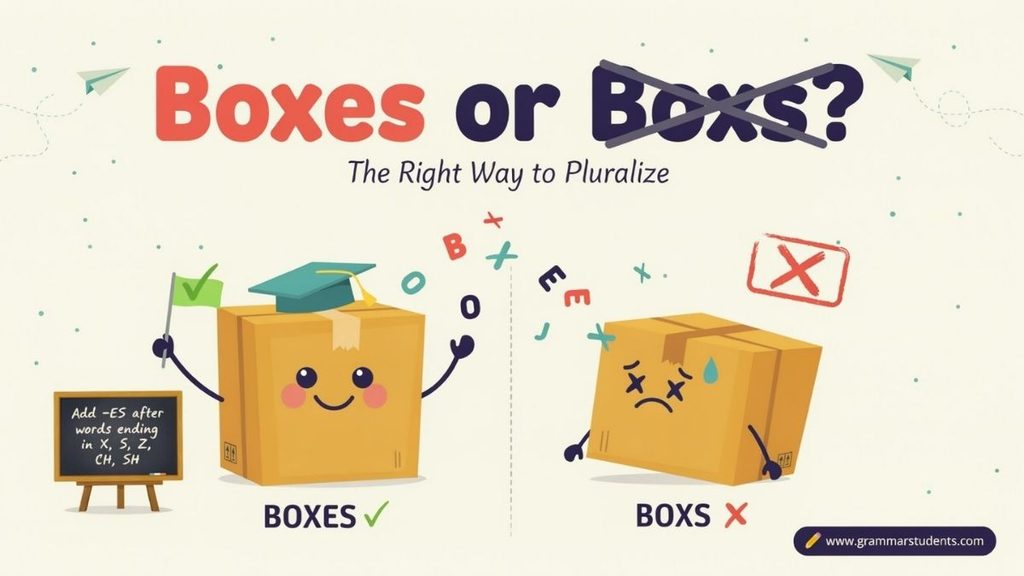
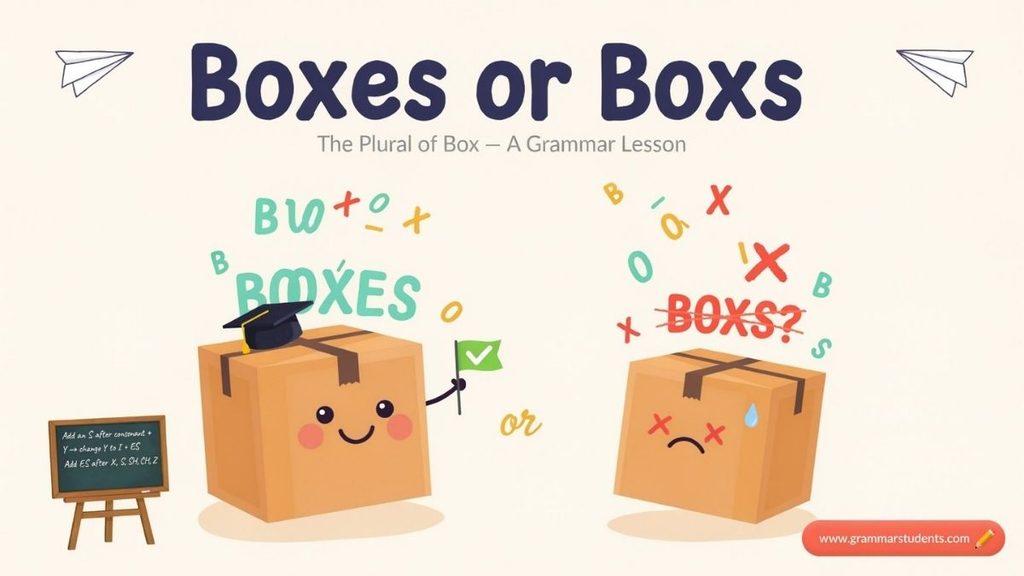
Boxes is the correct plural spelling of box. The word boxs is not the standard spelling used in American or British English.
The difference comes from a common English pluralization rule. Although many nouns form their plural by adding s nouns ending in x generally take es.
Here are a few examples:
- One box or Two boxes
- One fox or Two foxes
- One tax or Several taxes
- One toolbox or Three toolboxes
The same pattern applies whether the word refers to a physical container a storage space or another object called a box.
Boxes vs Boxs A Quick Comparison
| Feature | Boxes | Boxs |
| Correct spelling | Yes | No in standard English |
| Grammatical role | Plural noun | Usually a spelling error |
| Meaning | More than one box | No standard plural meaning |
| Example | We moved six boxes. | We moved six boxs. |
| Suitable for formal writing | Yes | No |
| Used in standard American English | Yes | No |
| Used in standard British English | Yes | No |
The distinction is straightforward use boxes whenever you mean more than one box.
Is Boxs Correct?
No. If you’re writing in standard English boxs is incorrect when you want the plural of box.
You might encounter the spelling in an informal online post a username a brand name or a typo. That doesn’t make it the accepted plural form.
For school assignments business emails reports blog posts and other formal or professional writing use boxes.
Is Boxs a Word?
The answer depends on what you mean by a word.
The spelling boxs can appear as a name label username or deliberately created term. However it isn’t the standard plural form of the English noun box.
If your question concerns English spelling and grammar the correct choice is boxes.
What Is the Plural of Box?
The plural of box is boxes.
A singular noun identifies one person place thing or idea. A plural noun identifies more than one. Since box ends in x you normally add es to make it plural.
- Singular: I need one box.
- Plural: I need four boxes.
This rule applies regardless of the size material or purpose of the containers.
For example you might have one cardboard box two gift boxes several shoe boxes or a collection of metal storage boxes. The plural spelling remains boxes.
Boxes or Boxs Singular or Plural?
The word box is singular when it refers to one item. The word boxes is plural when it refers to two or more items.
| Number | Correct form | Example |
| One | Box | The box is empty. |
| Two | Boxes | The boxes are empty. |
| Three | Boxes | Three boxes arrived today. |
| Ten | Boxes | Ten boxes fit in the truck. |
| Many | Boxes | The boxes contain books. |
Remember that the noun and its verb often need to agree in number.
- Singular: The box is heavy.
- Plural: The boxes are heavy.
Using boxes with a singular verb in an ordinary sentence is a common grammar error. Likewise using box with a plural verb can make a sentence sound incorrect.
Two Box or Two Boxes?
The correct expression is two boxes.
In standard English a countable noun usually takes its plural form after a number greater than one.
Correct examples include:
- Two boxes are waiting outside.
- I ordered two boxes of cereal.
- We need two boxes for these books.
- She carried two boxes upstairs.
Incorrect: I ordered two box.
The same rule applies to the written number and the numeral. Both two boxes and 2 boxes are correct.
One Box or One Boxes?
The correct expression is one box.
The number one refers to a single item so the noun remains singular.
Examples:
- I bought one box of tissues.
- Please move one box to the office.
- Only one box arrived today.
- We need one box for the documents.
Incorrect I bought one boxes.
A useful way to remember this distinction is to match the noun to the quantity:
- One box
- Two boxes
- Three boxes
- Four boxes
Why Is the Plural of Box Boxes Instead of Boxs?
English plural spelling follows several patterns. One of the most familiar is adding s to a noun as in book or books. However nouns ending in certain sounds and letters often need es.
Because box ends in x its standard plural form is boxes.
Why Do We Add Es to Box?
The ending es allows the plural to follow an established English spelling and pronunciation pattern.
Compare these Boxes or Boxs
| Singular | Plural | Rule |
| Book | Books | Add s |
| Chair | Chairs | Add s |
| Box | Boxes | Add es |
| Fox | Foxes | Add es |
| Dish | Dishes | Add es |
| Watch | Watches | Add es |
| Bus | Buses | Add es |
Nouns ending in x s sh and ch commonly form their plurals with es. Many nouns ending in z also use es sometimes with a doubled final z as in quiz or quizzes.
The main takeaway is that you shouldn’t apply one plural spelling rule to every English noun. Check the ending of the singular form before deciding how to pluralize it.
The Box Ending in X Plural Rule
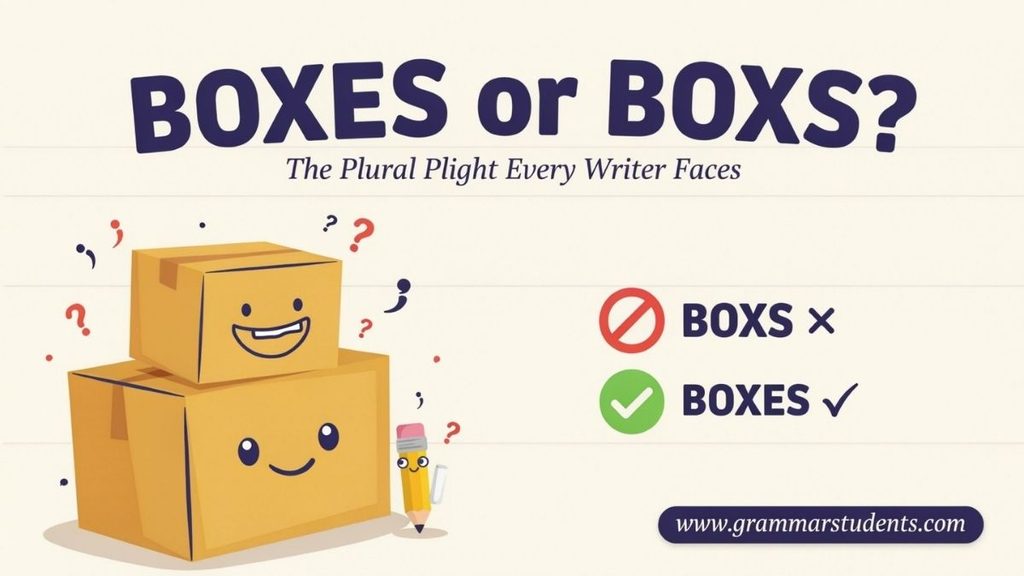
For most ordinary nouns ending in x add es.
Follow these examples:
- Box or Boxes
- Fox or Foxes
- Tax or Taxes
- Wax or Waxes
- Mix or Mixes
- Fix or Fixes
- Prefix or Prefixes
- Toolbox or Toolboxes
- Mailbox or Mailboxes
Notice that compound words containing box follow the same pattern. Adding a prefix or combining two words doesn’t change the plural rule for the final noun.
For example mailbox becomes mailboxes not mailboxs.
Pluralization Rules in English Adding S Versus ES
The following table summarizes several common plural spelling patterns.
| Noun ending | Typical plural pattern | Examples |
| Most consonants | Add s | Book or Books |
| Most vowels | Add s | Toy or Toys |
| x | Add es | Box or Boxes |
| s | Add es | Bus or Buses |
| sh | Add es | Dish or Dishes |
| ch | Add es | Watch or Watches |
| Consonant + y | Change y to ies | Baby or Babies |
| Many irregular nouns | Change the word or use a special form | Child or Children |
These are common patterns rather than rules without exceptions. English includes irregular plurals and words whose forms depend on their meaning or established usage.
For everyday writing learning frequent patterns and checking unfamiliar words will help you avoid common plural spelling mistakes.
Box vs Boxes Meaning Understanding the Difference
The difference between box and boxes is primarily grammatical. Both forms refer to the same general kind of object but they indicate different quantities.
Box Meaning
A box is commonly a container with flat sides often rectangular or square used for storing carrying organizing or packaging items.
Boxes can be made from cardboard wood plastic metal or other materials.
The word can also describe other things depending on context including:
- A container: Put the documents in the box.
- A storage compartment: The toolbox holds the equipment.
- A marked area: Write your answer in the box.
- A section of a form: Check the appropriate box.
- A designated space: The vehicle entered the starting box.
In other contexts box can refer to the sport of boxing or the act of putting something inside a box. Its precise meaning depends on how the word is used.
Boxes Meaning
Boxes is the plural of box. It refers to two or more containers compartments marked areas or other things described by the noun box.
For example:
- The boxes are stacked in the garage.
- She checked all the boxes on the form.
- The delivery included five boxes of supplies.
- We placed the tools in separate boxes.
The plural form can also appear in expressions such as thinking outside the box when multiple metaphorical compartments or categories are being discussed.
The meaning doesn’t change simply because the noun becomes plural. The main difference is the number of items being described.
Box or Boxes How to Choose the Right Word
Ask yourself how many items the sentence refers to.
Use box for one item:
Please put the package in the box.
Use boxes for more than one:
Please put the packages in the boxes.
You can also use nearby words as clues. Terms such as a an and one generally indicate a singular countable noun. Numbers greater than one as well as words such as many several and few usually call for the plural.
Compare these examples:
- A box is on the table.
- Several boxes are on the table.
- One box contains books.
- Four boxes contain books.
This simple quantity check works in most everyday situations.
Boxes or Boxs in a Sentence Practical Examples
Examples make spelling and grammar rules easier to apply. The following sentences show how box and boxes work in everyday English.
Box in a Sentence
Use box when referring to one item.
- The box is under the desk.
- I need a box for these old photographs.
- He opened the box carefully.
- The delivery driver left one box at the door.
- Please write your name in the box.
- This box contains fragile glassware.
- She bought a box of chocolates.
- The box was too large for the shelf.
In each sentence the noun refers to one box so the singular spelling is correct.
Boxes Examples

Use boxes when referring to multiple items.
- The boxes are waiting in the hallway.
- We packed our clothes into three boxes.
- These boxes contain kitchen supplies.
- The store received several boxes of books.
- Please stack the boxes against the wall.
- The moving company loaded eight boxes into the truck.
- All the boxes were labeled before shipping.
- She recycled the empty boxes after unpacking.
These examples also demonstrate plural subject-verb agreement. In The boxes are waiting the plural subject boxes takes the plural verb are.
Box Plural Examples in Different Situations
The correct plural form appears in many everyday settings.
| Situation | Example sentence |
| Moving | We packed the furniture accessories into boxes. |
| Shipping | The warehouse dispatched 25 boxes yesterday. |
| Retail | The store sells boxes in several sizes. |
| Education | Students placed their projects in labeled boxes. |
| Office work | The files are organized in separate boxes. |
| Online shopping | Two boxes arrived with the order. |
| Storage | The boxes contain seasonal decorations. |
| Forms | Please check all the relevant boxes. |
Whether you’re writing an email preparing a report or creating website content the spelling remains the same.
A Short Case Study Correcting a Packing List of Boxes or Boxs
Imagine a small business preparing a packing list for an order of office supplies.
The original list reads:
- 2 box of printer paper
- 3 boxs of pens
- 1 box of folders
- 5 boxs of notebooks
Although the reader can understand the list the plural forms contain spelling and grammar errors.
The corrected list is:
- 2 boxes of printer paper
- 3 boxes of pens
- 1 box of folders
- 5 boxes of notebooks
The correction does more than improve spelling. It makes the quantity of each item clear and gives the list a professional appearance.
Is It The Box Is or The Boxes Are?
Both expressions are correct but they describe different quantities.
| Singular | Plural |
| The box is heavy. | The boxes are heavy. |
| The box has a label. | The boxes have labels. |
| This box contains books. | These boxes contain books. |
| That box belongs to me. | Those boxes belong to me. |
The singular forms this that is and has generally pair with singular nouns in these examples. The plural forms these those are and have pair with plural nouns.
A common error is to write The boxes is heavy. The correct sentence is The boxes are heavy.
Choosing A An or No Article of Boxes or Boxs
A singular countable noun usually needs a determiner in a complete sentence. The article a is used before the consonant sound at the start of box.
Correct:
- I found a box in the garage.
- She packed a box of dishes.
- We moved the box upstairs.
For plural nouns a and an aren’t used directly before the noun.
Correct:
- I found boxes in the garage.
- She packed three boxes of dishes.
- We moved the boxes upstairs.
You can use the with singular or plural nouns when the reader knows which item or items you mean.
Common Plural Spelling Mistakes Boxes or Boxs
English learners and native speakers alike sometimes make errors when applying plural spelling patterns.
| Incorrect | Correct | Explanation |
| Boxs | Boxes | Nouns ending in x usually take es. |
| Foxs | Foxes | Add es after x. |
| Dishs | Dishes | Add es after sh. |
| Watchs | Watches | Add es after ch. |
| Two box | Two boxes | Use the plural after a number greater than one. |
| The boxes is here | The boxes are here | A plural subject needs a matching verb. |
| One boxes | One box | Use the singular with one. |
One useful proofreading habit is to scan for quantities first. If a sentence contains two several many or another plural indicator check the noun that follows it.
Fix common more word mistakes in English
To or Too Which One Belongs in Your Sentence?
Box’s vs Boxes’ vs Boxes Apostrophes Explained
The forms box boxes box’s and boxes’ look similar but they serve different grammatical purposes.
The distinction matters because an apostrophe can show possession or in some cases represent omitted letters. It doesn’t normally make a noun plural.
Boxes The Ordinary Plural
Use boxes when referring to more than one box.
Examples:
- The boxes are empty.
- We bought four boxes.
- These boxes belong in storage.
No apostrophe is needed because the word is simply plural.
Box’s The Singular Possessive

Use box’s to show that something belongs to or is associated with one box.
Examples:
- The box’s lid is missing.
- The box’s contents were damaged.
- The box’s label identifies the shipment.
In each example the apostrophe comes before the s because the possessive noun is singular.
Box’s can also represent the contraction box is or box has in a suitable context although such usage is less common because box is often an object rather than an animate subject.
For example The box’s been moved can be read as The box has been moved. In formal writing spelling out has may be clearer.
Boxes’ The Plural Possessive
Use boxes’ when something belongs to or is associated with multiple boxes.
Examples:
- The boxes’ labels were difficult to read.
- We checked the boxes’ contents.
- The boxes’ lids were stored separately.
The apostrophe comes after the plural s because boxes is already plural.
Box Boxes Box’s and Boxes’ Compared
| Form | Function | Example |
| Box | Singular noun | The box is open. |
| Boxes | Plural noun | The boxes are open. |
| Box’s | Singular possessive or contraction | The box’s lid is missing. |
| Boxes’ | Plural possessive | The boxes’ lids are missing. |
The easiest way to remember the rule is to separate number from possession:
- More than one: boxes
- Belonging to one box: box’s
- Belonging to multiple boxes: boxes’
Don’t add an apostrophe just because a noun ends in s. Apostrophes serve a grammatical purpose they aren’t a general plural marker.
American English Box Plural vs British English Box Plural
There is no spelling difference between American and British English for this word. Both varieties use boxes as the standard plural of box.
| English variety | Singular | Plural |
| American English | Box | Boxes |
| British English | Box | Boxes |
| Australian English | Box | Boxes |
| Canadian English | Box | Boxes |
You don’t need to change the spelling based on your audience’s location.
American and British English do differ in the spelling of certain other words such as color/colour and organize/organise in some style conventions. However box or boxes follows the same spelling pattern across these varieties.
If you’re writing for an international audience boxes is the safe standard choice.
Similar Words That Follow the Same Plural Rule of Boxes or Boxs
Learning the plural form of box can help you spell other English nouns correctly. Many nouns ending in x s sh or ch form their plurals with es.
| Singular noun | Plural noun | Example |
| Fox | Foxes | Two foxes crossed the road. |
| Tax | Taxes | The business paid its taxes. |
| Wax | Waxes | Different waxes are used in these products. |
| Mix | Mixes | The chef prepared two mixes. |
| Fix | Fixes | The technician made several fixes. |
| Bus | Buses | The buses arrived on time. |
| Dish | Dishes | The dishes are clean. |
| Watch | Watches | The store sells watches. |
| Brush | Brushes | The brushes are on the shelf. |
| Match | Matches | We bought several matches. |
| Toolbox | Toolboxes | The workers stored their equipment in toolboxes. |
| Mailbox | Mailboxes | The apartment building has separate mailboxes. |
Some words can have additional meanings that affect how they’re used. For example mixes can refer to mixtures or to the action of mixing depending on the sentence.
The key point is that these examples illustrate common spelling patterns. When you encounter an unfamiliar noun check its established plural rather than assuming every word follows the same rule.
How to Remember the Correct Spelling of Boxes
If you frequently confuse boxes and boxs use one or more of these practical methods.
Remember the Ending
Think of the pattern:
Words ending in x usually add es to form the plural.
For example:
- Box or Boxes
- Fox or Foxes
- Tax or Taxes
Once you recognize the final x you’ll have a useful clue about the correct spelling.
Learn the Word in a Sentence
Memorizing a word in context can be more useful than memorizing its letters alone.
Try remembering this sentence:
We packed the books into three boxes.
The number three signals that the noun is plural and the spelling shows the -es ending.
Use a Quick Singular to Plural Exercise
Test yourself by completing the following sentences.
- One box two ______.
- One fox three ______.
- One tax several ______.
- One mailbox four ______.
The correct answers are boxes foxes taxes and mailboxes.
Proofread Before Publishing
If you’re writing for a website a business or a school assignment search your draft for boxs. Replace it with boxes when you mean the standard plural of box.
Spell checking software may catch this error but you shouldn’t rely on automated tools alone. A proofreading pass can also catch number agreement and apostrophe mistakes that a simple spell checker may miss.
Practice Sessions of Boxes or Boxs
Fill in the Blank
- I packed three _____ of books for the move.
- There is one _____ on the kitchen table.
- The delivery driver brought five _____ this morning.
- Please put the gift inside the _____.
- We need two _____ to store these toys.
- She opened the _____ carefully.
- Several _____ were stacked in the garage.
- He bought one _____ of chocolates.
- The moving company loaded ten _____ onto the truck.
- This _____ contains important documents.
- The correct plural spelling of box is _____
- I need two _____ for my shoes.
- The _____ is empty.
- She packed three lunch_____ for the children.
- The _____ are too heavy to carry.
- One _____ is missing from the delivery.
- We ordered six _____ online.
- Please put all the toys into these _____.
- The _____ lid is broken.
- The _____ labels are missing.
- One box two _____.
- The _____ are full of clothes.
- Please bring me one _____ of tissues.
- The children carried their lunch_____.
- The boxes _____ ready for shipping.
Answer Key
- boxes
- box
- boxes
- box
- boxes
- box
- boxes
- box
- boxes
- box
- boxes
- boxes
- box
- boxes
- boxes
- box
- boxes
- boxes
- box’s
- boxes’
- boxes
- boxes
- box
- boxes
- are
Here’s a trusted source for clear more words Comparison:
Grammar Update
Frequently Asked Questions About Boxes or Boxs
Is it correct to say 2 box or 2 boxes?
2 boxes is correct. Use the plural form boxes for quantities greater than one. For example I ordered 2 boxes of printer paper.
What is the plural of box?
The plural of box is boxes. Because box ends in x you add es instead of just s.
Is it correct to write 3 box or 3 boxes?
3 boxes is correct. The number three refers to multiple items so the noun must be plural. For example She packed 3 boxes for the move.
What is the correct spelling: boxes or boxs?
Boxes is the correct spelling in standard English. Boxs is a common spelling mistake because nouns ending in x generally form their plurals by adding es.
How do you use boxes in a sentence?
Use boxes when referring to two or more containers or objects called boxes. For example The delivery driver left three boxes outside the office.
Which plural spelling rule applies to box?
The word box follows the rule for nouns ending in x add es to form the plural. Examples include box or boxes fox or foxes and toolbox or toolboxes.
What is the plural of lunch box?
The plural of lunch box is lunch boxes. For example The children placed their lunch boxes on the table. The plural ending applies to box the main noun in the compound.
What is the plural possessive of box?
The plural possessive is boxes’. It shows that something belongs to multiple boxes. For example The boxes’ labels were damaged. In contrast box’s is the singular possessive.
Is boxes a noun?
Yes boxes is a plural noun when it refers to more than one box. It can also function as a verb as in She boxes the products for shipping.
Is boxes already plural?
Yes. Boxes is already the plural form of box. The correct singular and plural forms are one box and two boxes.
What are the three common types of boxes?
Three common types are cardboard boxes plastic storage boxes and wooden boxes. Cardboard boxes are widely used for packaging and shipping plastic boxes are useful for reusable storage and wooden boxes provide sturdy storage or transport.
Why are boxes called boxes?
The English word box came through Old French boiste meaning a container and is generally traced to Latin buxis associated with a boxwood container. Over time the word came to describe many kinds of containers and enclosed spaces.
What do people call lunch boxes?
People commonly use the terms lunch box and lunchbox. Both refer to a container used to carry food to school work or another location. The one word spelling lunchbox is also standard.
What is the plural of breakfast?
The plural of breakfast is breakfasts. For example The hotel offers several breakfast options. When referring to the meal in general the singular form is more common as in I eat breakfast at 8 a.m.
Is there a plural form of lunch?
Yes. The plural of lunch is lunches. For example The cafeteria prepared 100 lunches for the students. When discussing the meal generally lunch is usually singular.
Is it boxed lunches or box lunches?
Both expressions are correct. Boxed lunches emphasizes that the meals are packed in individual boxes while box lunches is also an established expression especially in American English. For example The company ordered 50 boxed lunches for the meeting.
What do British people call a lunch box?
British people commonly use the term lunch box just as Americans do. The term refers to a container used to carry food although the foods packed inside may vary by region and personal preference.
Why don’t people say supper as often anymore?
People still use supper but its popularity varies by region and family tradition. In many parts of the United States dinner is more common for the evening meal. In other communities supper remains widely used and dinner may refer to the main meal of the day whether eaten at midday or in the evening.
Conclusion
So is it boxs or boxes The answer is as clear as an empty box boxes is the correct plural spelling! English may enjoy throwing a few spelling surprises our way but this rule is easier than packing a box without sitting on the lid. Just remember that words ending in x usually need es to form their plurals.
Whether you’re writing about two cardboard boxes a few lunch boxes or a stack of gift boxes choosing the correct spelling helps your writing look polished and professional. And don’t forget the little apostrophe troublemakers: box’s shows possession by one box while boxes’ shows possession by several boxes.
Next time you’re tempted to write boxs pause before that missing e escapes! With a little practice you’ll use box and boxes confidently without second guessing yourself. After all grammar doesn’t have to be a box of mysteries. Sometimes all you need is the right spelling to think outside the box.

Jacob AJS is an experienced blogger and English language enthusiast dedicated to making grammar and vocabulary simple, clear, and practical. As a writer for Grammarstudent, he creates insightful word comparisons, easy-to-follow explanations, and useful examples that help learners avoid common mistakes. His passion is to make English easier to understand while helping readers communicate with confidence, clarity, and accuracy.