English has a funny habit of making two tiny words sound exactly alike while giving them completely different jobs. That’s where to or too confusion begins. You might write I want too learn when you really mean I want to learn or accidentally turn I love you too into I love you to. One extra letter can send your sentence in the wrong grammatical direction. Don’t worry this common mistake is easy to fix once you understand the difference. In this guide you’ll learn when to use to and too discover simple memory tricks explore clear examples and avoid these sneaky grammar mistakes with confidence.
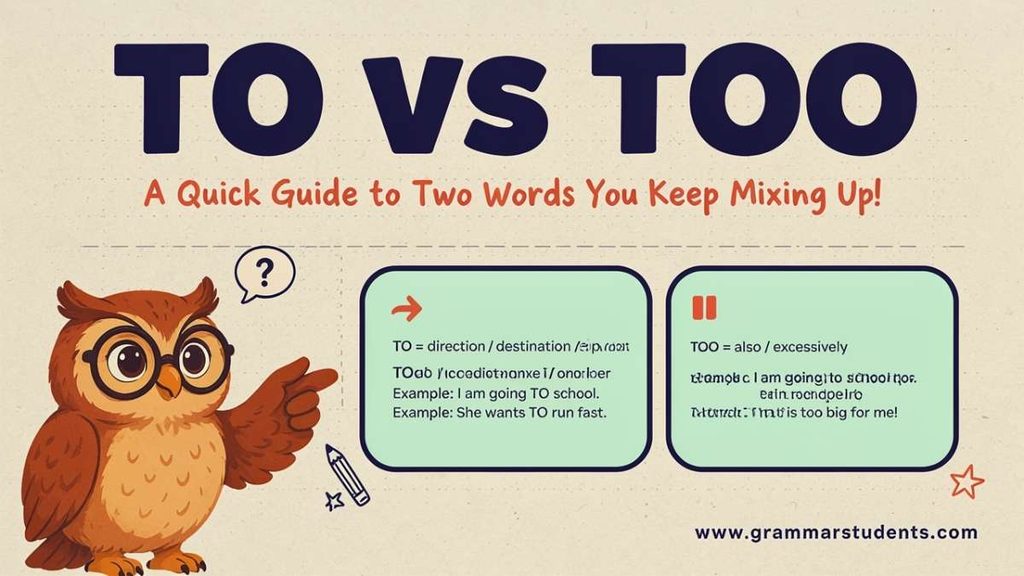
To or Too The Quick Answer
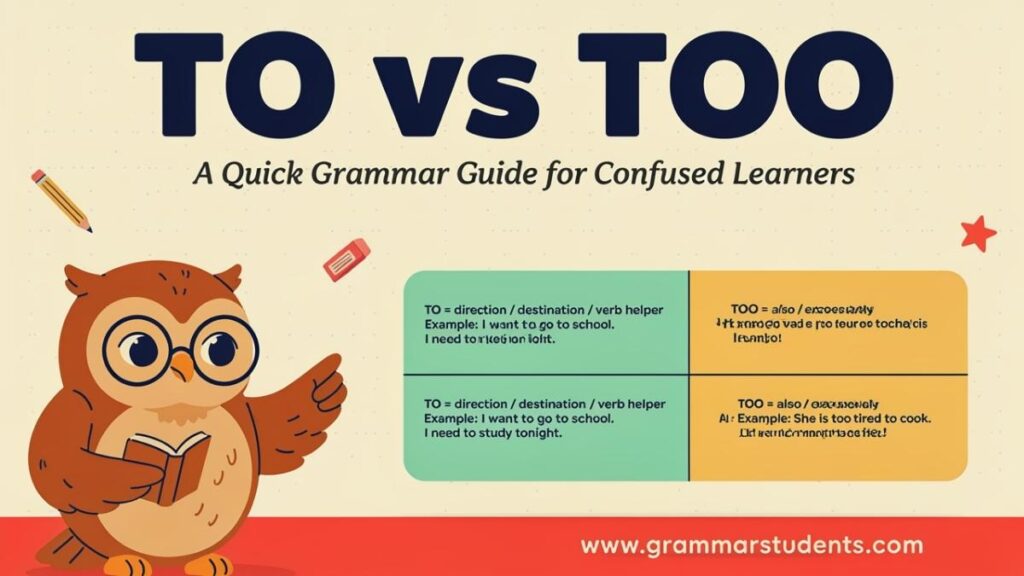
Before diving into the details here’s the short version of the to or too difference:
| Word | Main function | Example |
| to | Direction or destination | We went to school. |
| to | Recipient or connection | Give the book to Maria. |
| to | Infinitive marker | I want to learn. |
| to | Purpose | She called to ask a question. |
| too | Also or as well | I want to come too. |
| too | More than necessary | The coffee is too hot. |
So which is correct to or too The answer depends on what the word is doing in the sentence.
Try these two sentences:
- I want to eat.
- I want dessert too.
In the first sentence to connects want with the verb eat. In the second too adds another idea: the speaker also wants dessert.
That’s the basic to vs too difference in action.
To or Too Meaning What Does To Mean?
The word to has several grammatical jobs. That’s why a simple definition doesn’t cover every situation.
Cambridge describes to as a preposition and also as part of the to infinitive. It can indicate destination, direction a receiver and certain relationships involving time or other expressions.
To Shows Direction or Destination
One major to meaning involves movement toward a place person or destination.
Consider:
- We drove to the airport.
- She walked to the library.
- They moved to Texas.
- He ran to his mother.
- Send the package to my office.
Here, to answers a question such as Where? or Toward whom?
The distinction becomes obvious when you compare it with too:
- We went to the store.
- We went too the store.
The first sentence identifies the destination. The second doesn’t make grammatical sense.
To Introduces an Infinitive Verb
Another major use of to appears before the base form of a verb.
This structure is called the to infinitive:
to + base verb
Examples include:
- to eat
- to sleep
- to study
- to write
- to travel
- to understand
- to improve
In sentences:
- I want to learn English.
- She needs to study tonight.
- They decided to leave early.
- We hope to visit California.
- He plans to apply for the job.
The word after to is the base verb or base form of a verb.
That’s why these sentences are correct:
I want to go home.
She needs to finish her work.
They decided to stay.
Using too would change the grammatical function:
I want too go home.
She needs too finish her work.
The extra o isn’t decorative. It changes the word.
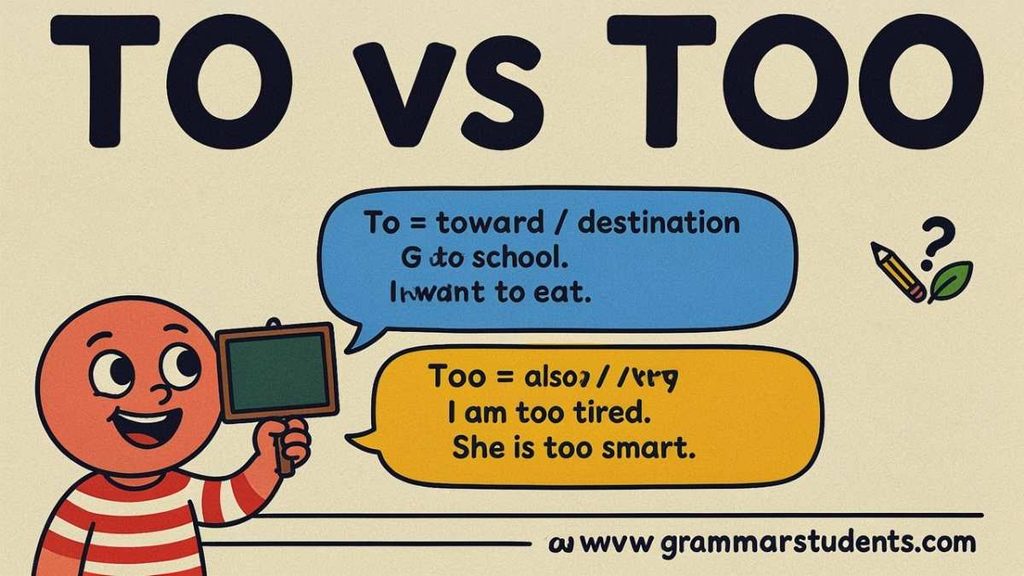
To Can Express Purpose
Sometimes to answers the question Why?
Compare:
- She went outside to get some fresh air.
- I called to ask a question.
- He saved money to buy a car.
- We stopped to take a break.
- They arrived early to prepare the room.
In each example, to + base verb explains the purpose of an action.
You can often mentally replace the structure with in order to.
For example:
She went outside to get fresh air.
means:
She went outside in order to get fresh air.
You don’t need to make that replacement every time. It’s simply a useful way to recognize the purpose structure.
To Shows a Recipient or Relationship
The meaning of to isn’t limited to physical movement. It can also identify the person or thing receiving something.
Examples:
- Give the keys to James.
- She sent an email to her teacher.
- Please explain the problem to me.
- He gave the award to the winner.
- Write to your parents.
Cambridge specifically identifies this recipient use with verbs such as give hand send and write.
The same word can also express relationships:
- the answer to the question
- the key to success
- the solution to the problem
- an invitation to the event
- a response to the email
Here to links one element with another. It doesn’t mean also and it doesn’t mean excessively.
Too Meaning What Does Too Mean?
The too meaning is easier to narrow down because too has two central uses in everyday English.
It can mean:
- also / as well
- more than necessary / excessively
Too Means Also or As Well
When too means also it adds another person thing or idea.
Examples:
- I like pizza too.
- She wants to come too.
- We watched the movie too.
- He speaks Spanish too.
- I need a copy too.
A useful test is to replace too with also.
I like pizza too.
becomes:
I also like pizza.
The wording changes but the basic meaning remains.
That makes also a helpful test when deciding when to use to or too.
Too Means More Than Necessary
The second major use of too indicates excess.
Examples:
- The coffee is too hot.
- This box is too heavy.
- The music is too loud.
- The test was too difficult.
- You’re driving too fast.
Here too doesn’t simply mean very.
It usually means that something has crossed a desirable acceptable practical or necessary limit.
Compare:
The coffee is very hot.
This simply describes a high temperature.
The coffee is too hot.
This suggests that the coffee is hotter than it should be for the situation.
That’s an important piece of to too grammar.
Too Much and Too Many
The word too also appears in quantity expressions.
Use:
- too much with uncountable nouns
- too many with countable nouns
Examples:
| Correct phrase | Example |
| too much | There is too much sugar in the tea. |
| too much | We spent too much money. |
| too many | There are too many people here. |
| too many | She has too many books. |
To vs Too What Is the Difference?
The easiest way to understand the to vs too meaning is to focus on grammatical function.
| Function | Correct word | Example |
| Direction | to | Go to the office. |
| Destination | to | We traveled to Boston. |
| Recipient | to | Give it to her. |
| Infinitive | to | I want to sleep. |
| Purpose | to | I called to help. |
| Also | too | I want one too. |
| Excessive degree | too | It’s too expensive. |
| Excessive quantity | too | There are too many cars. |
The words may sound identical in ordinary speech but their grammatical function is different.
That’s why pronunciation isn’t a reliable test.
Instead ask what the word means in context.
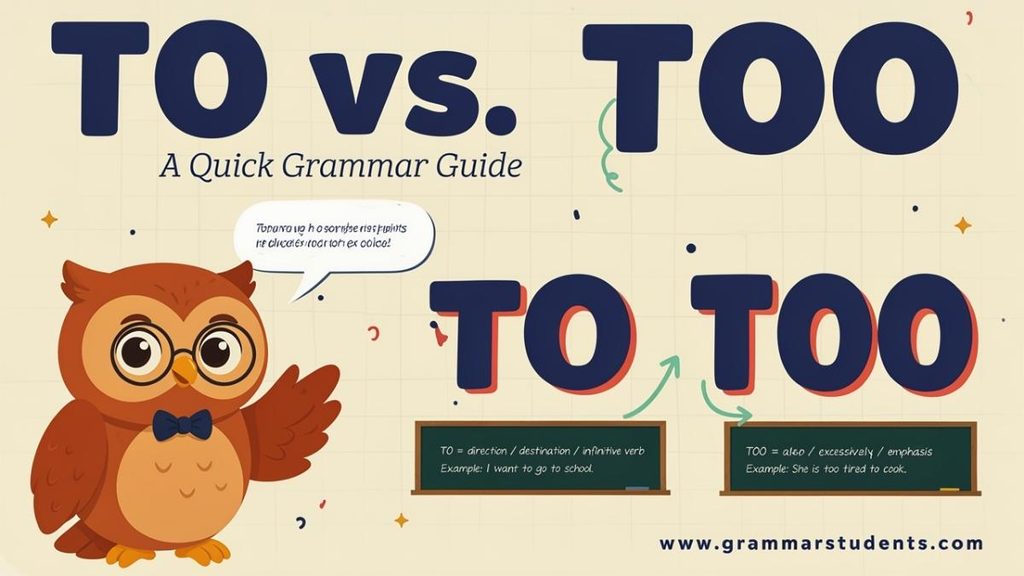
How to Use To and Too A Simple Decision Process
If you hesitate while writing don’t stare at the sentence until the letters start swimming. Use a quick five question test.
Do You Mean Also?
Choose too.
I want to go too.
The sentence means:
I also want to go.
Do You Mean More Than Necessary?
Choose too.
This bag is too heavy.
The weight exceeds what is practical or acceptable.
Does It Show Direction or a Destination?
Choose to.
She went to the bank.
The word identifies the destination.
Does It Come Before a Base Verb?
Choose to when it forms a to infinitive.
I need to study.
They hope to win.
We plan to travel.
Does It Express Purpose?
Choose to.
He went outside to exercise.
The infinitive explains why he went outside.
These checks provide a practical answer to when to use to vs too without requiring you to memorize dozens of disconnected rules.
To or Too Examples You Use Every Day
Real sentences make the to or too difference easier to recognize.
| Incorrect | Correct | Explanation |
| I want too eat. | I want to eat. | To introduces the verb. |
| She went too school. | She went to school. | To shows destination. |
| It is to cold. | It is too cold. | Too means excessively. |
| I like it to. | I like it too. | Too means also. |
| He wants too help. | He wants to help. | To introduces the infinitive. |
| We arrived to late. | We arrived too late. | Too means more late than acceptable. |
These to vs too examples show why spelling alone isn’t enough. You need to identify the word’s job.
To and Too in the Same Sentence
Here’s a useful point that often gets overlooked to and too can appear in the same sentence without competing with each other.
Consider:
I want to go too.
The first word introduces the verb go. The second means also.
Another example:
It’s too late to call.
Here too means more than is appropriate while to introduces the verb call.
More examples:
- She needs to study too.
- I went to the store too.
- It’s too expensive to buy.
- We have to leave too.
- He wants to come too.
These examples of to and too in a sentence are particularly useful because they demonstrate that the correct choice depends on each word’s individual grammatical role.
To Go or Too Go?

The correct phrase is to go when to introduces the verb go.
Examples:
- I want to go home.
- We need to go now.
- It’s time to go.
- She plans to go tomorrow.
Why isn’t toogo correct?
Because too doesn’t function as an infinitive marker.
So:
to + base verb = correct
to go
to eat
to study
to sleep
to work
But:
too go is wrong
This is one of the most common examples people search for when wondering which is correct to or too.
Too Late or To Late?
The correct expression is too late when you mean later than is acceptable or useful.
Examples:
- It’s too late to call.
- We arrived too late.
- You’re too late for the meeting.
- By the time we arrived it was too late.
Here too modifies the adjective late.
Compare:
We went to the meeting.
Here to shows the destination.
So the difference is simple:
- to the meeting = destination
- too late = excessive degree
I Love You Too or I Love You To?
The correct sentence is:
I love you too.
Here too means I also love you.
For example:
Person A: I love you.
Person B: I love you too.
The word to cannot perform this job.
I love you to. is wrong
That version doesn’t express the intended meaning.
This is one of the clearest cases where replacing too with also solves the puzzle
I love you too.
or I also love you.
I Would Love To or I Would Love Too?
The correct phrase is:
I would love to.
Here to belongs to an understood infinitive.
For example:
Would you like to join us?
I would love to.
The verb that follows to is understood from the previous sentence.
You could expand the answer:
I would love to join you.
In this context too doesn’t work because the intended meaning isn’t also. The speaker is accepting an invitation or expressing willingness.
Look Forward To or Look Forward Too?

The correct expression is:
look forward to
Examples:
- I look forward to meeting you.
- We look forward to hearing from you.
- She looks forward to the weekend.
Here’s the interesting grammar point: to in lookforwardto functions as a preposition not the infinitive marker.
That means it can be followed by a noun:
I look forward to your reply.
Or an ing form:
I look forward to meeting you.
This is an important distinction because learners sometimes assume every to + verb related word must be followed by the base verb. That’s not true.
Compare:
I want to meet you.
Here to introduces an infinitive.
But:
I look forward to meeting you.
Here to is a preposition so meeting functions as a gerund participial form.
That small grammatical difference explains many common English mistakes.
Referring To or Referring Too?
The correct expression is:
referring to
Examples:
- What are you referring to?
- She was referring to the earlier email.
- The report is referring to recent research.
Here, to is part of the phrase refer to.
Too doesn’t fit because the sentence isn’t expressing also or excessively.
This is another reminder that to usage depends heavily on context and grammatical relationships.
To and From or Too and From?
The standard phrase is:
to and from
Examples:
- Flights to and from New York are available.
- She travels to and from work every day.
- The bus runs to and from the airport.
The word to marks movement toward a destination. From marks the starting point or source.
We traveled to Chicago from Dallas.
Using too would create a different word with a completely different grammatical role.
Common Mistakes With To and Too
Mistake I Want Too Eat.
Incorrect I want too eat.
Correct: I want to eat.
Why? To introduces the infinitive eat.
Mistake Me To.
Incorrect: Me to.
Correct: Me too.
Why? Too means also.
I like pizza.
Me too.
Mistake It Is To Expensive.
Incorrect: It is to expensive.
Correct: It is too expensive.
Why? Too modifies the adjective expensive and indicates that the price exceeds what is acceptable or affordable.
Mistake I Would Love Too Help.
Incorrect: I would love too help.
Correct: I would love to help.
Why? To introduces the infinitive help.
Mistake: I Love You To.
Incorrect: I love you to.
Correct: I love you too.
Why? Too means also.
Mistake Too Go
Incorrect: I want too go.
Correct: I want to go.
Why? To introduces the base verb go.
Mistake To Late
Incorrect: We arrived to late.
Correct: We arrived too late.
Why? Too modifies late to show an excessive degree.
A Simple Trick to Remember To or Too
Grammar becomes easier when you have a quick mental shortcut.
Too Has an Extra O
Think of the second o in too as a visual reminder of something extra.
- too = also is something extra is added
- too = excessively is the amount goes beyond the limit
This isn’t the historical origin of the word. It’s simply a useful memory trick.
Replace Too With Also
If also works use too.
I want to come too.
or I also want to come.
Replace Too With Excessively
If the sentence describes something beyond a suitable limit too is probably correct.
The box is too heavy.
or The box is excessively heavy.
Look for To + Base Verb
If you see a structure such as:
- to eat
- to read
- to work
- to learn
- to write
you’re often dealing with the to infinitive.
Ask What the Word Is Doing
Use this five-part shortcut:
| Question | Answer | Word |
| Does it show direction? | Yes | to |
| Does it introduce an infinitive? | Yes | to |
| Does it show purpose? | Yes | to |
| Does it mean also? | Yes | too |
| Does it mean excessively? | Yes | too |
That is the simplest practical set of to or too rules to remember.
To and Too in Formal and Informal English
The spelling distinction doesn’t disappear in casual writing.
You still need:
- to in school assignments
- to in professional emails
- too when you mean also
- too when something exceeds a limit
Texting may encourage shortcuts but standard written English still expects the correct word.
Consider a professional email:
I would like to discuss the proposal too.
The first word introduces the verb discuss. The second means also.
Both are correct because they perform different jobs.
To and Too in American English
American English follows the same fundamental distinction between to and too.
There isn’t a separate American spelling rule that makes one replace the other. The grammatical functions remain the same.
In ordinary American English:
- to shows direction or introduces an infinitive.
- too means also or excessively.
A Closer Look at Too vs Very
One subtle point deserves special attention.
Too doesn’t always mean exactly the same thing as very.
Compare:
The room is very small.
This simply describes the room as small to a high degree.
The room is too small.
This suggests that the room is smaller than necessary or suitable for the situation.
The distinction matters:
very = high degree
too = excessive degree
Quick Reference To vs Too
Keep this table handy when you need a fast answer.
| If you mean… | Use | Example |
| Direction | to | Walk to the door. |
| Destination | to | Travel to Miami. |
| Recipient | to | Give it to John. |
| Infinitive | to | Want to learn. |
| Purpose | to | Called to ask. |
| Connection | to | Answer to the question. |
| Also | too | I want one too. |
| As well | too | She came too. |
| Excessively | too | It’s too loud. |
| Excessive quantity | too | There are too many. |
Practice Fill in the Blanks With To or Too
Choose to or too to complete each sentence.
- I want ___ learn English grammar.
- The soup is ___ hot to eat right now.
- She went ___ the library after school.
- I enjoyed the movie ___.
- Please give this book ___ Sarah.
- He is ___ tired to continue working.
- We need ___ finish the project today.
- “Have a great weekend! — You ___!
- They decided ___ visit their grandparents.
- The box is ___ heavy for me to lift.
- I would love ___ join you for dinner.
- My brother wants ___ come with us ___.
- It is never ___ late ___ learn something new.
- She speaks ___ quickly for me ___ understand.
- I hope you are happy ___.
- I love you ___.
- I have ___ much work ___ do tonight.
- He walked ___ the store ___ buy some milk.
- I’m going ___ the party. — Me ___!
- The coffee is ___ hot so I need ___ wait.
- She wants ___ become a teacher ___.
- We arrived ___ late ___ see the beginning of the movie.
- I’m looking forward ___ meeting you ___.
- He gave the letter ___ me ___.
- I want ___ improve my writing ___ so I practice every day.
Answer Key
- to
- too
- to
- too
- to
- too
- to
- too
- to
- too
- to
- to, too
- too, to
- too, to
- too
- too
- too, to
- to, to
- to, too
- too, to
- to, too
- too, to
- to, too
- to, too
- to, too
Here’s a trusted source for clear more words Comparison:
Grammar Update
Frequently Asked Questions About To or Too
What is the rule for too?
Too has two main uses. It can mean also or as well as in I want to go too. It can also mean more than necessary as in The coffee is too hot. If you can replace too with also or excessively too is usually the correct choice.
Is it too late or to late?
The correct phrase is too late. Here too means more than is acceptable or possible.For example It’s too late to change the decision.To late is incorrect in standard English.
Is it I love you too or I love you to?
The correct expression is I love you too. Here too means also. The speaker is returning the same feeling I love you too. The word to cannot perform this meaning.
When should I use too and to?
Use to for direction connection or before a verb in the infinitive We went to school and I want to learn. Use too when you mean also or more than necessary She came too and The bag is too heavy.
Is I too am grammatically correct?
Yes. I too am is grammatically correct when too means also. For example I too am interested in the project. In everyday conversation I am interested in the project too may sound more natural.
Is too late grammatically correct?
Yes. Too late is a standard and grammatically correct phrase. It means something has happened after the acceptable or useful time We arrived too late to catch the train.
Which is correct till death or til death?
Till death is the standard form when you mean until death.Till death do us part is a traditional expression. ’Til is an informal shortened form of until while til without the apostrophe is common in casual writing but is less formal.
What are some examples of using too correctly?
Here are several common uses:
- I want to come too. too means also.
- She was too tired to walk. too means more than necessary.
- The box is too heavy. excessive weight.
- He talks too quickly. excessive speed.
- There are too many people here. more people than appropriate.
- I too agree with the decision. too means also.
Is it I love you too much or I love you to?
The correct phrase is I love you too much. Here too modifies much and means more than is appropriate or desired. For example I love you too much to ignore what happened. The phrase I love you to is incomplete unless to connects to another word or verb.
Do you say I would love too or I would love to?
The correct phrase is I would love to. Here to introduces an implied verb I would love to [go/help/join you]. I would love too would only work if too means also normally with additional context.
When should I say you too?
Say you too when you want to return a wish greeting compliment or similar statement to another person. For example:
Have a wonderful weekend!
You too!
It means I hope you have a wonderful weekend too.
Is I want to or I want too correct?
I want to is correct when another verb follows or is understood. For example I want to travel. The word to introduces the infinitive travel. I want too would mean I want also so it normally requires additional context.
Is it I hope you are too or I hope you are to?
The correct expression is I hope you are too when too means also. For example I’m happy to see you. I hope you are too. The second clause means I hope you are happy to see me too.
Is I love you too or I love you too correct grammar?
Both forms can be correct. The comma in I love you too is often used to set off too because it adds the meaning also. In modern writing I love you too is also widely accepted especially in informal communication. For formal or carefully punctuated writing I love you too is a clear choice.
What can I say instead of I love you too?
The best alternative depends on the feeling and context. You could say:
- I love you as well.
- I feel the same way.
- I love you more than words can say.
- You mean so much to me.
- I feel exactly the same.
If you want a simple natural response I love you too remains the clearest option.
Is it correct to say thank you to you too?
The phrase thank you to you too can be grammatically possible but it often sounds awkward. If someone thanks you and you want to return the thanks Thank you too or Thank you as well is usually more natural.
For example:
Person A: Thank you for helping me.
Person B: Thank you too.
What does it mean when a girl says I love you too?
In ordinary English I love you too means I love you also. The word too shows that the feeling is mutual. The exact emotional meaning however depends on the relationship and context the grammar itself simply indicates that the speaker is expressing the same sentiment.
Conclusion
Mastering to or too doesn’t require a grammar detective badge. You just need to remember what each word is doing in the sentence. To usually shows direction connects ideas or comes before a base verb as in go to school and want to learn. Too means also or more than necessary as in I want to go too and It’s too cold. When these two tiny words start causing big confusion pause and check the meaning. That extra o in too can be your helpful clue. Get this distinction right and you’ll avoid one of English’s smallest but most persistent grammar traps.

Jacob AJS is an experienced blogger and English language enthusiast dedicated to making grammar and vocabulary simple, clear, and practical. As a writer for Grammarstudent, he creates insightful word comparisons, easy-to-follow explanations, and useful examples that help learners avoid common mistakes. His passion is to make English easier to understand while helping readers communicate with confidence, clarity, and accuracy.