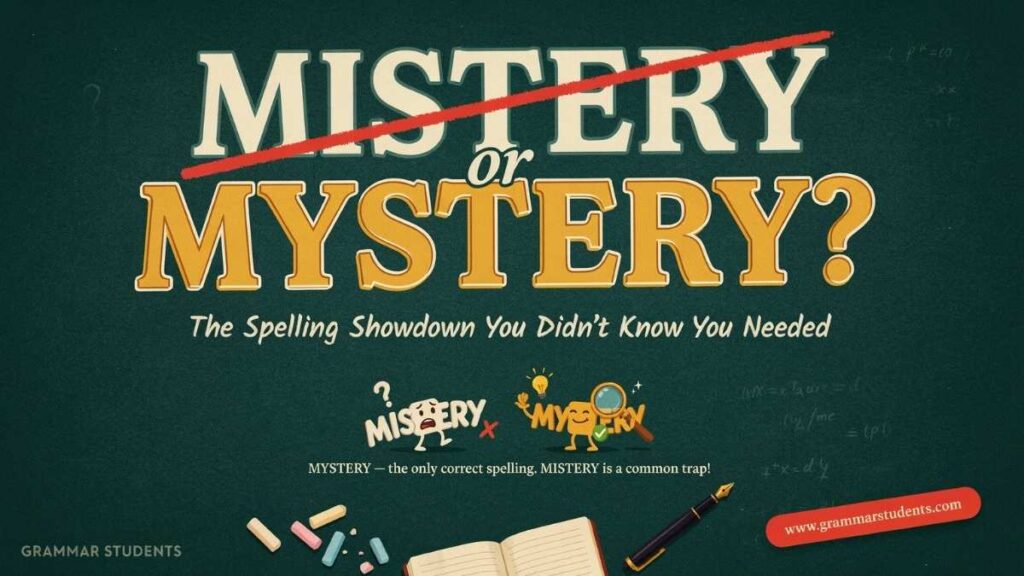
English spelling has a funny habit of making simple words look suspicious. If you’ve ever typed mistery and wondered whether your keyboard was secretly rewriting your thoughts you’re not alone. The confusion around mistery or mystery is common because both versions sound nearly identical when spoken. However only one is the standard modern spelling for something strange unknown or unexplained mystery. In this guide you’ll learn why mystery is correct whether mistery is ever used and how to avoid related spelling mistakes. You’ll also explore meanings examples word forms pronunciation and easy memory tricks too. By the end this spelling mystery won’t be mysterious anymore.
Mistery or Mystery Which Spelling Is Correct?
The correct modern spelling is mystery.
If you mean something that is difficult to explain a secret an unknown situation or a story involving an unexplained crime use mystery.
| Word | Modern usage | Meaning |
| Mystery | Correct | Something unexplained unknown puzzling or secret |
| Mistery | Incorrect for the modern sense | Usually a misspelling of mystery |
| Mistery | Historical/archaic | An older word associated with a trade craft or occupation |
For example:
The disappearance remains a mystery.
Not:
The disappearance remains a mistery.
The spelling mystery contains two important y letters:
M-Y-S-T-E-R-Y
That first y is the one writers often forget.
Why Is Mystery Correct?
Modern English inherited mystery through several historical stages. Etymological records trace the ordinary word through Old French and Latin to Greek mystērion. English records show forms such as misterie in the early 14th century before the word developed its modern spelling and broader meanings.
The modern standard form is therefore mystery not mistery.
Is Mistery a Word?

This question needs a more careful answer than a simple yes or no.
If by is mistery a word you mean Can mistery ever appear in English the answer is yes historically.
If you mean Can I use mistery as the modern spelling of something unexplained the answer is no.
Historical English had a separate mistery meaning handicraft trade or art. Etymological sources connect that form with Medieval Latin misterium related to ministerium meaning service occupation or office.
That historical distinction explains why the statement mistery has never been an English word is too absolute.
For modern writing however the rule is simple:
Use mystery.
Mystery Meaning What Does Mystery Mean?
The mystery meaning changes slightly depending on context but the central idea is something that isn’t fully known understood or explained.
Oxford lists several modern meanings of mystery including something difficult to understand or explain a strange or unknown person or thing the quality of being difficult to explain a story involving crimes or strange events and certain religious concepts.
Mystery as Something Unknown
A mystery can be something unknown.
The origin of the ancient symbol remains a mystery.
Nobody has established a satisfactory explanation. The unknown fact creates the mystery.
Mystery as Something Unexplained
A mystery can also involve something unexplained.
The sudden disappearance of the painting is still a mystery.
The event happened, but its cause or circumstances remain unclear.
Mystery as a Secret
Sometimes a mystery involves information that has been deliberately or unintentionally hidden.
The identity of the anonymous donor remained a mystery.
In this context the person’s identity is unknown.
A secret and a mystery overlap but they aren’t identical. A secret is often information someone deliberately keeps hidden. A mystery may remain unknown simply because nobody has discovered the answer.
Learn the difference between tricky more English words
Lader or Ladder Which One Is Correct
Mystery as a Puzzling Person or Thing
You can call someone or something a mystery when you don’t know much about it or cannot understand it.
Her sudden decision was a complete mystery to me.
Oxford also gives examples such as a mystery guest mystery man and mystery backer.
This explains the common phrase mystery person meaning it generally refers to someone whose identity background motives or circumstances are unknown or intriguing.
Mystery as a Story Genre

A mystery story is built around an unexplained event crime puzzle or secret.
A typical detective mystery may include:
- a crime or unexplained event
- a detective or investigator
- suspects
- clues and evidence
- hidden information
- false leads
- unanswered questions
- a final explanation
The central goal is usually to solve a mystery.
The Origin and History of Mystery
The history of mystery is more interesting than its spelling might suggest.
The modern word traces through Anglo-French and Old French to Latin mysterium which came from Greek mystērion. The original Greek sense involved a secret rite or doctrine known only to initiated people.
English first used the word mainly in religious contexts. By the late 14th century its meaning had expanded to include a hidden or secret thing and a matter whose explanation or cause was unknown. The modern detective story sense appeared much later Etymonline dates that meaning to 1908.
That gives us a useful historical progression
secret religious knowledge or hidden or unexplained matter or mystery story or detective fiction
The spelling also developed over time. Early English forms included misterie which helps explain why modern readers may occasionally encounter older looking spellings.
Avoid everyday grammar mistakes with simple tips
Persuing or Pursuing Meaning Difference and Correct Spelling
The Historical Mistery
The historical story becomes even more interesting because English also had another word spelled mistery.
That word referred to a:
- trade
- craft
- occupation
- art
- professional skill
It came from a different historical source associated with Latin ministerium meaning service or occupation.
This old sense is now archaic. It shouldn’t be used as evidence that mistery is an acceptable modern spelling of mystery.
The distinction can be summarized like this:
Modern mystery: something unknown unexplained puzzling, or secret.
Historical mistery: an archaic term associated with a trade craft or occupation.
That’s an important fact for anyone researching mistery spelling historical texts or English etymology.
Is Mistery British or American English?
Neither.
Mistery is not a British-versus-American spelling difference.
Both British English and American English use mystery as the standard modern spelling.
Is Mistery British English?
No.
If you’re writing in British English use:
The mystery remains unsolved.
Not:
The mistery remains unsolved.
Is Mistery American English?
No.
American English also uses:
mystery
There is no modern American spelling mistery.
Fix common more word mistakes in English
Trialled or Trialed Meaning Difference and Usage
Mystery British vs American Spelling
Unlike color/colour or center/centre or organize/organise this word does not have a standard British American spelling difference.
| Feature | British English | American English |
| Standard spelling | mystery | mystery |
| Plural | mysteries | mysteries |
| Adjective | mysterious | mysterious |
| Adverb | mysteriously | mysteriously |
| Mistery as modern spelling | No | No |
So mystery British vs American spelling is really a case of identical spelling rather than two competing forms.
Mistery vs Mystery Quick Comparison
If you’re in a hurry this table gives you the answer.
| Question | Mystery | Mistery |
| Correct modern spelling? | Yes | No |
| Means something unexplained? | Yes | No |
| Used for a detective story? | Yes | No |
| Used in mystery novel? | Yes | No |
| Used in mystery shopper? | Yes | No |
| British English? | Yes | No |
| American English? | Yes | No |
| Historical English form? | Yes | Yes with another historical sense |
| Plural | mysteries |
The practical rule is easy:
If you mean something mysterious unexplained secret or puzzling write mystery.
Common Mistakes With Mistery and Mystery
Understanding the mistake is often more useful than simply memorizing the correction.
Mistake 1 Writing Mistery Instead of Mystery
Incorrect:
The detective solved the mistery.
Correct:
The detective solved the mystery.
The incorrect form usually results from spelling the word according to its sound.
Mistake 2 Writing Misteries Instead of Mysteries
The plural creates a second common problem.
Incorrect:
Several misteries remain unsolved.
Correct:
Several mysteries remain unsolved.
The singular and plural forms are:
mystery or mysteries
Not:
mistery or misteries
Mistake 3 Confusing Mystery With Mysterious
These words belong to the same word family but they perform different grammatical jobs.
The disappearance is a mystery.
Here mystery is a noun.
The disappearance is mysterious.
Here mysterious is an adjective.
The difference is small in spelling but important in grammar.
Mistake 4 Confusing Mystery With Mysteriously
Mysteriously is an adverb.
Compare these three sentences:
The disappearance is a mystery.
The disappearance is mysterious.
The evidence disappeared mysteriously.
The first names the unknown thing. The second describes it. The third describes how something happened.
Mistake 5 Assuming Pronunciation Reveals the Spelling
English spelling doesn’t always work like a sound to letter conversion system.
The pronunciation of mystery can make the internal spelling less obvious especially in rapid speech. That’s why mistery looks plausible even though it isn’t the standard modern spelling.
When a word has an unusual spelling, visual memory becomes useful.
Mystery Mysterious and Mysteriously What’s the Difference?
These related words form a useful mystery word family.
| Word | Part of speech | Meaning | Example |
| mystery | Noun | Something unknown or unexplained | The case remains a mystery. |
| mysteries | Plural noun | More than one mystery | Several mysteries remain. |
| mysterious | Adjective | Strange unknown or difficult to explain | A mysterious stranger arrived. |
| mysteriously | Adverb | In a mysterious or unexplained way | The document mysteriously vanished. |
Mystery as a Noun
The origin of the artifact is a mystery.
Mysterious as an Adjective
A mysterious message appeared on the screen.
Mysteriously as an Adverb
The message mysteriously disappeared.
Learning these related forms together is much more effective than memorizing isolated spellings.
Understand confusing English more words simply
Slushy or Slushie Correct Spelling Meaning and Usage
What Is the Plural of Mystery?
The mystery plural is mysteries.
This is the answer to the common question what is the plural of mystery?
mystery or mysteries

Examples:
- one mystery
- two mysteries
- several mysteries
- unsolved mysteries
- historical mysteries
Why Does Mystery Become Mysteries?
The noun ends in consonant + y.
English commonly changes the final y to ies in this pattern:
- mystery or mysteries
- story or stories
- city or cities
- family or families
- country or countries
So mysteries spelling follows a familiar English plural pattern.
How Do You Spell Mysteries?
The correct spelling is:
M-Y-S-T-E-R-I-E-S
Incorrect forms include:
- misteries
- mysterys
- mysteris
Correct:
The museum contains several historical mysteries.
Mystery Pronunciation
The mystery pronunciation varies slightly between common English varieties but the word begins with the familiar /ˈmɪst-/ sound.
Oxford lists British pronunciations including /ˈmɪstri/ and /ˈmɪstəri/ while its American English entry gives /ˈmɪstəri/.
The key spelling lesson is simple pronunciation may explain why people make the mistake but it doesn’t change the standard spelling.
If you’re learning how to spell mystery remember the written form rather than trying to reconstruct it entirely from sound.
Mystery in Everyday Sentences
Context makes spelling easier to remember.
Everyday Examples
- The missing keys are still a mystery.
- Her sudden reaction was a mystery to everyone.
- Nobody knows who sent the letter.
- The sender’s identity remains a mystery.
- The cause of the strange noise remains a mystery.
- His decision to leave was a complete mystery.
Formal Examples
- The researchers investigated the mystery surrounding the unexplained event.
- The origin of the artifact remains a mystery.
- Several historical mysteries remain unresolved.
- Investigators collected additional evidence to solve the mystery.
Casual Examples
- It’s a complete mystery to me.
- Why she said that is still a mystery.
- The whole thing is a mystery.
- That’s one of life’s little mysteries.
Learn the difference between confusing more English words
Presence or Presense Which Spelling Is Correct?
Common Expressions With Mystery
Some natural expressions include:
- solve a mystery
- unravel a mystery
- remain a mystery
- a complete mystery
- a mystery to someone
- mystery surrounding something
- shrouded in mystery
- an air of mystery
- mystery person
- mystery guest
- mystery caller
- mystery novel
- murder mystery
Oxford specifically records common patterns such as mystery to somebody mystery about mystery as to an air of mystery and the mystery surrounding.
Mystery in Different Contexts
The word mystery appears in everyday conversation literature entertainment religion and even business.
Mystery in Everyday Conversation
In ordinary conversation mystery usually refers to something you cannot explain or understand.
Why the printer stopped working is a mystery.
No crime is involved. Nobody necessarily expects a detective to arrive with a magnifying glass. The cause is simply unknown.
Mystery in Literature
Mystery in literature is often associated with stories built around unanswered questions.
A mystery novel may introduce a crime disappearance suspicious event or hidden identity and gradually reveal clues.
Readers often try to solve the case alongside the protagonist.
A strong mystery usually balances two competing goals:
- Give readers enough clues to form a theory.
- Withhold enough information to preserve suspense.
That balance is what makes a mystery story satisfying rather than frustrating.
Mystery in Movies
A mystery movie uses many of the same techniques as a novel.
The filmmaker might hide:
- a character’s identity
- the motive behind a crime
- an important piece of evidence
- the truth about a disappearance
- the connection between several characters
The audience receives information gradually.
A good mystery film makes you question what you think you know.
Mystery in Religion
The word also has specialized religious meanings.
Oxford records mysteries as referring to secret religious ceremonies or secret knowledge. It also defines a religious mystery as a belief that cannot be explained or proved scientifically.
For example:
The mystery of creation has been discussed by philosophers and theologians for centuries.
This isn’t a detective mystery. The word refers to a profound question or belief that goes beyond ordinary explanation.
Learn the difference between commonly mixed-up more words
Where or When Difference and Uses
Mystery as an Atmosphere
Mystery can describe a quality or atmosphere rather than a specific problem.
The abandoned house had an air of mystery.
The sentence doesn’t necessarily mean that someone committed a crime there. It means the house feels strange secretive or intriguing.
Mystery Synonym What Words Can Replace It?
A mystery synonym depends on the context.
Possible synonyms for mystery include:
- enigma
- puzzle
- riddle
- secret
- unknown
- conundrum
- uncertainty
- unexplained problem
These words overlap but they aren’t perfect substitutes.
Mystery vs Enigma
An enigma is something puzzling or difficult to understand.
His behavior remains an enigma.
Mystery is more common in everyday English.
Mystery vs Riddle
A riddle is usually a question or puzzle designed to be solved.
The children tried to solve the riddle.
A mystery can be much broader and may involve real events hidden information or a crime.
Mystery vs Secret
A secret is usually information that is intentionally hidden.
The company kept the decision a secret.
A mystery can exist without anyone deliberately hiding information.
The cause of the failure remains a mystery.
Mystery vs Puzzle
A puzzle is something that requires thought or problem-solving.
The unusual pattern presented a puzzle for researchers.
Mystery often carries a stronger sense of secrecy uncertainty or intrigue.
Learn the difference between similar English words
Personel or Personnel The Correct Spelling
What Is a Mystery Box?
A mystery box is a package or container whose contents aren’t revealed before it is opened.
The concept directly uses the ordinary meaning of mystery something unknown.
For example, a seller might offer several possible products inside a box but not tell the buyer which particular item they will receive.
The standard spelling is:
mystery box
Not:
mistery box
What Is a Mystery Shopper?
A mystery shopper is someone who acts as an ordinary customer while evaluating a company’s products services procedures or customer experience.
For example a business may hire a mystery shopper to visit a store and report on:
- customer service
- staff behavior
- product availability
- store conditions
- checkout procedures
- overall customer experience
The shopper’s identity or purpose is kept unknown to the employees being evaluated.
Again, the correct spelling is mystery shopper.
What Does Mystery of Life Mean?
The phrase mystery of life usually refers to profound questions about existence that don’t have simple or universally accepted answers.
Depending on context it may concern:
- the origin of life
- consciousness
- human existence
- the purpose of life
- the nature of death
- the possibility of life beyond Earth
- spiritual questions
For example:
The origin of consciousness remains one of the great mysteries of life.
Here mystery doesn’t mean a detective case. It refers to a deep unanswered question.
Why Do People Spell Mystery as Mistery?
The question why do people spell mystery as mistery has a fairly practical answer: the spelling feels more intuitive than the correct form.
Several factors can contribute to the mistake.
Pronunciation of Mistery or Mystery
People often use sound as a guide when spelling unfamiliar words. The pronunciation doesn’t make the first y especially obvious.
Familiar Spelling Patterns
English contains many common words beginning with mis including:
- mistake
- misread
- misplace
- misunderstand
- mislead
That familiar pattern can make mistery look natural.
Historical Forms

There is another complication. Historical English really did contain forms such as misterie and mistery. That means the incorrect modern spelling isn’t completely invented. It has a genuine historical connection to English although its historical meanings and development differ from the modern standard mystery.
For modern writing don’t let that historical detail create confusion.
Modern standard English mystery.
Learn the difference between tricky grammar words
Many or Meny What’s the Right English Word?
How to Remember the Correct Spelling of Mystery
A simple memory trick can make the spelling stick.
Remember MYST
Break the word into:
MYST + ERY
The opening MYST is the key.
You can also connect it with related words such as:
- mystic
- mystical
- mysteriously
- mysterious
The shared myst pattern reinforces the spelling.
Remember the Word Family
Learn these forms together:
mystery or mysteries or mysterious ormysteriously
When you recognize the family mistery begins to look unusual.
Use a Simple Memory Sentence
Try:
My story has a mystery.
The repeated myst pattern creates a useful visual association.
Another trick is to connect mystery with a question:
A mystery makes you ask why?
That gives the first y a memorable role.
When Should You Use Mystery?
Use mystery when you mean:
- something unknown
- something unexplained
- a secret
- an unanswered question
- a puzzling situation
- a strange person or thing
- an unexplained event
- an unexplained disappearance
- a detective story
- a mystery novel
- a mystery movie
- a religious mystery
- an atmosphere of secrecy or intrigue
Examples:
The cause of the accident remains a mystery.
She enjoys reading mystery novels.
His identity was a mystery.
The old house had an air of mystery.
Detectives worked for months to solve the mystery.
Mystery vs Mistery Common Questions Answered
| Question | Correct answer |
| Mistery or mystery which is correct? | Mystery |
| Is mistery correct? | Not for the ordinary modern meaning |
| Is mistery a word? | Historically yes in an archaic sense |
| Is mystery correct? | Yes |
| What is the correct spelling of mystery? | Mystery |
| How do you spell mystery correctly? | M-Y-S-T-E-R-Y |
| What is the plural of mystery? | Mysteries |
| What is mystery pronunciation? | Commonly /ˈmɪstəri/ in American English |
| Is mistery British English? | No |
| Is mistery American English? | No |
| What is a mystery synonym? | Enigma puzzle riddle secret depending on context |
| What is a mystery person? | Someone whose identity or background is unknown or intriguing |
| What is a mystery box? | A package whose contents are unknown until opened |
| What is a mystery shopper? | Someone who secretly evaluates a customer experience |
Practice Mistery or Mystery
Fill in each blank
- The strange disappearance remains a complete __________.
- The detective finally solved the __________ surrounding the missing painting.
- She enjoys reading __________ novels filled with clues and unexpected twists.
- The reason for his sudden departure is still a __________.
- The old house has a __________ atmosphere that makes visitors curious.
- Scientists are still trying to explain the __________ behind the unusual phenomenon.
- The plural form of mystery is __________.
- The detective investigated several unsolved __________ during his career.
- His behavior was so __________ that nobody could understand his motives.
- The lights in the abandoned building began to flicker __________.
- An __________ is something difficult to understand or explain.
- The correct modern spelling is __________ not mistery.
- The identity of the masked visitor remains a __________.
- Many readers love stories in which detectives solve complex __________.
- The strange message added another layer of __________ to the case.
- Why the machine stopped working without warning remains a __________.
- The word mystery can describe something unknown secret or __________.
- The author created a __________ character whose past was never fully revealed.
- There are several __________ surrounding the ancient artifact.
- The missing evidence made the investigation even more __________.
- A difficult problem that seems impossible to explain can be called an __________.
- The phrase the mystery of life refers to the unanswered questions surrounding human __________.
- If you mean something unexplained do not write mistery write __________.
- The detective carefully followed every clue to uncover the __________.
- The strange events surrounding the abandoned castle remain one of the town’s greatest __________.
Answer Key
- mystery
- mystery
- mystery
- mystery
- mysterious
- mystery
- mysteries
- mysteries
- mysterious
- mysteriously
- enigma
- mystery
- mystery
- mysteries
- mystery
- mystery
- unexplained
- mysterious
- mysteries
- mysterious
- enigma
- existence
- mystery
- mystery
- mysteries
Here’s a trusted source for clear more words Comparison:
Grammar Update
Frequently Asked Questions
Is it spelled mystery or mistery?
The correct modern spelling is mystery. Use mystery for something unknown unexplained secret or difficult to understand. Mistery is not the standard modern spelling for this meaning.
What is a mistery?
In modern English mistery is usually a misspelling of mystery. Historically however mistery appeared as an archaic word associated with a trade craft occupation or professional skill.
What does mistry mean?
Mistry is not the standard spelling of the English word mystery. If you mean something unexplained or puzzling the correct word is mystery.
What is the meaning of mystery in one word?
Enigma is a good one word equivalent for mystery particularly when you mean something puzzling or difficult to understand.
How do you spell mistery?
If you’re referring to something unknown or unexplained the correct spelling is mystery M-Y-S-T-E-R-Y.
What is a fancy word for mystery?
Enigma is perhaps the most natural sophisticated alternative to mystery. Depending on the context conundrum riddle or puzzle may also work.
What is the verb for mystery?
Mystery is normally a noun, not a verb. Depending on your meaning, suitable verbs include puzzle baffle perplex confound conceal or uncover.
Is it mystery or mystery?
Both spellings shown in the question are mystery. There is no spelling difference between them.
What is a mistry?
Mistry is not the standard modern spelling of mystery. If you’re talking about a secret unexplained event puzzling situation or detective story use mystery.
How do you spell mistry?
If you mean the English word for something unexplained spell it mystery not mistry. The correct spelling is M-Y-S-T-E-R-Y.
What does mistry mean in English?
Mistry does not normally mean mystery in standard modern English. It may appear as a proper name or in particular regional contexts so its meaning depends on where you encounter it.
What did mystery mean historically?
Historically mystery was associated with secret religious rites or doctrines. Its meaning later expanded to include something hidden unexplained or difficult to understand. The word eventually developed its modern meanings including the literary sense of a mystery or detective story.
What is called a mystery?
Something is called a mystery when its cause identity explanation or truth is unknown or difficult to discover. An unexplained disappearance for example may be described as a mystery.
What is an example of mystery?
An unexplained disappearance is a straightforward example of a mystery. In fiction a detective investigating a crime by examining clues and suspects is another common example.
What do you call a person who is mysterious?
A person who is mysterious can be described as a mysterious person or an enigmatic person. Enigmatic is especially appropriate when someone’s personality behavior or motives are difficult to understand.
Is mistery a word?
Mistery has historical English usage including an archaic meaning connected with a trade or occupation. It is not, however the standard modern spelling of mystery when referring to something unknown or unexplained.
Is it spelled mistery or mystery?
The correct modern spelling is mystery. A useful way to remember it is to start with MYST M-Y-S-T-E-R-Y.
What are the two types of mysteries?
There is no single official system that divides all mysteries into exactly two types. In detective fiction one useful distinction is between whodunits which focus on identifying the culprit and howdunits which focus on discovering how a crime or event was carried out.
What is a better word for mystery?
The best alternative depends on the context. Enigma suggests something difficult to understand riddle suggests a problem requiring an answer secret emphasizes hidden information and conundrum describes a difficult problem or question.
How do you spell mystery?
The correct spelling is M-Y-S-T-E-R-Y mystery. The word begins with myst not mist.
What is the full name of mystery?
Mystery is already the complete English word. It is a noun while related forms include mysteries as the plural mysterious as the adjective and mysteriously as the adverb.
Conclusion
The spelling mystery is finally solved mystery is the correct modern spelling when you mean something unknown puzzling secret or unexplained. Although mistery may look tempting, especially because it sounds similar when spoken it isn’t the standard spelling for this meaning. Remember the little clue MYST + ERY = MYSTERY. You can also connect it with related words such as mysterious and mysteriously to keep the spelling firmly in mind. So the next time you write about a strange disappearance puzzling question or detective story don’t let mistery sneak into your sentence. Case closed your spelling mystery has been solved!

Jacob AJS is an experienced blogger and English language enthusiast dedicated to making grammar and vocabulary simple, clear, and practical. As a writer for Grammarstudent, he creates insightful word comparisons, easy-to-follow explanations, and useful examples that help learners avoid common mistakes. His passion is to make English easier to understand while helping readers communicate with confidence, clarity, and accuracy.