English spelling has a funny habit of making two words look like twins when they barely know each other. The confusion around emerse or immerse is a perfect example. One missing letter can turn a clear sentence into a grammar mystery. If you have ever paused before typing immerse you are not alone. Many writers wonder whether emerse is a valid alternative a British spelling or simply a spelling mistake wearing a clever disguise. In this guide, we will clear up the confusion explain the meanings and show you how to use each word correctly. By the end, your spelling choices should feel much easier.
Emerse or Immerse Quick Answer
The emerse or immerse correct spelling question becomes easy once you separate the meanings.
| Word | Main meaning | Modern everyday use | Example |
| Immerse | Put completely into liquid or become deeply involved | Common | She immersed herself in her studies. |
| Emerse | Rare/historical form related specialized forms describe rising above water | Very uncommon | Usually avoid it unless the context specifically calls for it. |
| Emersed | Rising or standing above a water surface, especially in botanical usage | Specialized | The pond contains several emersed plants. |
| Emerge | Come out, appear, or become visible | Common | The swimmer emerged from the water. |
Therefore, if the intended meaning is deep involvement or complete submersion immerse is the correct word.
Correct Example
She decided to immerse herself in Spanish culture during her year abroad.
Here, immerse has a figurative meaning. She isn’t literally putting herself underwater. Instead, she’s becoming deeply involved in the language and culture.
Another example uses the literal meaning
Immerse the cloth in warm water before washing it.
Cambridge gives the same two broad senses putting something completely under a liquid and becoming completely involved in something.
Incorrect Example
She decided to emerse herself in Spanish culture.
If the writer means become deeply involved emerse is not the appropriate modern word. The sentence should use immerse.
What Does Immerse Mean?
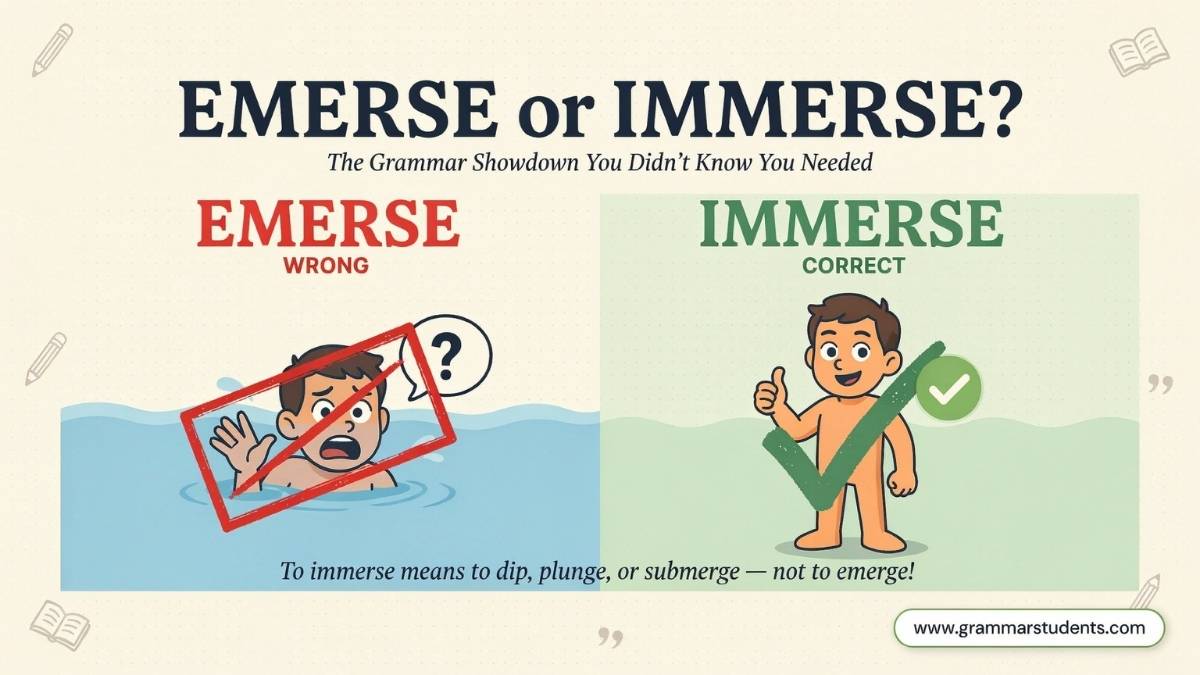
Immerse is a verb that has two closely related meanings:
- To put something or someone completely under the surface of a liquid.
- To involve someone completely in an activity subject environmen or experience.
The first meaning is physical. The second is figurative.
That connection makes sense. If something is completely surrounded by water it is physically deep in that environment. Likewise someone who is completely focused on a subject can be described as immersed in it.
Cambridge defines immerse as both putting something completely under a liquid and becoming completely involved in something.
Immerse in a Literal Sense
The literal meaning involves physical submersion.
For example:
- Immerse the vegetables in boiling water.
- The technician immersed the device in the test solution.
- The researcher immersed the sample in liquid.
- The swimmer was completely immersed in the water.
In each sentence something goes into a liquid and becomes covered by it.
This is why immerse something in water is such a common construction.
Avoid everyday grammar mistakes with simple tips
Amateur vs Amatuer Which Spelling Is Correct
Immerse the object in water for five minutes.
The word doesn’t simply mean touch the water. It normally suggests that the object goes completely under the surface.
Immerse in a Figurative Sense
The figurative meaning is just as common in modern English.
You can immerse yourself in:
- a book
- a language
- a culture
- your studies
- music
- research
- a new subject
- a creative project
- an activity
- a new environment
For example:
After choosing Japanese as her major Maya immersed herself in the language.
Here Maya isn’t physically entering the language. She gives it sustained attention and becomes deeply involved in learning it.
Cambridge specifically recognizes the phrase immerse yourself in something for becoming completely involved in an activity or subject.
Immerse Definition and Meaning in Modern English
The simplest immerse definition is:
To put something completely into a liquid or to become deeply involved in something.
That definition covers both major uses without making the word sound more complicated than it is.
Physical meaning
Immerse put completely under a liquid.
The instructions say to immerse the filter in water.
Figurative meaning
Immerse become deeply involved or absorbed
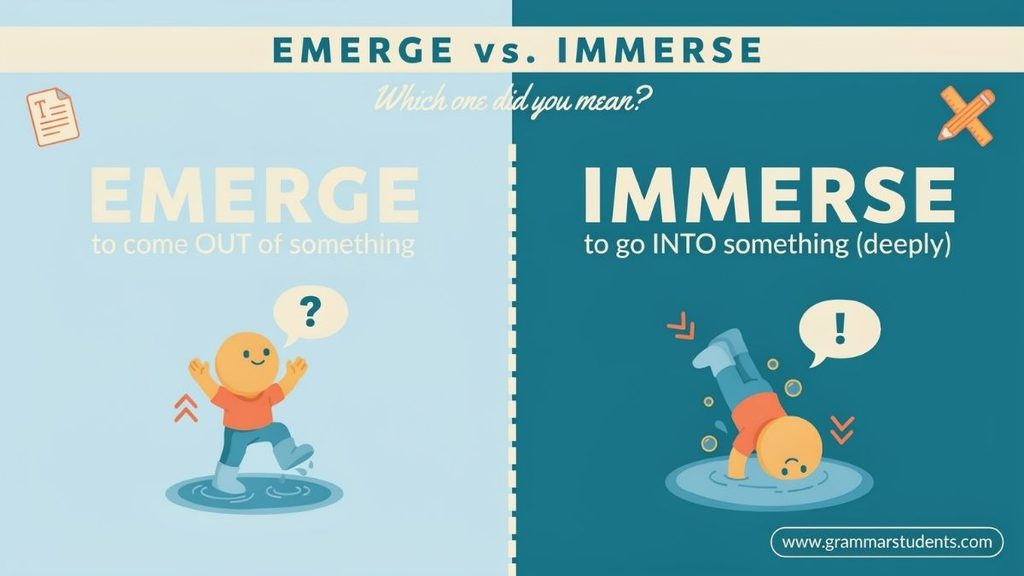
He immersed himself in the research.
The figurative use is especially common in education travel literature entertainment and professional writing.
For example:
Students who immerse themselves in a language often encounter it in many different situations.
The noun immersion carries the same idea. Cambridge defines immersion as complete involvement and also uses it for language learning methods and physical submersion.
What Does Emerse Mean?
The question what does emerse mean needs a more careful answer than simply calling the word wrong.
Emerse has a complicated history. Wiktionary records emerse as an obsolete form of immerse with historical usage dating back to the 19th century.
At the same time related forms such as emersed have specialized scientific and botanical uses. In botany emersed can describe aquatic plants or plant parts that rise above the water’s surface.
That distinction matters.
Calling every appearance of emerse an ordinary spelling mistake would oversimplify the history and specialized terminology. However if you’re writing normal modern English and want to say that someone became deeply involved in something emerse is not the word to use.
Emerse Definition in Context
A historical or rare emerse definition can relate to rising out of a liquid. Specialized forms such as emersed are more recognizable in botanical contexts.
For example, a botanical description may discuss:
emersed leaves
That means leaves that rise above the water rather than remain completely submerged.
So emerse and immerse shouldn’t be treated as two interchangeable spellings.
Emerse or Immerse Meaning The Main Difference
The emerse or immerse meaning difference becomes clearer when you think about direction.
Immerse points into something.
Emersed describes something above or out of a surface especially water in specialized usage.
Compare these
The scientist immersed the sample in water.
The sample went into the water.
The plant had emersed leaves.
The leaves stood above the water.
That is a very different relationship with the water.
For everyday English however another word handles the coming out idea much more naturally emerge.
Immerse vs Emerse Why Are They Confused?
The immerse vs emerse confusion partly comes from their similar appearance.
Both contain the familiar merse sequence and both connect historically with Latin roots involving plunging or rising from a liquid. The resemblance can make the words look like simple spelling variants when they actually have different histories and uses.
Another source of confusion is emerge.
Writers may mentally blend
- immerse
- emerge
- emersion
- immersion
That creates a spelling problem that is easy to understand once the words are placed side by side.
Immerse vs Emerge
The immerse vs emerge distinction is much more important for everyday writing.
| Word | Meaning | Example |
| Immerse | Put into liquid or become deeply involved | She immersed herself in the project. |
| Emerge | Come out appear or become visible | She emerged from the building. |
Cambridge defines emerge as appearing by coming out of something or from behind something.
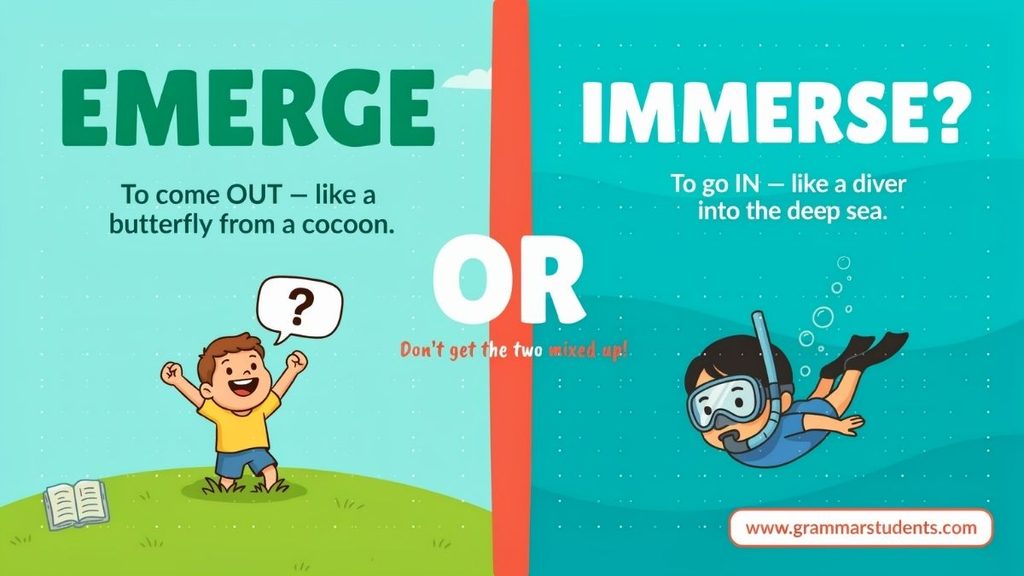
A useful memory trick is:
Immerse go in.
Emerge come out.
The trick isn’t a complete explanation of their etymology, but it can help you remember the modern distinction.
Learn how to use confusing more words correctly
Repast vs Repass Meaning Difference Correct Usage
Emerse vs Immerse Are They Different Spellings?
The emerse vs immerse comparison isn’t simply a case of American English versus British English.
There is no standard US spelling emerse that replaces immerse. American and British English both use immerse for the standard verb.
Cambridge provides both UK and US pronunciations and definitions for immerse confirming its use across the two major English varieties.
| Variety | Standard verb | Example |
| American English | immerse | Immerse the object in water. |
| British English | immerse | Immerse the object in water. |
| Global professional English | immerse | Immerse yourself in the subject. |
So there is no reason to switch to emerse because you’re writing for a British audience.
Emerse or Immerse Correct Spelling in English
If you’re asking for the emerse or immerse correct spelling in English start with your intended meaning.
Use immerse when you mean:
- put something completely into liquid
- submerge something
- become deeply involved
- become fully absorbed
- give full attention to an activity
- involve yourself deeply in a subject or experience
Examples:
She immersed herself in the novel.
The technician immersed the sensor in water.
He immersed himself in learning French.
Use emerge when you mean:
- come out
- appear
- become visible
- come out of water
- become known or apparent
Examples:
The swimmer emerged from the pool.
New evidence emerged during the investigation.
Use emersed only when the specialized context calls for it
For example:
The aquarium contained several emersed aquatic plants.
In this botanical sense, emersed describes growth above the water surface.
How to Use Immerse Correctly
Learning how to use immerse is easier when you remember its common sentence patterns.
This construction describes physical submersion.
The chef immersed the vegetables in boiling water.
The researcher immersed the sample in a chemical solution.
The basic structure is:
immerse + object + in + liquid/substance
Immerse Yourself in Something
This is one of the most useful figurative patterns.
She immersed herself in her studies.
They immersed themselves in the local culture.
He immersed himself in a new language.
I immersed myself in the book over the weekend.
The structure is:
immerse + yourself/themselves/himself/herself + in + subject/activity
Cambridge lists this exact pattern for becoming completely involved in something.
Immerse Someone in Something
You can also use the verb with another person.
The program immerses students in real-world language practice.
The course immerses learners in American literature.
Here, the course or program places learners into an environment where they experience the subject extensively.
Immerse Verb Forms
Immerse is a regular verb so its main forms are straightforward.
| Form | Word | Example |
| Base form | immerse | I want to immerse myself in the course. |
| Third-person singular | immerses | She immerses herself in every project. |
| Past tense | immersed | He immersed himself in research. |
| Past participle | immersed | They were immersed in the activity. |
| Present participle | immersing | She is immersing herself in French culture. |
The immerse past tense is immersed. Cambridge also identifies immersed as the past simple and past participle of immerse.
The immersing meaning simply refers to the present participle form. Depending on the sentence it can describe physically putting something into liquid or becoming deeply involved in something.
Fix common more word mistakes in English
Maxxed or Maxed Which Spelling Is Correct
Immerse in a Sentence Examples You Can Actually Use
If you’re searching for immerse in a sentence the best examples should show different contexts rather than repeat one pattern.
Everyday examples
- I like to immerse myself in a good book after work.
- She immersed herself in the new project.
- They spent the afternoon immersed in conversation.
- He immersed himself in learning to play the guitar.
Academic examples
- The students immersed themselves in their studies before the final exams.
- The researcher immersed herself in the subject for several months.
- The course encourages students to immerse themselves in academic reading.
Cultural examples
- Traveling abroad allowed him to immerse himself in a different culture.
- She immersed herself in the local traditions.
- Living with a host family helped the students immerse themselves in the language.
Physical examples
- Immerse the vegetables in boiling water.
- The instructions say to immerse the object completely.
- The laboratory team immersed the sample in the solution.
These immerse sentence examples show why context matters. The same verb works for physical submersion and deep mental or cultural involvement.
Immerse Examples Literal vs Figurative Use
One of the easiest ways to understand the word is to compare its two major uses.
| Type | Meaning | Example |
| Literal | Put something completely under liquid | Immerse the cloth in water. |
| Figurative | Become deeply involved | Immerse yourself in the language. |
| Literal | Place an object under a solution | Immerse the sample in the liquid. |
| Figurative | Give sustained attention | She immersed herself in research. |
The figurative sense isn’t random. It builds on the physical image of being completely surrounded by something.
When you’re immersed in a book for example your attention is so focused that the book seems to surround your thoughts.
Immersion Meaning and Emersion Meaning
The nouns immersion and emersion can cause another round of confusion.
Immersion meaning
Immersion is the noun associated with immerse.
It can refer to
- physical submersion
- complete involvement
- language learning through extensive exposure
- deep participation in an experience
Cambridge gives both physical and figurative meanings for immersion including language learning.
For example
The program uses language immersion to help students practice English throughout the day.
Emersion meaning
Emersion is much less familiar in general English. Depending on the context, it can relate to emergence from a liquid or the state of coming out from concealment or submersion.
This is another reason not to assume that immersion and emersion are simply alternative spellings.
The spelling difference changes the word and its meaning.
Emersion vs Immersion
The emersion vs immersion distinction follows the same directional contrast.
| Term | General idea | Commonness |
| Immersion | Going into something or becoming deeply involved | Common |
| Emersion | Coming out or emerging from something | Rare/specialized |
The contrast is useful but modern everyday English usually favors emerge when talking about something coming out.
For example most readers will find this natural:
The swimmer emerged from the water.
That sentence is clearer than choosing a rare alternative simply because it appears to form a neat pair with immersion.
Common Mistakes With Emerse and Immerse
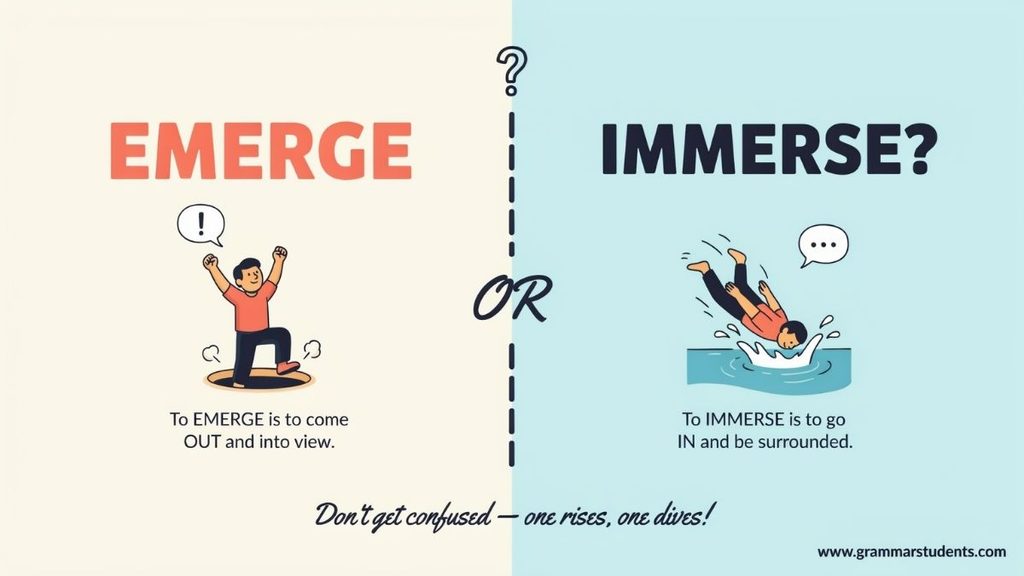
The biggest problems usually come from treating similar-looking words as interchangeable.
Using Emerse Instead of Immerse
This is the most common mistake when the intended meaning is become deeply involved.
Incorrect:
She emersed herself in her studies.
Correct:
She immersed herself in her studies.
The second sentence uses the standard modern verb.
Learn the difference between similar English words
Inact or Enact Which Spelling Is Correct
Confusing Immerse With Emerge
These verbs describe almost opposite movements.
Incorrect:
The swimmer immersed from the pool.
Correct:
The swimmer emerged from the pool.
However:
The swimmer immersed herself in the water.
Here immersed is correct because the meaning is going into the water.
Assuming Emerse Is British Spelling
This is another common misconception.
Immerse is used in both American and British English. There isn’t a British version called emerse. Cambridge lists immerse in both its UK and US dictionary entries.
Confusing Emersed With Immerse
This mistake becomes especially interesting in scientific writing.
Emersed can legitimately describe an aquatic plant that rises above the water.
For example:
The wetland contains submerged and emersed vegetation.
Here emersed is a specialized botanical term not a misspelling of immersed.
That distinction is supported by botanical terminology sources describing emerse/emersed material as rising above or standing out of water.
Immerse vs Submerge
The immerse vs submerge distinction is subtle.
Both can describe putting something under water or another liquid. However submerge strongly emphasizes going below the surface while immerse can also carry the broader figurative meaning of becoming deeply involved.
Compare:
The diver submerged himself in the water.
The student immersed herself in her studies.
The second sentence cannot naturally be replaced with submerged because the meaning is figurative involvement rather than physical movement beneath a surface.
Immerse vs Engage
Immerse and engage overlap when talking about activities but they aren’t always equally strong.
Engage can simply mean taking part or becoming involved.
Immerse suggests a much deeper level of involvement.
Compare:
She engaged with the material.
She immersed herself in the material.
The first suggests active interaction. The second suggests sustained and intensive involvement.
That difference makes immerse useful when you want to emphasize depth.
Immerse Synonyms
The best immerse synonym depends on the context.
For example
- submerge
- dip
- plunge
- sink
- soak
Deep involvement requires
- absorb
- engage
- involve
- engross
- devote
- envelop
When referring to physical submersion
She immersed herself in the subject.
Could become:
She became deeply involved in the subject.
Or:
She devoted herself to the subject.
The words aren’t always perfect replacements. Immerse combines the ideas of depth attention and involvement in a particularly useful way.
Immerse Antonym
An immerse antonym also depends on which meaning you’re using.
For physical submersion, possible opposites include:
- remove
- lift
- extract
- withdraw
For figurative involvement possible opposites include:
- disengage
- withdraw
- detach
- ignore
Emerge can contrast with immerse in contexts involving movement into and out of water. However it isn’t a universal antonym for every figurative use.
For example:
She immersed herself in the project.
The natural opposite might be:
She withdrew from the project.
Not necessarily:
She emerged from the project.
Precision matters more than forcing two words into a perfect opposite pair.
Case Study A Simple Writing Correction
Consider this sentence:
The new employee decided to emerse herself in the company’s training program.
At first glance the sentence looks reasonable because emerse resembles both immerse and emerge.
But the intended meaning is clear: the employee wants to become deeply involved.
Better version
The new employee decided to immerse herself in the company’s training program.
Why does this work?
- Immerse expresses deep involvement.
- herself makes the reflexive construction natural.
- in the company’s training program identifies the area of involvement.
Now compare a physical example:
The technician immersed the component in the testing solution.
The same verb works, but this time it describes physical submersion.
That flexibility explains why immerse appears in everyday academic professional and technical writing.
How to Remember Emerse or Immerse
A simple memory trick can prevent most mistakes:
Immerse go in.
Emerge come out.
Think of a swimmer.
When the swimmer goes underwater the swimmer is immersed.
When the swimmer comes back to the surface the swimmer emerges.
For specialized botanical language remember another form:
Learn the difference between confusing word pairs
Handle or Handel Correct Spelling Meaning and Usage
Emersed above the water.
So you can keep the three ideas separate:
| Word | Mental picture |
| Immerse | Go into |
| Emerge | Come out |
| Emersed | Standing above the water |
It’s a small distinction but it prevents a surprisingly common spelling mistake.
Emerse or Immerse Usage in Everyday Writing
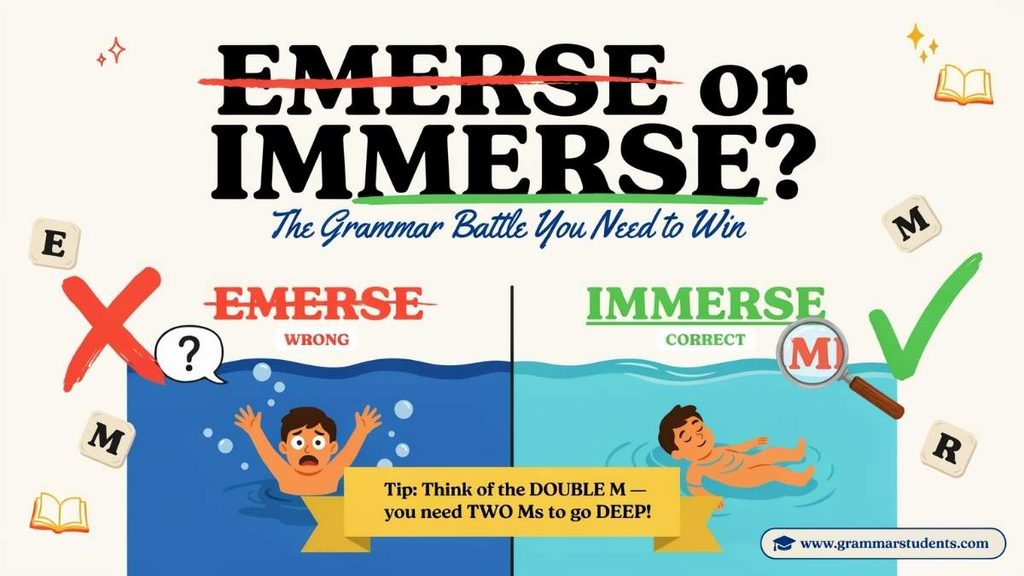
For ordinary writing the safest approach is straightforward.
Use immerse when you’re talking about:
- learning
- studying
- reading
- culture
- travel
- research
- hobbies
- work
- physical submersion
Examples include:
She immersed herself in the new language.
He immersed himself in the research.
Immerse the material in warm water.
They immersed themselves in the local culture.
If the idea is that something comes out, use emerge:
The sun emerged from behind the clouds.
If you’re describing an aquatic plant or another specialized scientific subject, emersed may be appropriate.
This approach keeps your English usage natural without ignoring legitimate specialized vocabulary.
Is Emerse a Word?
The answer to is emerse a word is more nuanced than a simple yes or no.
Historical sources record emerse as an obsolete form of immerse. Meanwhile related scientific terminology uses emersed for things that rise above water particularly aquatic vegetation.
So, is emerse a real word It has documented historical and specialized connections but that doesn’t make it a normal replacement for immerse in modern everyday English.
If you’re writing a standard email essay article or general website content and mean become deeply involved, choose immerse.
Is Emerse Correct?
The answer to is emerse correct depends on the intended context.
If you write:
She emersed herself in the subject.
and mean she became deeply involved in the subject the standard modern choice is:
She immersed herself in the subject.
If you encounter emersed in botanical writing however don’t automatically correct it. Specialized terminology can have meanings that differ from everyday vocabulary.
That distinction is particularly important when editing scientific or technical material.
Is Immerse Correct?
Yes Immerse is the standard modern English verb for both physical submersion and deep involvement.
Cambridge lists it as a verb in both British and American English and provides both meanings.
Examples:
Immerse the brush in water.
She immersed herself in the course.
They immersed themselves in the local culture.
So if you’re asking is immerse correct the answer is straightforward yes.
Emerse or Immerse Which Is Correct?
So, emerse or immerse which is correct?
For ordinary modern English immerse is the correct choice when you mean:
- put something completely into liquid
- submerge something
- become deeply involved
- become fully absorbed
- give sustained attention to a subject
Use emerge when something comes out or becomes visible.
Reserve emersed for appropriate specialized contexts, particularly botanical descriptions involving growth above water.
The quick rule
Immerse into.
Emerge out.
Emersed above the water in specialized usage.
Once those meanings are separated the emerse or immerse difference becomes much easier to remember.
Emerse or Immerse Final Comparison
| Feature | Immerse | Emerse | Emerge | Emersed |
| Standard everyday verb | Yes | No | Yes | No |
| Physical liquid meaning | Yes | Historical/rare | Can mean come out | Specialized |
| Figurative deep involvement | Yes | No | No | No |
| Means come out | No | Rare/historical association | Yes | Not generally |
| Botanical use | No | Related forms | Sometimes | Yes |
| Common in modern English | Yes | Very rare | Yes | SpecializedPractice Session Emerse or Immerse Fill in the Blanks |
Practice Session Emerse or Immerse
Fill in the Blanks
- The correct spelling for becoming deeply involved in something is ________.
- She decided to ________ herself in learning French.
- Please ________ the cloth completely in warm water.
- The noun form of immerse is ________.
- He became fully ________ in his research project.
- The standard expression is immerse yourself ________ something.
- The word ________ means to come out, appear, or become visible.
- A plant that rises above the surface of the water may be described as ________.
- Immersion generally describes going ________ or becoming deeply involved.
- Emersion refers to coming ________ or rising above a surface.
- She was completely ________ in the book and forgot about the time.
- The teacher encouraged students to ________ themselves in the language.
- If you mean put completely under a liquid use ________ rather than emerse.
- The past participle of immerse is ________.
- Immerse yourself ________ the experience is the standard construction.
- The word immersed can describe someone who is deeply ________ in an activity.
- Emerse is a rare or historical word while emerge is common in ________ English.
- The swimmer was completely ________ in the water.
- Language ________ involves extensive exposure to and use of a language.
- The opposite idea of physical immersion can involve ________ from the water.
- She immersed herself in her studies means she became deeply ________ in them.
- The words immerse and emerge have different ________ and should not be used interchangeably.
- A simple way to remember the difference is immersion means going ________, while emersion means coming out.
- He was ________ in his work all afternoon means he was deeply involved in it.
- If you want to describe something coming out of water emerge is usually more appropriate in ________ everyday English.
Answer Key
- Immerse
- Immerse
- Immerse
- Immersion
- Immersed
- In
- Emerge
- Emersed
- In
- Out
- Immersed
- Immerse
- Immerse
- Immersed
- In
- Involved
- Modern
- Immersed
- Immersion
- Emerging
- Involved
- Meanings
- In
- Immersed
- Modern
Here’s a trusted source for clear more words Comparison:
Grammar Update
FAQs About Emerse or Immerse
What does emerse mean?
Emerse is a rare or historical word associated with coming out of a liquid or rising above a surface. In modern everyday English emerge is the usual word for appearing or coming out. The related word emersed is also used in botanical contexts for plants or parts of plants that rise above the water.
What does immerse mean?
Immerse means to put something completely under a liquid or become deeply involved in something. For example Immerse the fabric in water describes physical submersion while She immersed herself in her studies describes deep involvement.
How do you spell immerse in English?
The correct spelling is immerse I-M-M-E-R-S-E. It begins with imm followed by erse. If you mean to put under a liquid or to become deeply involved immerse is the standard spelling.
What is the difference between emersed and immersed?
Emersed describes something that rises above or stands out of water particularly in botanical and scientific contexts. Immersed means completely covered by or placed under water or another liquid. It can also mean deeply involved in an activity or experience.
Which is more commonly used mmerse or emerge?
Immerse and emerge are both standard English words but they have completely different meanings. Immerse means to put something under a liquid or become deeply involved while emerge means to come out appear or become visible. They are not interchangeable.
How do you use immerse in a sentence?
Use immerse when describing complete physical submersion or deep involvement. For example She immersed herself in learning Spanish. This means she became deeply involved in learning the language.
What is another word for immerse myself?
Depending on the context, alternatives include involve myself engage myself absorb myself devote myself and engross myself. For example I immersed myself in the project could become I devoted myself to the project.
What is the difference between immersion and emersion?
Immersion refers to going into or being completely covered by something, especially a liquid. It can also mean deep involvement in an activity or environment. Emersion refers to coming out of or rising above something particularly a liquid. A simple way to remember the distinction is immersion going in and emersion coming out.
Is immerse yourself in or immerse yourself into correct?
Immerse yourself in is the standard and more natural expression. For example Immerse yourself in the language means to become deeply involved in learning or experiencing it. In most standard contexts use in rather than into after immerse yourself.
What is another word for immersed?
Depending on the context, synonyms for immersed include absorbed ngrossed involved engaged, submerged and deeply involved. For example He was immersed in the book can be rewritten as He was engrossed in the book.
What is the opposite of immerse?
The opposite depends on the intended meaning. For physical submersion, emerge can express the idea of coming out of a liquid. For deep involvement, words such as disengage withdraw detach, or step away may provide the opposite meaning.
What is the simple meaning of immerse?
The simple meaning of immerse is to put something completely into a liquid or become completely involved in something. In everyday language it can describe either going fully under something or becoming deeply involved in an experience.
What is the noun form of immerse?
The main noun form of immerse is immersion. It can refer to physical submersion or deep involvement in an activity subject language or culture. For example Language immersion gives students extensive exposure to the language.
Conclusion
The emerse or immerse confusion may look like a tiny spelling problem but one letter can send your sentence in a completely different direction. For everyday English immerse is the word you need when you mean putting something into liquid or becoming deeply involved in an activity subject, or experience. Emerge meanwhile means to come out or become visible. The related word emersed has specialized uses especially in botanical writing. So before your grammar checker starts raising an eyebrow remember the simple rule immerse means go in while emerge means come out. Once you know that difference this spelling puzzle becomes much easier to handle.

Jacob AJS is an experienced blogger and English language enthusiast dedicated to making grammar and vocabulary simple, clear, and practical. As a writer for Grammarstudent, he creates insightful word comparisons, easy-to-follow explanations, and useful examples that help learners avoid common mistakes. His passion is to make English easier to understand while helping readers communicate with confidence, clarity, and accuracy.