Words can be sneaky little troublemakers, especially when two spellings look almost identical. If you have ever paused before typing inact or enact you are certainly not alone. One tiny letter can turn a correct sentence into a grammar head scratcher. So, inact or enact which spelling is correct In standard modern English, enact is the word you normally need. It means to formally establish a law, rule, or policy, and it can also mean to perform or act out something. Inact is not normally used for these meanings. This guide clears up the confusion, explains the difference, and shows you exactly when to use each word correctly.
Inact or Enact Which Spelling Is Correct?
If you are writing about legislation, government policy, rules, regulations, or a performance, enact is the standard modern choice.
The short answer is enact.
For example:
- The legislature voted to enact the new law.
- The government plans to enact stricter safety regulations.
- The actors will enact a scene from the novel.
- The organization adopted and enacted a new policy.
By contrast, writing inact when you mean enact will generally look like a spelling error to a modern reader.
| Word | Modern standard use | Typical meaning |
| enact | Yes | Make a law or rule official; put something into effect; perform |
| inact | Rare/historical | Appears in older English and Scots records |
| inactive | Yes | Not active |
| inactivate | Yes | Make something inactive |
| deactivate | Yes | Turn off or disable something |
This distinction is more useful than simply memorizing one is right and one is wrong. The word inact has historical evidence behind it, but modern writers should not treat it as an interchangeable spelling of enact. Oxford’s entry specifically identifies inact as a former spelling or form in the history of enact.
Enact vs Inact at a Glance
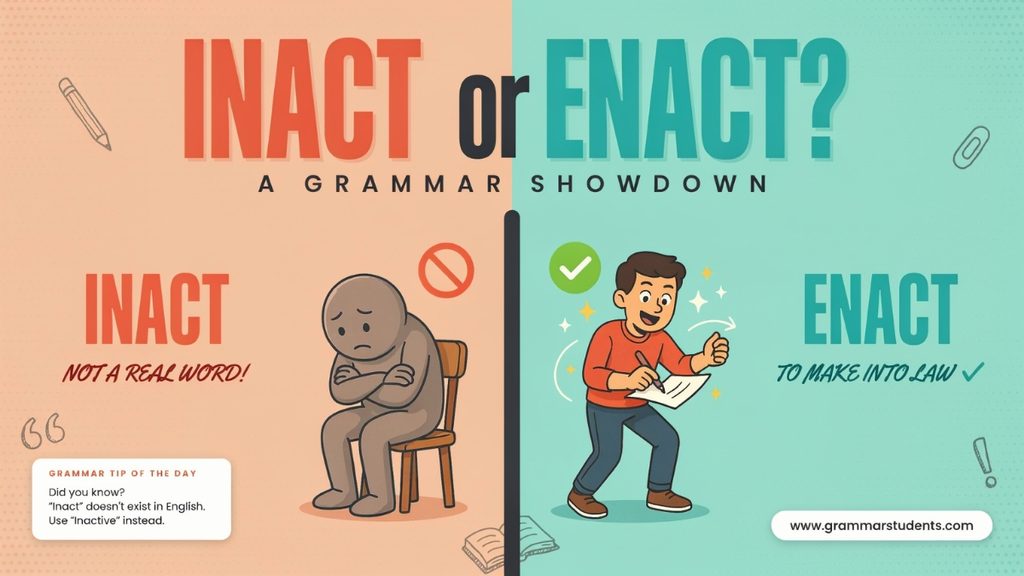
The enact vs inact question becomes much easier when you separate modern usage from historical usage.
| Point | Enact | Inact |
| Standard modern English | Yes | No, not as the ordinary equivalent of enact |
| Common today | Yes | No |
| Make a law | Yes | Not the normal modern choice |
| Put something into effect | Yes | Not the normal modern choice |
| Perform a scene or role | Yes | Not the normal modern choice |
| Historical usage | Yes | Yes |
| Related modern word | Enactment | Inactive/inactivate may cause confusion |
| Recommended in ordinary writing | Yes | No |
So if the question is should I use enact or inact, the answer for contemporary writing is straightforward choose enact when that is the meaning you need.
The historical existence of inact explains why the spelling isn’t completely mysterious. It does not change the modern recommendation.
What Does Enact Mean?
The basic enact meaning is connected to putting something into action or making something official.
Cambridge gives two major modern meanings. In legal use, enact means to put something into action, especially to make it law. In formal performance-related use, it means to perform a story or play.
That gives us two main uses.
Enact Meaning in Law
In legal and governmental writing, enact commonly means to formally make a law.
For example:
Congress enacted the legislation after months of debate.
Here, enacted does not merely mean that lawmakers discussed the proposal. It indicates that the legislation was formally made law.
You will often see the verb used with:
- law
- legislation
- statute
- regulation
- policy
- rule
- measure
- provision
For example:
- The legislature enacted a law protecting consumer data.
- The government enacted regulations for workplace safety.
- Lawmakers enacted legislation addressing the issue.
- The agency enacted new rules governing the process.
Cambridge’s Business English Dictionary similarly defines enact in legal contexts as making a law or rule become official.
Learn the difference between often confused words
Amateur vs Amatuer Which Spelling Is Correct
Enact Meaning Put Into Effect
The word can also have a broader sense to put something into action or practice.
That can include an idea, policy, solution, or measure.
For example:
The organization enacted a new strategy to improve customer service.
In this sentence, the word focuses on moving an idea from paper into actual practice.
Oxford lists this broader sense as put something into practice,” with examples involving enacting solutions.
Enact Meaning Perform
Here’s where the word takes an interesting turn.
Enact can also mean to perform a story, scene, role, or event. Cambridge lists this as a formal performance-related meaning.
For example:
The students enacted a scene from the play.
Or:
The performers enacted the historical event for the audience.
The connection is easy to see. In both major meanings, something moves from an idea, plan, text, or proposal into an actual action.
Enact Definition and Part of Speech
The basic enact definition is:
Enact is a verb meaning to make something official or effective, especially a law, or to perform something such as a story, scene, or role.
It is a transitive verb in its common uses, meaning it normally takes an object.
Compare:
- The legislature enacted the law.
- The government enacted the regulation.
- The actors enacted the scene.
The word has several useful forms:
| Form | Example |
| enact | They will enact the law |
| enacts | The statute enacts new protections |
| enacted | The legislature enacted the bill |
| enacting | Lawmakers are enacting new regulations |
| enactment | The enactment of the law took place later |
Oxford lists enact, enacts, enacted, and enacting as the standard verb forms.
Enact in a Sentence
Here are several natural examples:
- The state plans to enact a new law.
- Congress enacted legislation to address the problem.
- The company enacted a policy requiring stronger passwords.
- The school enacted new rules for laboratory safety.
- The actors enacted a famous scene from the play.
Notice something important: enact does not always belong in a sentence just because something is being done. It has a more specific sense than the everyday verb do.
What Does Enacted Mean?
If you are wondering about the enacted meaning, the answer is simple: enacted is the past tense and past participle of enact.
So:
The legislature enacted the law.
means the legislature formally made the law.
The word also appears in passive constructions:
The law was enacted in 2025.
Here, the sentence emphasizes the law rather than the lawmakers.
Enact vs Enacted
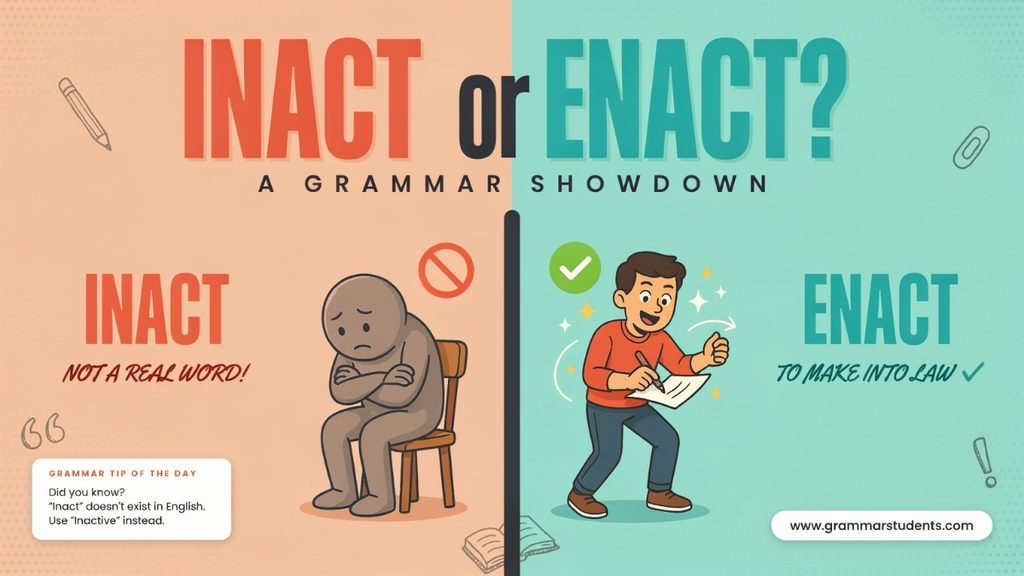
The difference is grammatical rather than mysterious:
- Enact = present or base form
- Enacted = past tense or past participle
Examples:
Lawmakers enact legislation.
Lawmakers enacted the legislation last year.
The legislation was enacted after a lengthy process.
Enacted in a Sentence
Here are a few examples:
- The new safety regulations were enacted last year.
- The legislature enacted the measure after several amendments.
- The policy was enacted across all departments.
- The law had already been enacted when the court reviewed the case.
Cambridge identifies enacted as the past simple and past participle of enact.
What Is the Legal Meaning of Enact?
The enact legal definition centers on formally making legislation or a rule effective.
In ordinary legal language, enact a law means to formally pass or establish it as law through the relevant legislative process.
However, legal systems differ. The exact steps between a bill’s introduction and its becoming law depend on the jurisdiction. That’s why enact should not be treated as a technical synonym for every stage of lawmaking.
For general writing, think of it this way:
A proposal is an idea Legislation is the formal text enactment is the process by which it becomes law.
Cambridge defines enactment as the act of putting something into action, especially making something law.
Enact a Law Meaning
The phrase enact a law means to formally make a proposed law part of the legal system through the appropriate process.
For example:
The legislature enacted a law requiring clearer product labels.
This doesn’t simply mean lawmakers talked about the proposal. It indicates formal legislative action.
The phrase enact a law meaning is therefore closely connected to make law, put into legal effect, and legislate, although these expressions are not identical in every legal context.
Enactment The Noun Form of Enact
Once you know enact, its noun form is easy enactment.
An enactment can refer to the act or process of making something law. It can also refer to a performance or dramatic representation. Cambridge recognizes both meanings.
For example:
The enactment of the new regulations changed the industry.
And in a theatrical context:
The historical enactment attracted hundreds of visitors.
The word family therefore looks like this:
| Word | Meaning |
| enact | Make official or perform |
| enacted | Made official or performed in the past |
| enacting | Making official or performing |
| enactment | The act or process of enacting |
| reenact | Perform or reproduce again |
| reenactment | A reproduction or performance of something that happened earlier |
Is Inact a Word?
Now we reach the tricky part.
If you search is inact a word the safest answer needs a little nuance.
Inact does have historical evidence. It isn’t accurate to claim that nobody ever used the word.
Oxford’s entry for enact says the word dates to late Middle English and notes that it was formerly also found as inact. Oxford connects the word with en and in plus act.
The Dictionary of the Scots Language also records inact as a verb, with historical examples from the 1600s. Its recorded meanings include entering a statute into an official record and enacting, ordaining, or decreeing something.
That’s an important distinction.
Learn the difference between commonly misused words
Repast vs Repass Meaning Difference Correct Usage
Is Inact Correct in Modern Standard English?
If you mean Can I use inact today instead of enact the answer is generally no.
Modern standard English uses enact for the meanings most people have in mind.
Writing:
The government will inact the new law.
would normally be treated as an error.
Write:
The government will enact the new law.
The historical record doesn’t change the modern spelling recommendation.
Inact Historical Meaning
Historical dictionaries show that inact had real uses.
The Dictionary of the Scots Language records inact as a verb associated with official records, statutes, decrees, fines, and obligations. Its examples date from the 1600s.
So the statement inact never existed goes too far.
A more accurate explanation is:
Inact is a historical or rare form found in older records, but it is not the standard modern spelling to use when you mean enact.
That distinction gives readers a better understanding of English than a simple red-pen correction.
Why Do People Confuse Inact and Enact?
The difference between enact or inact is partly a spelling problem and partly a word formation trap.
English contains many words beginning with in and en and their meanings don’t always follow a neat mathematical pattern.
Then inactive enters the picture.
The Inactive Trap
Consider these words:
- active
- inactive
- activity
- inaction
- inactivate
Because inactive means not active it can seem logical to invent a verb called inact meaning make inactive.
But English doesn’t always build words that way.
The established verb is inactivate.
The technician inactivated the old account.
You can also use deactivate:
The administrator deactivated the account.
You generally should not create inact simply by removing the ending from inactive.
The Prefix Trap
Another problem comes from assuming that en and in are interchangeable prefixes.
English word formation is shaped by history, borrowing, sound changes, and established usage. A word that looks as though it should exist may not be a standard word at all.
Inact vs Inactive
That’s why the best way to learn enact spelling is to learn the word as a complete unit rather than trying to reconstruct it from active or inactive.
The inact vs inactive confusion deserves special attention because these forms look like they belong to the same family.
They don’t function the same way in modern English.
Inactive is a standard adjective meaning not active or not operating.
Examples:
- The account is inactive.
- The machine remained inactive.
- The volcano has been inactive for centuries.
If you need a verb meaning make inactive use inactivate or deactivate, depending on the context.
| Intended meaning | Better word |
| Make a law official | enact |
| Put a policy into effect | enact or implement |
| Make something inactive | inactivate |
| Turn off or disable something | deactivate |
| Describe something that isn’t active | inactive |
This distinction solves a surprisingly large number of spelling mistakes.
Inact vs Inactivate
The inact vs inactivate question is really a question about meaning.
Suppose you are writing about an online account.
Incorrect:
The administrator will inact the account.
Better
The administrator will inactivate the account.
Or:
The administrator will deactivate the account.
Now suppose you’re writing about legislation.
Correct:
The legislature will enact the law.
The words may look related on the page, but they perform different jobs.
Enact vs Act What’s the Difference?
The enact vs act distinction is another useful piece of the puzzle.
Act is a broad verb. It can mean to do something, behave in a particular way, or perform a role.
Enact is more specific.
In legal contexts, enact refers to formally making a law or rule official. In performance contexts, it can mean to perform or act out something.
For example:
The legislature enacted the law.
versus:
The legislature acted on the proposal.
These sentences aren’t identical.
The first describes formal enactment. The second simply says the legislature took some action.
In legal terminology, an Act can also refer to a formal body of law enacted by a legislature. Cornell’s Legal Information Institute explains that an Act in legislation is a formal body of law enacted by a legislature.
Enact vs Implement
People sometimes use enact and implement as if they’re interchangeable. They aren’t always.
Enact often emphasizes formally establishing something, especially a law or rule.
Implement emphasizes carrying something out in practice.
Consider:
The legislature enacted the policy.
This focuses on formally establishing it.
Now:
The agency implemented the policy.
This focuses on putting that policy into practical operation.
A simple way to remember the difference is:
Enact = establish or make official.
Implement = put into practice.
The two processes can happen at different stages.
Enact vs Enforce
The difference becomes even clearer with enforce.
To enact a law is to formally establish it.
To enforce a law is to make sure people follow it.
For example:
The legislature enacted a new traffic law.
Later:
Police departments enforced the traffic law.
One creates the legal rule. The other concerns compliance with it.
This is why enact synonyms such as enforce should be used carefully. A synonym can overlap with a word without being interchangeable in every sentence.
Learn the difference between confusing word pairs
Maxxed or Maxed Which Spelling Is Correct
Enact Synonym Which Words Actually Work?
The best enact synonym depends on the meaning.
When Enact Means Make Law
Possible alternatives include:
- legislate
- pass
- establish
- institute
- adopt legislation
- make law
Example:
The legislature enacted the bill.
Depending on the legal context, you might instead say:
The legislature passed the bill.
But passed and enacted aren’t necessarily identical at every stage of a legislative process.
When Enact Means Put Into Effect
Possible alternatives include:
- implement
- establish
- introduce
- put into effect
- bring into force
- institute
Again, context matters.
When Enact Means Perform
Possible alternatives include:
- act
- perform
- portray
- dramatize
- represent
- act out
For example:
The actors enacted the historical scene.
could become:
The actors performed the historical scene.
That substitution works because the performance sense is intended.
Enact vs Inact in Real Sentences

The easiest way to master enact or inact examples is to see the words in context.
Correct Examples With Enact
The government plans to enact new regulations.
Congress voted to enact the legislation.
The company enacted a policy requiring employees to use stronger passwords.
The school enacted new rules for laboratory safety.
The actors enacted a scene from the novel.
Incorrect Modern Uses With Inact
The government will inact the law.
Use:
The government will enact the law.
Another example:
The company decided to inact a new policy.
Use:
The company decided to enact a new policy.
If you actually mean that the company is turning something off:
The company decided to deactivate the system.
Or:
The company decided to inactivate the account.
The right replacement depends on what you mean.
How to Use Enact Correctly
If you’re unsure about the correct use of enact, look at the object that follows it.
Natural combinations include:
- enact a law
- enact legislation
- enact a statute
- enact regulations
- enact rules
- enact a policy
- enact a measure
- enact a provision
- enact a solution
- enact a scene
- enact a role
Enact a Policy
For example:
The organization enacted a new remote-work policy.
The sentence says the policy was formally put into effect.
Enact Regulations
The agency enacted new regulations for workplace safety.
The phrase works naturally in formal writing.
Enact Rules
The board enacted new rules for membership.
Again, the focus is on formally establishing the rules.
Enact a Scene
The students enacted a scene from the historical drama.
Here, enact has nothing to do with legislation. It means to perform.
British English vs American English Enact or Inact
There is no standard American-versus-British spelling split in which Americans use enact while British writers use inact.
Enact is the standard modern spelling in both varieties.
Cambridge lists the same pronunciation for UK and US English and defines the word in both varieties.
So if you’re wondering is inact British English don’t use regional English as an excuse to choose it.
Historical usage is a different matter. Older English and Scots records contain inact, and Oxford notes the former spelling.
That’s history, not a modern American or British spelling preference.
Common Mistakes With Enact and Inact
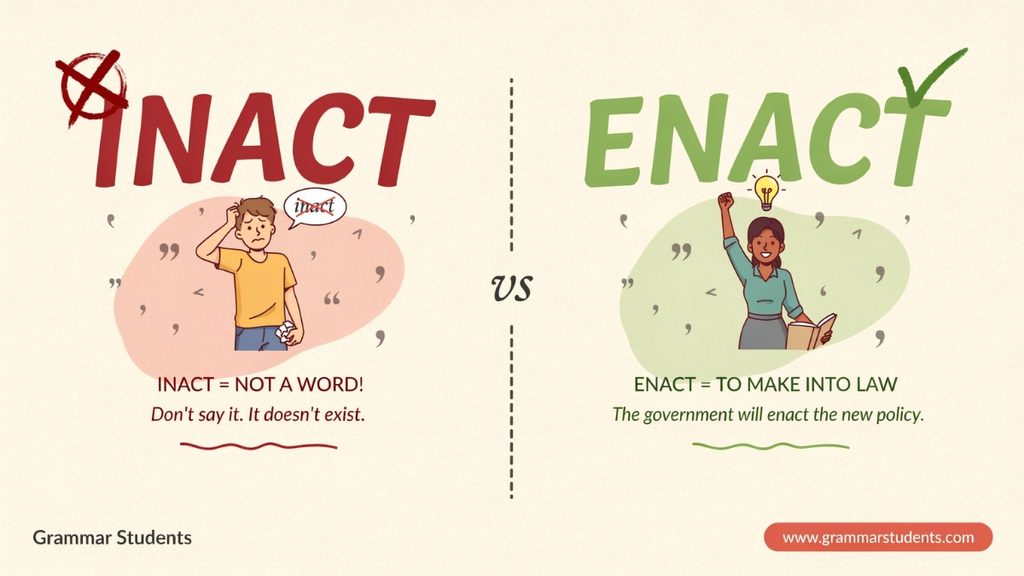
Mistake Writing Inact a Law
This is the most common error.
Wrong:
The government will inact a law.
Correct:
The government will enact a law.
Mistake Thinking Inact Means Make Inactive
It may look logical, but modern English already has inactivate and deactivate.
Wrong:
The administrator will inact the account.
Better:
The administrator will deactivate the account.
Mistake Treating Inact as the Opposite of Enact
Inact is not simply the opposite of enact.
The historical word has its own history and recorded uses. Modern English doesn’t use inact as a routine antonym for enact.
Mistake Assuming Every Prefix Creates a Valid Word
English is full of tempting patterns.
You might think:
active vs inactive vs inact
But word formation doesn’t work like a Lego set where every combination is automatically valid.
Established vocabulary wins.
How to Remember the Correct Spelling
Here’s a simple memory trick.
Think Enact and Put Into Action
The word contains act.
Think:
en or act or put into action
That isn’t a complete explanation of the word’s historical development but it is a useful memory aid for modern spelling.
Remember the Word Family
Connect these forms:
- enact
- enacted
- enacting
- enactment
- reenact
- reenactment
When you see enacted or enactment, the spelling becomes easier to recognize.
Keep Inactive in Its Own Lane
Remember:
inactive = not active
inactivate = make inactive
enact = make official, put into effect, or perform
That three-way distinction is much safer than trying to make inact fit somewhere it doesn’t normally belong.
Enact Word Family
The enact word family provides useful clues when you’re writing.
| Word | Part of speech | Meaning |
| enact | Verb | Make official, put into effect, or perform |
| enacts | Verb | Present-tense third-person form |
| enacted | Verb | Past tense/past participle |
| enacting | Verb form | Present participle |
| enactment | Noun | Act or process of enacting |
| reenact | Verb | Perform or reproduce again |
| reenacted | Verb | Performed or reproduced again |
| reenactment | Noun | Reproduction or performance of an earlier event |
Cambridge confirms enactment as both a law-related and performance related noun.
A Practical Case Study One Letter Changes the Meaning
Imagine that a company is writing a policy announcement.
A first draft says:
The company will inact a new data-security policy next month.
The reader may understand the intended meaning, but the wording creates a problem. Inact is not the standard modern form for this purpose.
The corrected version is:
The company will enact a new data-security policy next month.
Now imagine a different situation. The company wants to turn off an old user account.
The sentence becomes:
The company will deactivate the old account.
Not enact Not inact.
This tiny comparison demonstrates why spelling and meaning work together:
| Intended meaning | Correct choice |
| Make a policy official | enact |
| Make an account inactive | inactivate |
| Turn off an account/system | deactivate |
| Describe an account that isn’t active | inactive |
One misplaced letter can send the sentence in the wrong direction.
Quick Guide Should You Use Enact Inact?
- make a law
- establish legislation
- make a rule official
- put a policy into effect
- establish a measure
- perform a scene
- perform a role
- act out a story
inactivate vs deactivate
- make something inactive
- disable something
- turn off a system
- stop an account from operating
Don’t use inact as a routine modern substitute for enact.
That single rule will solve most inact or enact questions.
Final Comparison Inact or Enact

The inact differ enact confusion becomes much less troublesome once you separate modern usage from historical evidence.
| Question | Answer |
| Which spelling should you normally use today | Enact |
| What does enact mean | To make something official/effective or perform something |
| Can you enact a law | Yes |
| Can you enact legislation | Yes |
| Can you enact a policy | Yes |
| Can you enact a scene | Yes |
| Is inact the normal modern equivalent | No |
| Has inact existed historically | Yes |
| Is inactive a verb | No, it is normally an adjective |
| What verb means make inactive | Inactivate or deactivate |
| What is the noun form of enact | Enactment |
| Is enact used in US and UK English | Yes |
Practice Questions Session
- The legislature voted to ________ a new environmental law.
- The government plans to ________ stricter safety regulations next year.
- The actors will ________ a famous scene from the historical drama.
- The new policy was ________ after months of debate.
- The committee hopes to ________ the proposed rules soon.
- The word ________ is not normally used in standard modern English to mean not active.
- The agency will ________ the new regulations after receiving official approval.
- The machine became ________ after it remained unused for several months.
- Lawmakers worked together to ________ legislation addressing workplace safety.
- The students were asked to ________ a scene from the play.
- The newly ________ law introduced several important changes.
- If you mean not active the correct adjective is ________.
- The city council voted to ________ new parking regulations.
- The historical event was ________ by actors during the school performance.
- The legislature has the authority to ________ laws within its jurisdiction.
- The company decided to ________ a new workplace policy.
- The old account remained ________ for more than a year.
- The bill was eventually ________ into law after the required approval process.
- The director asked the performers to ________ the final scene more dramatically.
- The government intends to ________ regulations designed to protect consumers.
- The noun form of enact is ________.
- The formal creation of a law is called its ________.
- The word ________ should not be used simply as the opposite of enact.
- The new rule was ________ to address a growing safety concern.
- To formally establish a law, the correct verb is ________.
Answers
- enact
- enact
- enact
- enacted
- enact
- inact
- enact
- inactive
- enact
- enact
- enacted
- inactive
- enact
- enacted
- enact
- enact
- inactive
- enacted
- enact
- enact
- enactment
- enactment
- inact
- enacted
- enact
Here’s a trusted source for clear more words Comparison:
Grammar Update
Frequently Asked Questions
Is inact a word?
Inact does appear in some historical and specialized dictionary records, but it isn’t a standard word for everyday modern English. If you mean to make something official, use enact. If you mean not active use inactive.
Is inact correct?
Generally no In standard modern English, enact is the correct word when you mean to make a law official, establish a policy or rule, or perform something. For the meaning not active use inactive instead.
What does enact mean?
Enact is a verb with two main uses. It can mean to formally establish a law, policy, or rule. It can also mean to perform or act out a scene, role, or event.
What is the difference between enact and inact?
Enact is the standard modern English word. It can refer to formally establishing legislation or performing something. Inact isn’t normally used as its opposite. When you mean “not active,” the appropriate word is usually inactive.
What does enact mean in law?
In legal and legislative contexts, enact means to formally establish a bill, measure, or proposal as law through the required legislative process. An enacted measure becomes part of the applicable body of law once the necessary legal requirements are completed.
Can you say enact a law?
Yes enact a lawis a standard and widely used expression. It means to formally establish a proposed measure as law.
Example:
The legislature enacted a new law to improve workplace safety.
What is the noun form of enact?
The main noun form is enactment. It refers to the act or process of enacting something and can also refer to legislation that has been formally enacted.
What is another word for enact?
The best synonym depends on the context. For laws and legislation, alternatives include legislate, pass, establish, adopt and institute. When enactmeans to perform something, suitable alternatives include act, perform, portray and dramatize.
What does enacted mean?
Enacted is the past tense and past participle of enact. In legal writing, it usually means that a law, measure, or provision was formally approved and established through the required process.
How do you use enact in a sentence?
Use enact when discussing the formal creation of laws, policies, or rules, or when describing a performance.
Examples:
- The government plans to enact a new policy.
- Lawmakers voted to enact the legislation.
- The actors enacted a scene from the historical event.
What is the opposite of enact?
There isn’t one universal opposite because enact has more than one meaning. In a legislative context, repeal can serve as an opposite when a law is formally removed. Depending on the context, abolish, cancel, or withdraw may also work.
What does enacting change mean?
Enacting change means taking practical action to make a proposed change happen. It may involve introducing a policy, changing rules, implementing a plan, or taking concrete steps to achieve a specific result.
Is enact used only for laws?
No Although enact commonly appears in legal and legislative writing, it also has a theatrical meaning. For example, actors can enact a scene, enact a role, orenact an event by performing or portraying it.
What is the difference between enact and implement?
Enact generally means to formally establish something, especially a law or policy. Implementmeans to put an established decision, policy, plan, or law into practical operation.
For example, lawmakers may enact a law, while government agencies may implement the law.
What is the difference between enact and enforce?
Enact means to formally establish a law or rule. Enforce means to ensure that people follow and comply with that law or rule.
For example, a legislature can enact a law, while an authorized agency can enforce it.
Is enact used in American and British English?
Yes enactis a standard English verb in both American and British English. Its spelling remains enact in both varieties.
What is the easiest way to remember enact?
Think of enact as meaning make something official or act something out The word commonly appears in two settings establishing laws or policies and performing scenes or roles.
Should I use inact or enact?
For standard modern English, use enact when you mean to formally establish a law, policy, rule, or measure, or when you mean to perform something. Don’t use inact simply as the opposite of enact. If you mean not active use inactive instead.
Conclusion
When it comes to inact or enact the spelling choice is easier than it first appears. Enactis the standard modern English word you should use when you mean to formally establish a law, rule, or policy, or to perform a scene or role. Inact may appear in some historical or specialized sources, but it is not the normal choice in everyday English. And if you mean not active reach for inactive instead. One little letter may cause the confusion, but now you know the fix. So, before inact sneaks into your sentence, give it a polite wave good bye and choose enact when that is the meaning you need.

Jacob AJS is an experienced blogger and English language enthusiast dedicated to making grammar and vocabulary simple, clear, and practical. As a writer for Grammarstudent, he creates insightful word comparisons, easy-to-follow explanations, and useful examples that help learners avoid common mistakes. His passion is to make English easier to understand while helping readers communicate with confidence, clarity, and accuracy.