English can be wonderfully confusing especially when two words look almost identical but leave you wondering which one belongs in your sentence. If you’ve ever paused while writing and thought Wait is this even a word you’re not alone. Inconsolable or Unconsolable Which Is Correct is a common grammar and word choice question that can trip up even careful writers.
The good news is that the difference becomes much easier to understand once you know how each form works.In this guide you’ll learn their meanings spelling pronunciation usage and common mistakes with simple examples to help you choose the right word confidently.
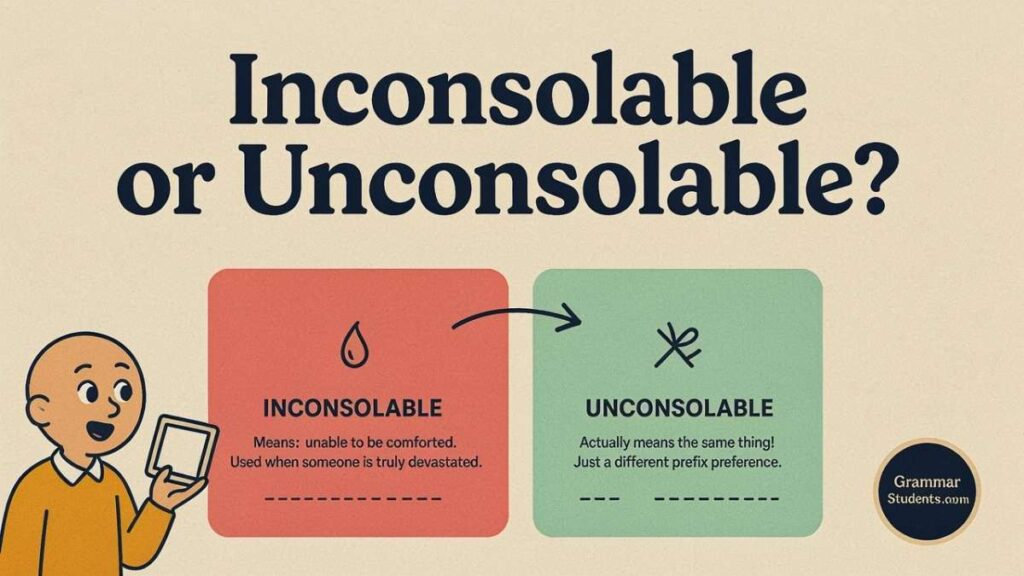
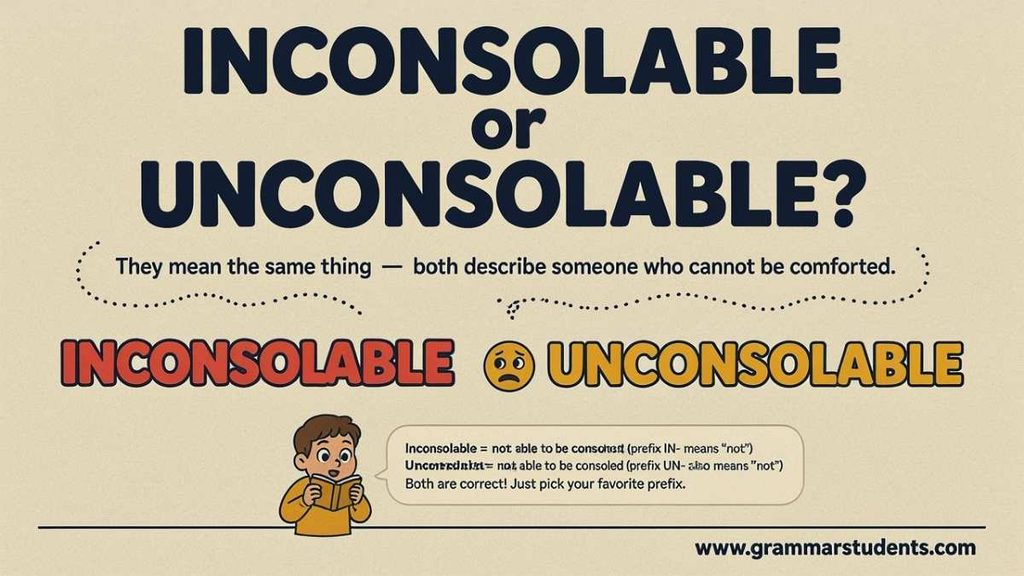
Inconsolable or Unconsolable Which Is Correct?
The important difference is their frequency and conventional usage.
| Word | Meaning | Usage |
| Inconsolable | Unable to be comforted or consoled | More common and preferred |
| Unconsolable | Unable or difficult to be comforted | Recognized but less frequent |
| Inconsolably | In an inconsolable manner | Standard adverb |
| Consolable | Able to be comforted | Opposite concept |
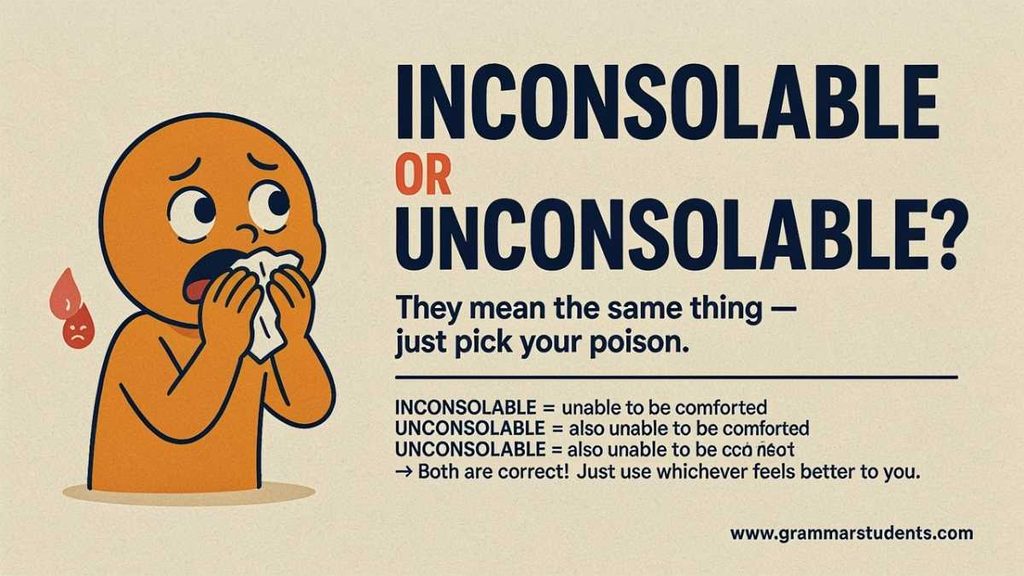
Therefore inconsolable is usually the better choice when you want the most familiar and widely accepted form.
That doesn’t make unconsolable meaningless or automatically incorrect. It simply isn’t the form most readers are likely to encounter.
What Does Inconsolable Mean?
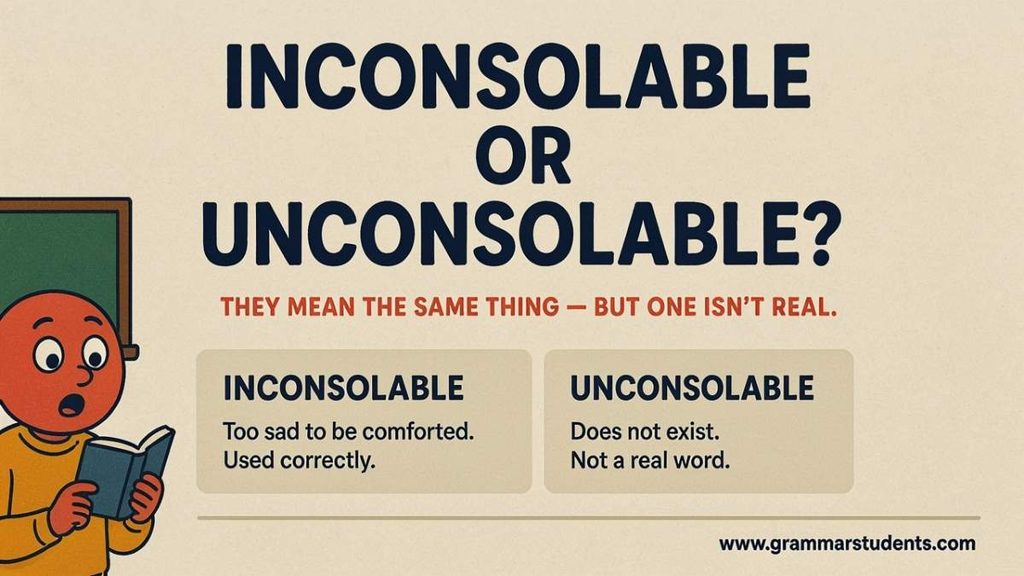
Cambridge defines inconsolable as being so sad or disappointed that it is impossible for someone to make the person feel better.
In simple English
The word describes a very strong emotional state.The word suggests intense sadness grief sorrow or emotional distress.
For example:
After hearing the news she was inconsolable.
This sentence tells us more than simply saying she was sad. It suggests that her emotional pain was overwhelming and that ordinary attempts at comfort weren’t helping.
Inconsolable Definition
You can summarize the definition of inconsolable as follows:
Inconsolable Unable to find comfort or calm because of intense sadness, grief, disappointment, or distress.
It’s an adjective so it normally describes a person emotion or emotional condition.
Common expressions include:
- inconsolable grief
- inconsolable sadness
- inconsolable sorrow
- an inconsolable child
- an inconsolable parent
- remain inconsolable
- become inconsolable
- seem inconsolable
Learn the difference between tricky more English words
Amateur vs Amatuer Which Spelling Is Correct
What Does Unconsolable Mean?
The unconsolable meaning is almost identical to inconsolable.
Unconsolable describes someone who is unable or difficult to comfort or console. The American Heritage Dictionary recognizes the word and defines it as impossible or difficult to console.
For example:
The child seemed unconsolable after losing her favorite toy.
The sentence is understandable and grammatically sound.
So if you’re wondering is unconsolable a word? the answer is yes.
And if you’re asking is unconsolable a real word? the answer is also yes.
The more useful question is whether it is the preferred form. In most modern contexts inconsolable is the safer and more familiar choice.
Inconsolable vs Unconsolable What’s the Difference?
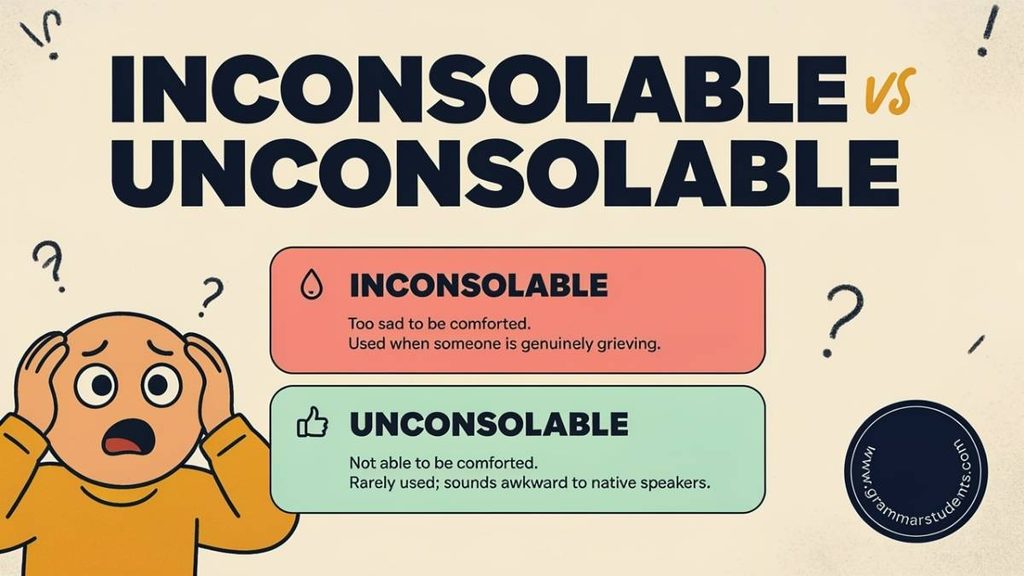
The main difference between inconsolable vs unconsolable isn’t their basic meaning. It’s their frequency and established usage.
Oxford lists unconsolable as a less frequent form of inconsolable.
That gives us a useful distinction:
- Inconsolable common established and preferred
- Unconsolable recognized but less frequent
This is why the question is unconsolable correct can be confusing. The answer isn’t simply yes or no.
If you’re writing an academic paper professional article school assignment or general interest piece inconsolable is the better default.
If you encounter unconsolable in a book article or other English text however there’s no need to assume it is a spelling mistake.
Is Inconsolable Correct?
Yes. Inconsolable is a standard English adjective.
If you’re searching is inconsolable correct the answer is definitely yes.
Major dictionaries define inconsolable as someone who cannot find comfort or consolation. People commonly use the word in both American and British English.
The correct spelling of inconsolable is:
inconsolable
Its spelling becomes easier to remember when you recognize its relationship with the word console.
Think of the word family this way:
console or consolable or inconsolable
The verb console means to comfort someone.Consolable describes someone who can receive comfort, while inconsolable describes someone who cannot easily find comfort.
Is Unconsolable Correct?
Yes, but there’s an important qualification.
Unconsolable is a recognized English adjective but it is less frequent than inconsolable.
Oxford lists it as a less frequent form while the American Heritage Dictionary also recognizes it.
So if someone asks is unconsolable correct a precise answer is:
Yes people recognize it but inconsolable remains the more common and preferred form.
That explanation is more accurate than simply calling unconsolable wrong.
Why Is Inconsolable Correct?
If you’re wondering why is inconsolable correct its history provides part of the answer.
Oxford traces inconsolable to Latin inconsolabilis.
The word combines in meaning not with the idea of receiving consolation. English speakers developed the word through established usage rather than simply adding a modern negative prefix.
This is an important lesson about English word formation a word can look logically constructed without being the conventional form.
For example English has many pairs that follow predictable patterns
- happy or unhappy
- fair or unfair
- able or unable
- clear or unclear
Because of this pattern unconsolable naturally feels right.
But historical development established inconsolable as the more frequent form.
Why Does Unconsolable Sound Correct?
The question why does unconsolable sound correct has a simple answer English speakers are very familiar with the prefix un.
The prefix un commonly expresses negation:
- unhappy
- unfair
- unable
- uncertain
- uncomfortable
- unsuccessful
So when people see:
un + consolable
the meaning seems obvious:
not consolable
And semantically that’s perfectly understandable.
The issue is not logic. It’s conventional usage.
English has many words that could theoretically take different forms but only one form usually becomes common.. That’s why dictionary evidence and real world usage matter when deciding between competing forms.
Inconsolable vs Unconsolable Understanding the Prefixes
The unconsolable vs inconsolable question also gives us a useful lesson in prefixes.
The Prefix In
The prefix in can express negation and occurs in many words derived from Latin or French.
Examples include:
- inaccurate
- incapable
- incomplete
- invisible
- ineffective
- inconsolable
In inconsolable the prefix contributes the sense of being unable to receive consolation.
The Prefix Un
The prefix un is a highly productive English negative prefix.
Examples include:
- unhappy
- unfair
- unclear
- unable
- uncertain
- unconvinced
That’s why unconsolable looks perfectly reasonable.
However a logical construction isn’t automatically the most established form. English usage determines which forms become conventional.
Is Unconsolable a Word or Not?
If you’ve searched is unconsolable a word or not the answer is yes.
Dictionaries recognize unconsolable as an English adjective. Oxford lists it as a less frequent form of inconsolable while the American Heritage Dictionary provides a definition for it.
So the better distinction is:
Inconsolable is more common. Unconsolable is less common but recognized.
This distinction is useful because it avoids an overly strict right versus wrong explanation.
Is Inconsolable a Word?
Yes. Inconsolable is a standard English word.
If you’re asking is inconsolable a word major dictionaries provide clear evidence that it is.
It’s an adjective that describes someone who cannot find comfort or consolation because of deep sadness, grief, or disappointment.
For example:
The grieving family was inconsolable.
The word is especially common when describing emotional reactions to loss or serious disappointment.
Inconsolable Pronunciation
The inconsolable pronunciation differs slightly between American and British English.
Cambridge gives these pronunciations
The main difference is the vowel sound in the stressed middle portion.
The strongest stress falls on the sol syllable.
If you’re learning the word don’t let the spelling intimidate you. Breaking it into syllables and connecting it to console makes the pronunciation easier to remember.
Avoid everyday grammar mistakes with simple tips
Repast vs Repass Meaning Difference Correct Usage
How to Spell Inconsolable
If you’re searching how to spell inconsolable remember the word family:
console or consolable or inconsolable
The correct spelling of inconsolable contains:
- in at the beginning
- consol in the middle
- able at the end
Common misspellings include:
- inconsolible
- inconsoliable
- inconsoluble
- inconsolabale
The ending is able not ible.
How to Spell Unconsolable
The correct spelling of unconsolable is:
unconsolable
The easiest way to remember the unconsolable spelling is:
un + consolable
Keep the complete consolable portion intact.
This also prevents a common spelling mistake in which writers accidentally drop one of the vowels in console.
Inconsolable in a Sentence
Seeing an inconsolable in a sentence example can make the meaning much clearer.
Here are several natural examples:
- She was inconsolable after hearing the tragic news.
- The child became inconsolable when her parents left.
- He remained inconsolable despite his friends attempts to comfort him.
- The family was inconsolable after the unexpected loss.
- She looked inconsolable so her friend stayed nearby.
- His grief left him inconsolable.
The word usually suggests a powerful emotional response rather than mild disappointment.
For example saying:
I was inconsolable when my favorite restaurant closed.
could work as humorous exaggeration.
In a serious context however inconsolable usually suggests much deeper emotional pain.
Unconsolable in a Sentence
You can also use unconsolable in a sentence:
- The child appeared unconsolable after losing the toy.
- She seemed unconsolable after hearing the news.
- He was unconsolable despite everyone’s efforts to reassure him.
- The grieving family was described as unconsolable.
These examples show why unconsolable can be understood naturally.
Still because inconsolable is more familiar to most readers it remains the better default for general writing.
Inconsolably Meaning and Definition
What about inconsolably
The inconsolably meaning is in a manner that cannot be comforted or consoled.
The inconsolably definition can be simplified to:
In a deeply distressed or sorrowful way that cannot easily be comforted.
For example:
- She cried inconsolably.
- The child sobbed inconsolably.
- He wept inconsolably after hearing the news.
Notice the grammatical difference:
She was inconsolable.
Here inconsolable is an adjective.
She cried inconsolably.
Here inconsolably is an adverb describing how she cried.
This distinction is important when you’re trying to avoid a grammar mistake.
Inconsolable vs Consolable
Consolable and inconsolable are closely related opposites.
Consolable means capable of being comforted.
Inconsolable means unable to be comforted.
Consider these examples:
After talking with her family she became consolable.
After receiving the devastating news she remained inconsolable.
The first suggests that comfort was possible. The second emphasizes that comfort wasn’t enough to ease the person’s distress.
WordFamily Table
| Word | Part of speech | Meaning |
| Console | Verb | To comfort someone |
| Consolation | Noun | Comfort given during sadness |
| Consolable | Adjective | Able to be comforted |
| Inconsolable | Adjective | Unable to be comforted |
| Unconsolable | Adjective | Unable or difficult to be comforted |
| Inconsolably | Adverb | In an inconsolable manner |
Understanding this word family makes the spelling and grammar much easier.
Inconsolable vs Distraught
Distraught means extremely upset or emotionally disturbed.
Inconsolable goes a step further by emphasizing that comfort doesn’t seem to work.
For example:
She was distraught after hearing the news.
This tells us that she was extremely upset.
She was inconsolable after hearing the news.
This tells us that her distress was so intense that she couldn’t easily be comforted.
Someone can be distraught without being inconsolable.
Inconsolable vs Heartbroken
Heartbroken usually describes deep emotional pain caused by loss rejection disappointment or the end of an important relationship.
Inconsolable focuses on the inability to find comfort.
For example:
He was heartbroken after the friendship ended.
This emphasizes emotional pain.
He was inconsolable after the friendship ended.
This emphasizes the intensity of the emotional reaction and his inability to be comforted.
The words can overlap but they aren’t exact synonyms.
Learn the difference between confusing more English words
Maxxed or Maxed Which Spelling Is Correct
Inconsolable vs Devastated
Devastated describes someone who is extremely shocked upset or emotionally overwhelmed.
Inconsolable specifically emphasizes that the person cannot easily be comforted.
Compare:
She was devastated by the result.
She was inconsolable after hearing the result.
Both sentences describe a strong emotional response but inconsolable adds the idea that consolation isn’t working.
Common Mistakes With Inconsolable and Unconsolable
Mistake Calling Unconsolable Completely Wrong
This is the most common misconception.
Because inconsolable is much more common, some writers assume that unconsolable isn’t a real word.
Dictionary evidence shows otherwise.
It’s better to describe unconsolable as recognized but less frequent.
Mistake Assuming Un Must Be the Correct Prefix
English learners often reason:
un + consolable = unconsolable
That construction makes sense but English isn’t completely predictable.
Historical usage has established inconsolable as the more common form.
Mistake Using Inconsolable for Every Small Disappointment
The word carries emotional weight.
Someone who is mildly annoyed isn’t necessarily inconsolable.
Using it for a small problem can sound humorous or exaggerated which may be intentional in casual conversation.
Mistake Confusing the Adjective and Adverb
Incorrect
She cried inconsolable.
Correct
She was inconsolable.
Or
She cried inconsolably.
Remember
inconsolable is adjective
inconsolably is adverb
When Should You Use Inconsolable?
Use inconsolable when you want to describe an intense emotional state in which someone cannot easily be comforted.
It works naturally in:
- everyday English
- formal English
- academic writing
- professional writing
- journalism
- fiction
- personal narratives
- essays
Common combinations include:
- inconsolable grief
- inconsolable sadness
- inconsolable sorrow
- an inconsolable child
- an inconsolable parent
- remain inconsolable
- become inconsolable
Because the word is familiar and widely understood, it works well for a broad audience.
Learn the difference between similar English words
Inact or Enact Which Spelling Is Correct
When Can You Use Unconsolable?
You can use unconsolable particularly when you encounter it in a context where the less frequent form fits the writer’s style.
However if you’re making a deliberate word choice for a school assignment article business document or other broadly edited text inconsolable is generally the more natural option.
That’s not because unconsolable has no meaning. It’s because the more established form is already available.
A useful writing principle applies here:
When two words communicate essentially the same idea the more familiar form is often the clearest choice for a broad audience.
A Practical Case Study
Imagine an editor receives these two sentences:
The mother was inconsolable after hearing the news.
The mother was unconsolable after hearing the news.
Both are understandable.
Both describe a mother who cannot easily be comforted.
But an editor writing for a general audience would normally choose inconsolable because it is the more frequent form.
This doesn’t make the second sentence meaningless or automatically ungrammatical.
It simply illustrates an important difference between validity and preference.
A word can be recognized in English without being the form most writers would normally choose.
Why Frequency Matters in English
When people ask whether a word is correct they often imagine a simple two column system:
| Correct | Incorrect |
| Word A | Word B |
Real English is more complicated.
Words can be
- standard
- uncommon
- regional
- archaic
- informal
- literary
- technical
- recognized variants
Inconsolable vs unconsolable is a good example.
The evidence doesn’t require us to pretend that one word exists and the other doesn’t. Instead it shows that inconsolable is the more frequent form while unconsolable is recognized but less common.
That’s a much more useful answer for English learners and writers.
Learn the difference between often confused words
Handle or Handel Correct Spelling Meaning and Usage
Is Inconsolable American or British English?
Inconsolable is used in both American English and British English.
Cambridge provides separate US and UK pronunciations and major dictionaries recognize the word across English varieties.
It isn’t a word that belongs exclusively to one side of the Atlantic.
| English variety | Inconsolable | Unconsolable |
| American English | Standard and common | Recognized less frequent |
| British English | Standard and common | Recognized less frequent |
| Formal writing | Preferred | Less common |
| Everyday English | Preferred | Less common |
So if you’re writing for a US audience inconsolable is completely natural.
Is Unconsolable British or American English?
Unconsolable isn’t restricted to one major English variety.
It is recognized in dictionary sources used for English generally including Oxford and American Heritage.
Therefore it would be misleading to say that unconsolable is exclusively British English or exclusively American English.
The more useful description is simply:
It is a recognized but less frequent form of inconsolable.
What Is the Opposite of Inconsolable?
The closest direct opposite of inconsolable is consolable.
If someone is consolable they can be comforted.
If someone is inconsolable they cannot easily be comforted.
Depending on the context related contrasting words might include:
- comforted
- reassured
- calm
- content
- cheerful
But consolable is the closest direct lexical opposite.
Is Inconsolable an Adjective or Adverb?
Inconsolable is an adjective.
It describes a noun or pronoun:
The child was inconsolable.
Her grief was inconsolable.
The adverb is
inconsolably
For example
The child cried inconsolably.
This is a simple but important grammar distinction.
If you’re writing professionally or academically using the correct form keeps the sentence precise.
Inconsolable Synonyms
There isn’t always a perfect synonym because each word emphasizes something slightly different.
Depending on context, possible alternatives include:
- distraught
- devastated
- heartbroken
- grief-stricken
- sorrowful
- deeply upset
- overwhelmed
- anguished
- miserable
However these words aren’t identical.
For example distraught emphasizes extreme emotional upset while inconsolable emphasizes the inability to be comforted.
Similarly heartbroken often points toward emotional pain caused by loss or disappointment.
Choosing the right synonym depends on what aspect of the emotional state you want to emphasize.
Learn the difference between everyday English mistakes
Emerse or Immerse Correct Spelling and Use
Inconsolable Meaning and Examples
Here are some additional examples to make the distinction practical:
After losing the competition the normally cheerful athlete was inconsolable.
Here the word emphasizes unusually intense disappointment.
The child became inconsolable when her parents left the room.
Here, the focus is on the child’s inability to calm down or accept comfort.
He was inconsolable after receiving the heartbreaking news.
Here the word describes deep emotional distress.
The puppy’s owner was inconsolable after the loss.
Here the word conveys profound sadness.
Practice Sessions Inconsolable or Unconsolable
Fill in the Blanks
- After hearing the heartbreaking news, she was completely ________.
- The child cried ________ after losing her favorite toy.
- The closest opposite of inconsolable is ________.
- ________ is the more common form in modern English.
- His grief was so intense that he seemed ________.
- The family remained ________ after the unexpected loss.
- She sobbed ________ throughout the night.
- Someone who can be comforted is described as ________.
- Unconsolable is a recognized but ________ frequent form of inconsolable.
- The correct spelling is in________able.
- Inconsolable is an ________ that describes someone who cannot easily be comforted.
- The adverb form of inconsolable is ________.
- The verb related to inconsolable is ________.
- The noun form related to console is ________.
- Someone who is inconsolable cannot easily be ________.
- She became ________ after receiving the heartbreaking news.
- The baby cried ________ until her mother comforted her.
- He was extremely upset and appeared ________.
- In formal writing ________ is generally the more familiar choice.
- Inconsolable and unconsolable have very similar ________.
- The word inconsolable describes someone who cannot easily be ________.
- In the sentence She cried inconsolably inconsolably is an ________.
- In the sentence She was inconsolable inconsolable is an ________.
- Someone who is able to receive comfort may be described as ________.
- The phrase crying _______ describes crying so intensely that the person cannot easily be comforted.
Answer Key
- inconsolable
- inconsolably
- consolable
- Inconsolable
- Inconsolable
- inconsolable
- inconsolably
- consolable
- less
- consol
- adjective
- inconsolably
- console
- consolation
- comforted
- inconsolable
- inconsolably
- inconsolable
- inconsolable
- meaning
- comforted
- adverb
- adjective
- consolable
- inconsolably
Here’s a trusted source for clear more words Comparison:
Grammar Update
Frequently Asked Questions
What is another word for inconsolable?
Common synonyms for inconsolable include distraught devastated heartbroken grief stricken anguished and deeply upset. The best synonym depends on the context because each word emphasizes a slightly different kind of emotional distress.
What does it mean when someone is inconsolable?
When someone is inconsolable they are so deeply upset sad or distressed that they cannot easily be comforted. The word often describes intense grief sorrow disappointment or emotional pain.
What is meant by inconsolable?
Inconsolable means unable to be comforted or consoled. It is an adjective used to describe someone experiencing very strong emotional distress.
What is the opposite of inconsolable?
The closest opposite of inconsolable is consolable meaning someone who can be comforted or reassured. Depending on the context words such as comforted calm or reassured may also express the opposite idea.
Which is correct unconsolable or inconsolable?
Inconsolable is the more common and generally preferred form in modern English. Unconsolable is also a recognized word but it is less frequent. For formal or general-purpose writing inconsolable is usually the better choice.
What is the English translation of inconsolable?
Inconsolable already is an English word. It means unable to be comforted because of intense sadness grief disappointment or distress.
How do you use inconsolable in a sentence?
You can use inconsolable as an adjective to describe someone who cannot easily be comforted. For example She was inconsolable after hearing the news.
What is another word for crying uncontrollably?
Depending on the situation, alternatives include sobbing weeping bawling crying hysterically or crying inconsolably. The phrase crying inconsolably specifically emphasizes that the person cannot be comforted.
What is a fancy way to say crying?
More polished alternatives include weeping shedding tears sobbing breaking down or shedding tears of sorrow. In literary writing, weeping is often a simple and elegant choice.
How do I say I’m crying without saying it?
You can describe the action instead of stating it directly. For example:
- Tears streamed down my face.
- My eyes filled with tears.
- I couldn’t hold back my tears.
- I broke down in tears.
- My voice trembled as I tried to speak.
What is extreme crying called?
Extreme crying may be described as inconsolable crying uncontrollable sobbing intense weeping or crying hysterically depending on the situation. Inconsolable specifically means that the person cannot easily be comforted.
What is a soft cry called?
A soft cry can be called whimpering quiet sobbing gentle weeping or sniffling depending on how the crying sounds. Whimpering usually suggests quiet weak or subdued crying.
What is the difference between inconsolable and distraught?
Inconsolable means someone cannot easily be comforte while distraught means someone is extremely upset or emotionally disturbed. A person can be distraught without being inconsolable.
What is the difference between inconsolable and heartbroken?
Heartbroken describes deep emotional pain often caused by loss rejection, or disappointment. Inconsolable focuses on the person’s inability to receive or find comfort.
What is the difference between inconsolable and devastated?
Devastated describes extreme emotional shock sadness or distress. Inconsolable specifically emphasizes that the person cannot easily be comforted.
Is unconsolable a real word?
Yes. Unconsolable is a recognized English adjective meaning unable or difficult to console. However it is less common than inconsolable which is generally the preferred form.
Is inconsolable an adjective or an adverb?
Inconsolable is an adjective. For example The child was inconsolable. Its adverb form is inconsolably as in The child cried inconsolably.
What is the adverb form of inconsolable?
The adverb form is inconsolably. It describes an action performed in a way that shows intense, unrelieved emotional distress.
Can you say crying inconsolably?
Yes. Crying inconsolably is grammatically correct and means crying so intensely that the person cannot easily be comforted.
Is inconsolable used in American English?
Yes. Inconsolable is commonly used in American English and is also established in British English.
Is unconsolable incorrect?
Not necessarily. Unconsolable is recognized but less frequent while inconsolable is the more common and familiar choice. Calling unconsolable simply wrong overlooks its documented usage.
What is the correct spelling of inconsolable?
The correct spelling is inconsolable. A useful way to remember it is to connect it with the word family console consolation consolable and inconsolable.
What is the correct spelling of unconsolable?
The correct spelling is unconsolable. It combines un with consolable although this form is less frequently used than inconsolable.
Which word should I use in formal writing: inconsolable or unconsolable?
For formal academic professional or general audience writing inconsolable is usually the better choice because it is more familiar and more frequently used. Unconsolable can still be understood and is a recognized alternative.
Conclusion
Choosing between inconsolabl and unconsolable doesn’t have to leave you emotionally inconsolable Although both forms exist inconsolable is the more common and generally preferred choice in modern English. It describes someone who cannot easily be comforted while unconsolable is a less frequent variant. When you’re writing an essay article email or formal piece sticking with inconsolable is usually the clearest option. Remember the simple rule if someone is so upset that comfort doesn’t seem to work they’re inconsolable. One small spelling choice can prevent a surprisingly big grammar headache and save your sentence from needing emotional support too.

Jacob AJS is an experienced blogger and English language enthusiast dedicated to making grammar and vocabulary simple, clear, and practical. As a writer for Grammarstudent, he creates insightful word comparisons, easy-to-follow explanations, and useful examples that help learners avoid common mistakes. His passion is to make English easier to understand while helping readers communicate with confidence, clarity, and accuracy.