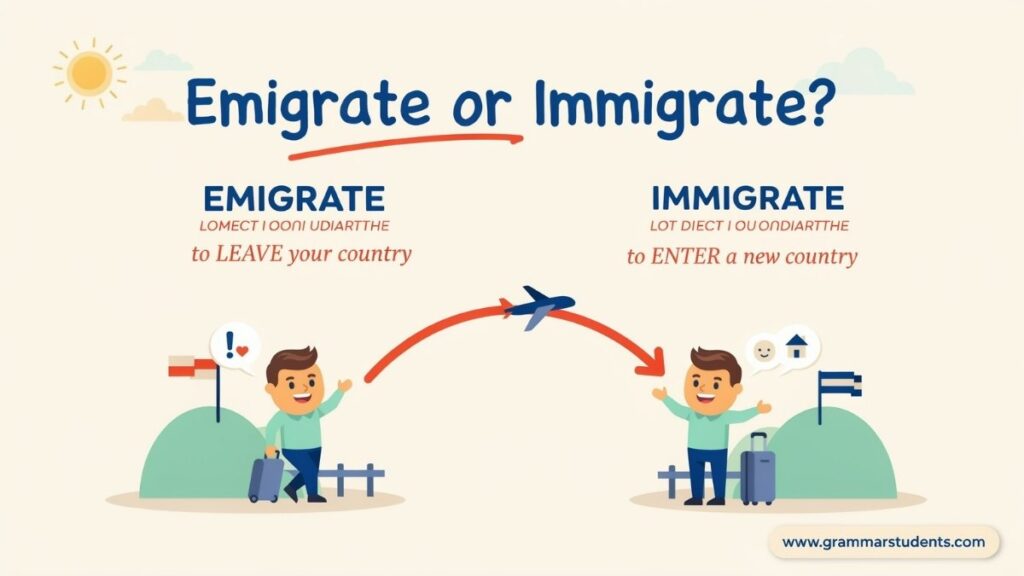
Ever wondered whether you should say emigrate or immigrate? You’re not alone! These two words often confuse even confident English speakers. After all both describe moving to another country so why does English insist on making things complicated? Here’s the trick emigrate vs immigrate depends on your point of view. One means leaving a country while the other means entering one. Mix them up and you might accidentally describe someone’s journey from the wrong direction! In this guide you’ll learn the difference through simple explanations practical examples and fill-in-the-blank exercises to help you use both words correctly.
Emigrate vs Immigrate Quick Comparison
The easiest way to remember the difference is to focus on whether someone is leaving or arriving.
| Word | Meaning | Focus | Example |
| Emigrate | To leave a country to live elsewhere | Departure | She emigrated from Pakistan. |
| Immigrate | To enter another country to live there | Arrival | She immigrated to Canada. |
| Migrate | To move from one place to another | Movement | The family migrated to another country. |
| Emigrant | A person who leaves a country to live elsewhere | The person leaving | He was an emigrant from Italy. |
| Immigrant | A person who enters another country to live there | The person arriving | He was an immigrant in Australia. |
| Emigration | The process of leaving a country | Departure as a process | Emigration from the region increased. |
| Immigration | The process of entering a country | Arrival as a process | Immigration to the country increased. |
Quick memory trick: Emigrate starts with the same letter as exit while immigrate starts with the same letter as in. This isn’t their linguistic origin but it’s a simple way to remember the difference.
What Does Emigrate Mean?

To emigrate means to leave a country to establish a life in another country. The word emphasizes the place someone leaves.
People may emigrate for better job opportunities education family reunification safety or improved living conditions.
For example:
- Maria emigrated from Mexico to pursue a career in the United States.
- My grandparents emigrated from Italy in the 1960s.
- Thousands of people have emigrated from the region in search of work.
- He plans to emigrate from Pakistan after completing his degree.
In each sentence emigrate focuses on leaving one country to live elsewhere.
How to Use Emigrate in a Sentence
The most common construction is emigrate from + the country someone leaves.
Examples:
- They emigrated from India in 2018.
- My uncle emigrated from Egypt to find better employment.
- She hopes to emigrate from her home country next year.
You can also use emigrate to to identify the destination. Although immigrate to is often more natural when the emphasis is on entering a country emigrate to is grammatically correct.
For example:
- He emigrated to Australia to start a new life.
- She emigrated from Brazil to Portugal.
Both constructions are acceptable. Choose the one that best communicates your intended meaning.
Learn the difference between tricky more English words
To or Too Which One Belongs in Your Sentence?
Emigrate in Everyday Context
Imagine that Ahmed leaves Pakistan and settles in Germany.
From Pakistan’s perspective Ahmed has emigrated. He has left the country to establish a life somewhere else.
A sentence describing the move might read:
Ahmed emigrated from Pakistan to Germany to pursue better career opportunities.
The sentence highlights his departure from Pakistan while also naming his destination.
What Does Immigrate Mean?
To immigrate means to enter another country with the intention of living there. The word emphasizes the country someone moves into.
People immigrate for many reasons including employment education family connections safety and long-term settlement.
For example:
- Maria immigrated to the United States from Mexico.
- My grandparents immigrated to Canada after World War II.
- She immigrated to Australia to join her husband.
- Many people immigrate to countries where they have family connections.
In each example immigrate focuses on entering a destination country to live there.
How to Use Immigrate in a Sentence
The most common construction is immigrate to + the country someone enters.
Examples:
- They immigrated to Canada in 2020.
- My cousin immigrated to the United Kingdom for work.
- She hopes to immigrate to New Zealand next year.
You can also use immigrate from to identify the country a person came from.
For example:
- He immigrated from Nigeria to the United States.
- They immigrated from China and settled in France.
These sentences are correct because the destination and origin can both appear in a sentence about immigration.
Immigrate in Everyday Context
Imagine that Ahmed leaves Pakistan and settles in Germany.
From Germany’s perspective Ahmed has immigrated. He has entered the country to establish a life there.
A sentence focused on his arrival might read:
“Ahmed immigrated to Germany from Pakistan to pursue better career opportunities.”
The event is the same but the sentence emphasizes his arrival in Germany.
What Is the Difference Between Emigrate and Immigrate?

The main difference between emigrate and immigrate is perspective.
- Emigrate describes leaving a country.
- Immigrate describes entering another country.
Neither word is inherently more correct than the other. The right choice depends on what you want to emphasize.
Consider someone moving from Pakistan to Australia.
| Perspective | Example |
| Leaving Pakistan | She emigrated from Pakistan. |
| Entering Australia | She immigrated to Australia. |
| Describing the move generally | She moved from Pakistan to Australia. |
| Describing both sides | She emigrated from Pakistan and immigrated to Australia. |
All four sentences can describe the same move.
One Journey Two Perspectives
Think of an international move as a journey with two sides: departure and arrival.
When someone leaves their home country the move can be described as emigration. When that person enters another country to live there the move can be described as immigration.
This distinction is useful in news articles research and government reports. A country may report emigration when discussing people leaving and immigration when discussing people arriving.
The key is to identify which side of the journey matters to your sentence.
Emigrate vs Immigrate vs Migrate
Although emigrate immigrate and migrate are closely related they aren’t interchangeable in every situation.
The word migrate has a broader meaning. It describes movement from one place to another without necessarily emphasizing departure from or arrival in a particular country.
Avoid everyday grammar mistakes with simple tips
Boxes or Boxs Correct Spelling Meaning and Usage
What Does Migrate Mean?
To migrate means to move from one place to another often for work living conditions seasonal changes or other reasons.
Migration can occur within a country or across international borders.
Examples:
- Workers migrate from rural areas to cities in search of employment.
- Birds migrate to warmer regions during winter.
- Families migrate to areas with better economic opportunities.
- People migrate between countries for education work or family reasons.
Unlike emigrate and immigrate migrate doesn’t automatically emphasize leaving or entering a country.
When Should You Use Each Word?
Use emigrate when the country being left is the main focus.
Many young professionals emigrate from their home countries to pursue international careers.
Use immigrate when the destination country is the main focus.
Skilled professionals immigrate to countries that offer opportunities in their fields.
Use migrate when discussing movement in general or when the departure and arrival perspectives aren’t important.
Many families migrate to cities in search of better employment.
Remember: Emigration and immigration are specific perspectives on international movement while migration is the broader term.
For example someone moving from Karachi to Lahore migrates within Pakistan. That person doesn’t emigrate from Pakistan or immigrate to Pakistan because the move doesn’t involve crossing an international border.
Emigrant vs Immigrant
The difference between emigrate and immigrate also applies to the nouns emigrant and immigrant.
An emigrant is someone who leaves a country to live elsewhere.
An immigrant is someone who enters another country to live there.
For example a person who moves from Bangladesh to the United Kingdom can be described as an emigrant from Bangladesh and an immigrant to the United Kingdom.
| Term | Meaning | Example |
| Emigrant | A person leaving a country | He is an emigrant from Bangladesh. |
| Immigrant | A person entering another country | He is an immigrant in the United Kingdom. |
The same person can be both an emigrant and an immigrant. These terms describe different perspectives on one international move.
Emigrant vs Immigrant in Context
Imagine a family that leaves Italy and settles in the United States.
An Italian newspaper might describe the family as emigrants because it focuses on people leaving Italy. An American newspaper might describe them as immigrants because it focuses on people arriving in the United States.
Neither description is incorrect. The choice depends on the perspective of the writer.
It’s also important to distinguish these terms from citizen and resident. Being an emigrant or immigrant doesn’t automatically determine someone’s citizenship visa category or legal right to remain in a country.
Emigration vs Immigration
Emigration and immigration are the noun forms of emigrate and immigrate. Both describe international movement but they emphasize different sides of the process.
What Is Emigration?
Emigration is the act or process of leaving a country to live elsewhere.
Examples:
- Emigration from the region increased during the economic downturn.
- The government introduced measures to understand patterns of emigration.
- High levels of emigration can affect a country’s workforce.
The term is useful when discussing population trends economic changes or the movement of people out of a country.
What Is Immigration?
Immigration is the act or process of entering a country to live there.
Examples:
- Immigration has contributed to the country’s population growth.
- The government revised its immigration policies.
- Immigration can influence a country’s labor market and cultural landscape.
The term often appears in discussions about visas settlement employment population growth and government policy.
Emigration vs Immigration Key Differences
| Emigration | Immigration |
| Focuses on leaving a country | Focuses on entering a country |
| Describes movement out of a country | Describes movement into a country |
| Example: Emigration from Pakistan | Example: Immigration to Canada |
| Related person: Emigrant | Related person Immigrant |
Both terms can describe different aspects of the same international movement.
Which Prepositions Go With Emigrate and Immigrate?
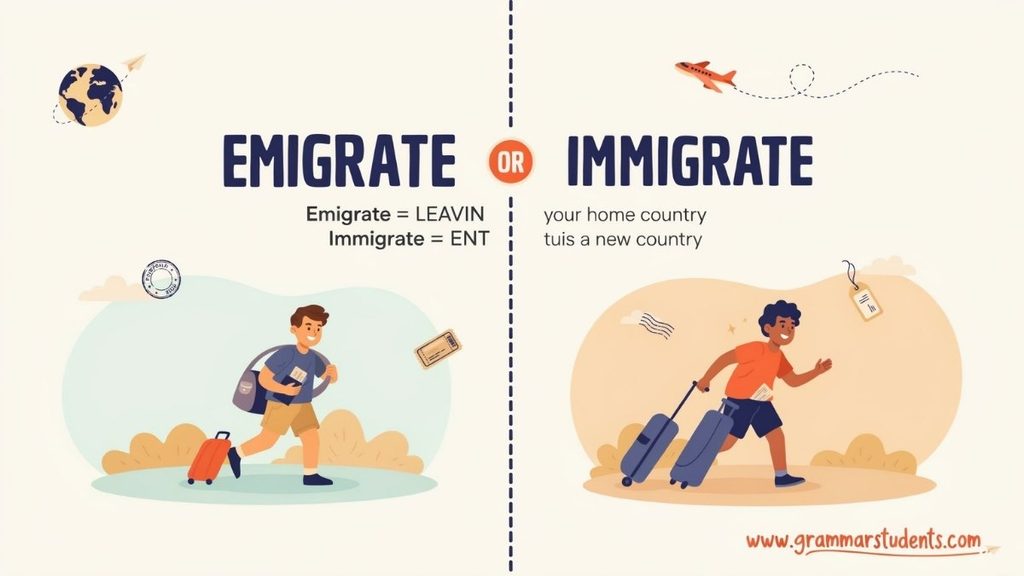
Prepositions help make your meaning clear. Fortunately the most common patterns are easy to learn.
Emigrate From
Use emigrate from to identify the country someone leaves.
Examples:
- She emigrated from Pakistan.
- They emigrated from Spain in 2015.
- Many families emigrated from the region during the conflict.
This is one of the most common constructions with emigrate.
Immigrate To
Use immigrate to to identify the country someone enters to live there.
Examples:
- She immigrated to Canada.
- My relatives immigrated to Australia several years ago.
- He plans to immigrate to Germany after finishing university.
This is the most common construction with immigrate.
Can You Say Emigrate To?
Yes. Emigrate to is grammatically correct.
For example:
- She emigrated to Canada from Pakistan.
- They emigrated to France to start a business.
Although emigrate from emphasizes departure emigrate to can identify the destination. You don’t need to avoid it or treat it as a grammatical mistake.
Likewise immigrate from is acceptable when identifying where someone came from.
For example:
She immigrated from Pakistan to Canada.
Choose the verb and preposition that best express the perspective you want to emphasize.
Learn how to use confusing more words correctly
Classes or Class’s Meaning Difference and Usage
Common Mistakes When Using Emigrate and Immigrate
Even experienced English speakers sometimes confuse these words. Understanding the following mistakes can help you choose the right term.
1. Using Emigrate When You Mean Immigrate
Consider this sentence:
She emigrated to Canada and received support from local settlement services.
The sentence is grammatically correct. However if the focus is on her arrival and settlement in Canada immigrated to Canada may be more direct.
Better for an arrival focused sentence:
She immigrated to Canada and received support from local settlement services.
The difference is one of emphasis not necessarily grammatical correctness.
2. Assuming Emigrate Can Only Be Followed by From
Some writers assume that emigrate must always be followed by from. That’s incorrect.
Both sentences are acceptable:
- He emigrated from Pakistan to Australia.
- He emigrated to Australia from Pakistan.
The first emphasizes departure before naming the destination. The second names the destination first.
3. Confusing Immigration With Travel
A vacation doesn’t usually make someone an immigrant.
For example visiting Japan for two weeks is generally described as traveling to Japan not immigrating to Japan. Immigration refers to entering a country to live there although a person’s formal legal classification depends on the country’s laws and individual circumstances.
4. Confusing Immigrants With Citizens
An immigrant isn’t necessarily a citizen of the destination country.
Someone may live in a country under a temporary or permanent immigration status without holding citizenship. Immigration status and citizenship are separate concepts and their legal definitions depend on the country.
5. Using Migrate When You Need a More Specific Term
The word migrate works well when discussing movement generally. However it may be too broad when you need to distinguish between leaving and entering a country.
Instead of:
She migrated from Pakistan to Canada.
You could write:
She emigrated from Pakistan and immigrated to Canada.
The second sentence explicitly identifies both perspectives.
Real Life Examples of Emigrate and Immigrate
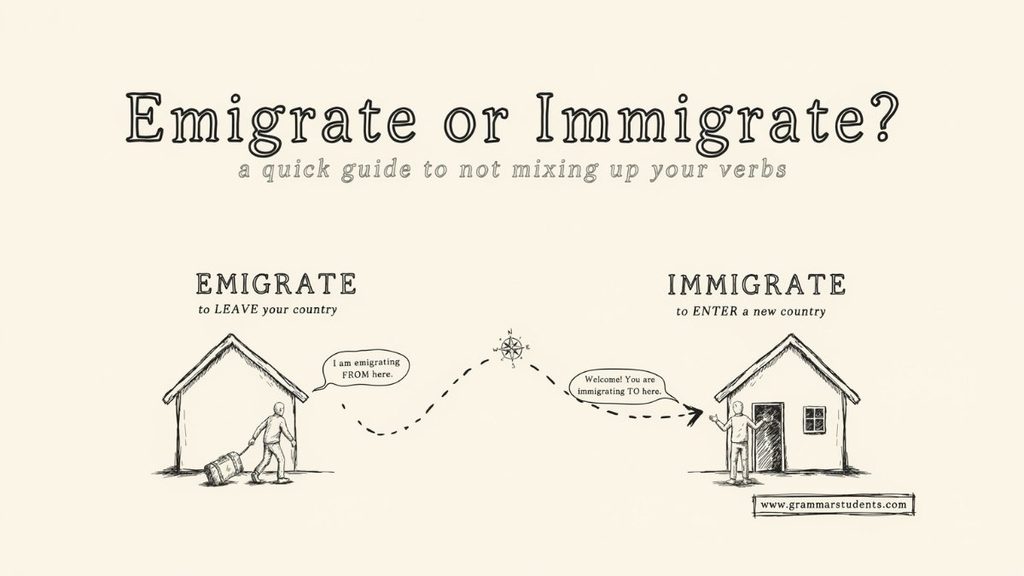
Here are several everyday situations that show how these words work in context.
Example 1 Moving for Work
Sara leaves Pakistan and accepts a job in the United Kingdom.
- She emigrates from Pakistan.
- She immigrates to the United Kingdom.
- She migrates internationally.
Each phrase describes the same move from a different perspective.
Example 2 Joining Family Members
Ali moves from Egypt to Canada to live with his family.
- From Egypt’s perspective Ali is an emigrant.
- From Canada’s perspective Ali is an immigrant.
- The process of leaving Egypt is emigration.
- The process of entering Canada is immigration.
Example 3 Moving Within the Same Country
A family moves from Islamabad to Karachi for a new job.
The family has migrated within Pakistan. The move isn’t emigration from Pakistan or immigration to Pakistan because it doesn’t involve crossing an international border.
Example 4 Moving to Study
A student leaves Nigeria to attend university in Australia.
Depending on the context the student may be described as having emigrated from Nigeria and immigrated to Australia. However studying abroad doesn’t necessarily mean the student intends to settle permanently. Their formal immigration classification depends on the relevant visa and legal circumstances.
These examples show why it’s important to consider both the direction of movement and the purpose of your sentence.
A Case Study Moving From Pakistan to Australia
Imagine that the Rahman family moves from Pakistan to Australia because one parent has accepted a job there.
After arranging the necessary travel and immigration documents the family relocates to Australia.
How should you describe the move?
From Pakistan’s perspective: The family emigrated from Pakistan. The focus is on leaving the country.
From Australia’s perspective: The family immigrated to Australia. The focus is on entering the destination country to live there.
When discussing the move generally: The family migrated from Pakistan to Australia.
A news article about population movement might discuss emigration from Pakistan. An Australian report about newcomers might discuss immigration to Australia. A general article about international mobility might use the broader term migration.
The family’s journey remains the same. The wording changes to match the perspective and purpose of the discussion.
Emigrate and Immigrate Pronunciation and Word Origins
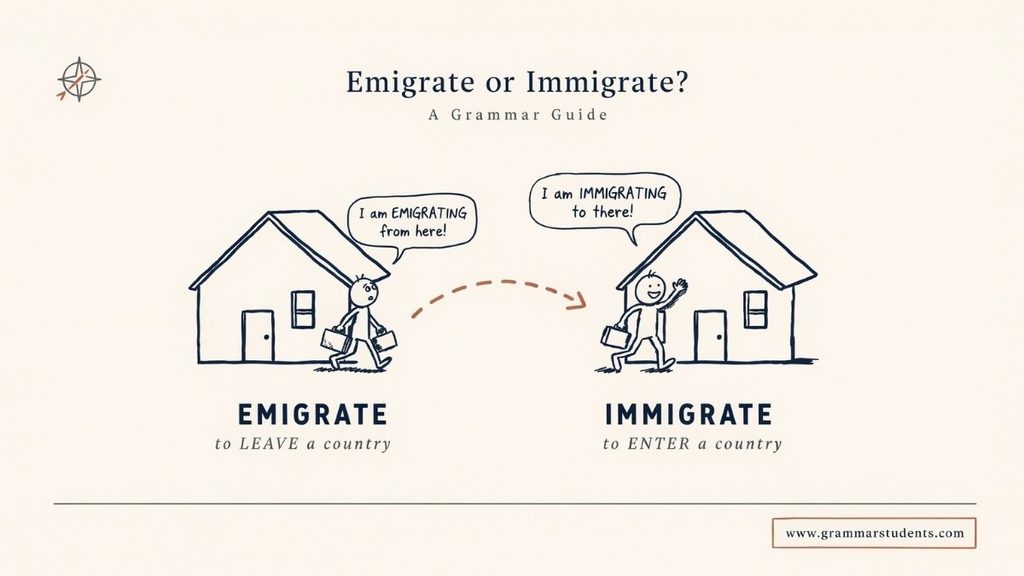
Because emigrate and immigrate look and sound similar their pronunciation and origins can help you distinguish them.
How to Pronounce Emigrate
Emigrate is commonly pronounced EM-ih-grayt with the stress on the first syllable.
How to Pronounce Immigrate
Immigrate is commonly pronounced IM-ih-grayt also with stress on the first syllable.
The opening sounds differ slightly but the words are otherwise very similar. Pronunciation varies somewhat by accent.
Where Do These Words Come From?
Both words have Latin roots.
- Emigrate comes from the Latin emigrare meaning to move away.
- Immigrate comes from the Latin immigrare meaning to move into.
Their origins reflect the modern distinction between departure and arrival.
You don’t need to memorize the Latin roots to use the words correctly. Remembering emigrate = exit and immigrate = enter is usually enough.
Use Immigrate When Entering a Country
The distinction between emigrate and immigrate is essentially the same in American and British English.
Both varieties use emigrate to describe leaving a country and immigrate to describe entering another country to live there.
For example:
- American English: Her parents emigrated from India and immigrated to the United States.
- British English: Her parents emigrated from India and immigrated to the United Kingdom.
The destination changes but the meanings of the verbs remain consistent.
In both varieties immigration also appears frequently in discussions about visas settlement border policy and government regulations.
Use this guide:
- If you’re focusing on leaving use emigrate.
- If you’re focusing on entering use immigrate.
- If you’re discussing movement in general use migrate.
- If you’re describing the person leaving use emigrant.
- If you’re describing the person arriving use immigrant.
- If you’re describing the process of leaving use emigration.
- If you’re describing the process of entering use immigration.
With these distinctions in mind choosing the correct word becomes much easier.
Think and Solve this practice session
1. when Sara left Pakistan to settle in Canada she decided to ______ from Pakistan.
2. Ahmed plans to ______ to Australia to live with his family.
3. Many birds ______ to warmer regions during the winter.
4. A person who leaves their home country to settle elsewhere is called an ______.
5. Someone who moves to another country to live there is generally called an ______.
6. The government studied the effects of ______ as more people left the country to live abroad.
7. The government introduced new ______ policies to regulate the entry of people into the country.
8. A ______ is someone who moves from one place to another either within a country or across international borders.
9. My grandparents decided to ______ from Italy and build a new life overseas.
10. She hopes to ______ to New Zealand after receiving a job offer.
11. The seasonal movement of animals from one region to another is known as ______.
12. High levels of ______ can reduce a country’s population when many people leave to settle abroad.
13. The country welcomed an ______ who had moved there to reunite with family members.
14. After leaving Brazil for Portugal Daniel became an ______ from Brazil’s perspective.
15. Many workers ______ from rural areas to cities to find better employment opportunities.
16. The process of entering another country to live there is called ______.
17. Maria wants to ______ from Mexico to pursue better career opportunities abroad.
18. People who ______ to another country may need to apply for the appropriate visa.
19. The researcher interviewed each ______ about their experience of moving to a new region.
20. An ______ may face challenges such as learning a new language and adapting to a different culture.
21. Every year many birds ______ south to escape the cold winter weather.
22. The report examined patterns of ______ from the country over the past decade.
23. After settling in Canada the former ______ began working at a local school.
24. People who ______ from their home countries may maintain close ties with family members back home.
25. The government reviewed its ______ system to improve the processing of applications from people seeking to enter the country.
Answer Key
- Emigrate
- Immigrate
- Migrate
- Emigrant
- Immigrant
- Emigration
- Immigration
- Migrant
- Emigrate
- Immigrate
- Migration
- Emigration
- Immigrant
- Emigrant
- Migrate
- Immigration
- Emigrate
- Immigrate
- Migrant
- Immigrant
- Migrate
- Emigration
- Immigrant
- Emigrate
- Immigration
Here’s a trusted source for clear more words Comparison:
Grammar Update
Frequently Asked Questions about Emigrate or Immigrate
1. Do You Immigrate or Emigrate to America?
You immigrate to America when you enter the country to live there. You emigrate from your home country when you leave it. For example someone moving from Pakistan to the United States emigrates from Pakistan and immigrates to the United States.
2. What Is the Difference Between Emigrate and Immigrate?
Emigrate means to leave one country to live in another while immigrate means to enter a different country to live there. Emigration focuses on departure whereas immigration focuses on arrival.
3. How Do You Use Emigrate and Immigrate Correctly?
Use emigrate from to emphasize the country someone leaves and immigrate to to emphasize the country someone enters. For example She emigrated from India and immigrated to Canada. Both verbs can be used with other prepositions when the context calls for them.
4. What Is the Difference Between Emigration and Immigration?
Emigration is the process of leaving a country to live elsewhere. Immigration is the process of entering another country to live there. Both terms can describe different perspectives on the same international move.
5. Am I Emigrating or Immigrating?
You’re emigrating if you’re leaving your current country to live elsewhere. You’re immigrating if you’re entering another country to live there. If you’re moving between countries both terms may describe your move from different perspectives.
6. Do Humans Migrate or Emigrate?
Humans can do both. Migrate describes movement from one place to another within a country or across international borders. Emigrate specifically emphasizes leaving a country to live elsewhere.
7. Can You Use Emigrate and Immigrate in the Same Sentence?
Yes. For example Daniel emigrated from Brazil and immigrated to Portugal to pursue a new career. Emigrated describes his departure from Brazil while immigrated describes his arrival in Portugal.
8. What Does Emigrate Mean?
Emigrate means to leave one country to live in another. For example someone who leaves Nigeria to settle in the United Kingdom emigrates from Nigeria.
9. Why Do People Emigrate?
People emigrate for reasons such as employment education family reunification safety political instability or better living conditions. Their decisions may involve several personal social and economic factors.
10. What Is Another Word for Emigrate?
Depending on the context alternatives to emigrate include move abroad relocate overseas and leave one’s country to settle elsewhere. These expressions convey a similar idea although their meanings aren’t always identical.
11. What Is the Difference Between a Migrant and an Immigrant?
A migrant is a broad term for someone who moves from one place to another either within a country or across borders. An immigrant generally refers to someone who moves to another country to live there. Exact definitions may vary by legal or statistical context.
12. Is It Correct to Say Emigrate to Canada?
Yes. Emigrate to Canada is grammatically correct because emigrate can identify the destination as well as the departure. However immigrate to Canada is often more direct when the focus is on entering Canada to live there.
Conclusions:
The difference between emigrate and immigrate is easier than it looks. You just need to know which side of the border you’re talking about! When someone leaves a country they emigrate. When they enter another country to settle there they immigrate. And when you want a general word for moving from one place to another migrate does the job.
Remember the person moving hasn’t changed but your perspective has. So the next time you discuss moving abroad you won’t have to let these confusing words send your grammar in the wrong direction. Practice regularly use the examples in this guide and you’ll master the difference in no time. After all your grammar deserves a smooth journey ev if your passpot is still waiting for its first stamp.

Jacob AJS is an experienced blogger and English language enthusiast dedicated to making grammar and vocabulary simple, clear, and practical. As a writer for Grammarstudent, he creates insightful word comparisons, easy-to-follow explanations, and useful examples that help learners avoid common mistakes. His passion is to make English easier to understand while helping readers communicate with confidence, clarity, and accuracy.