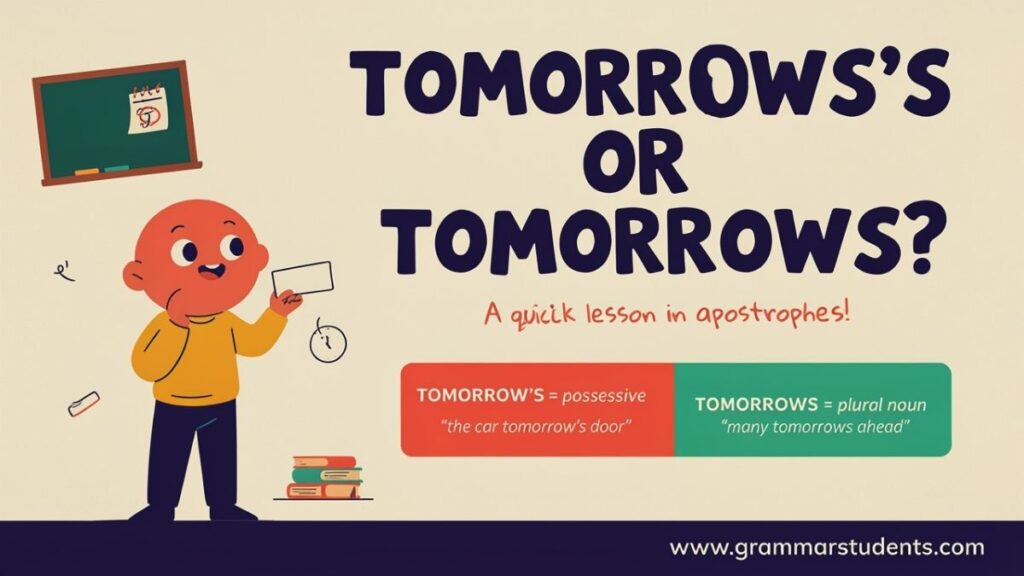
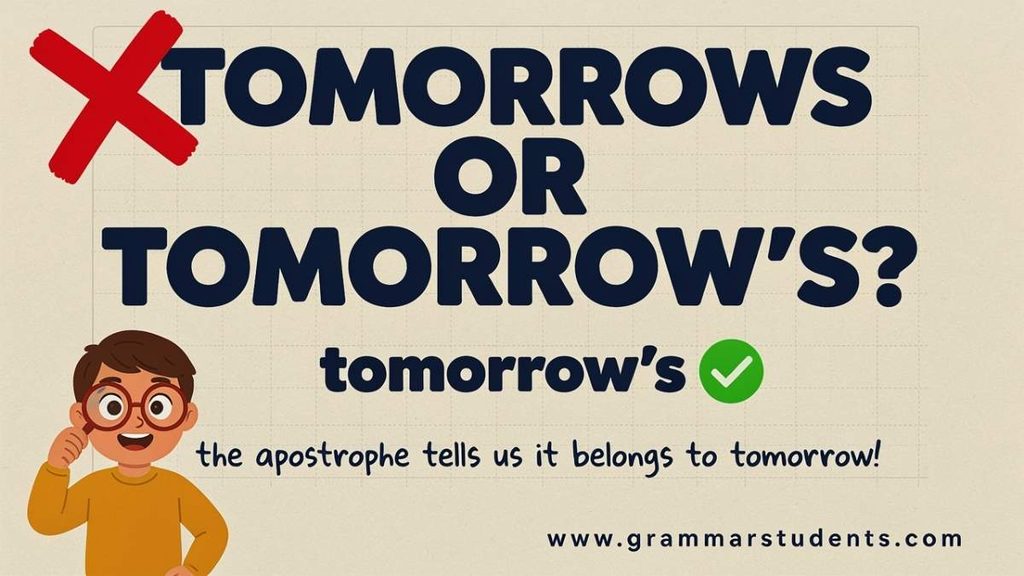
English grammar has a funny habit of turning one tiny apostrophe into a fullblown spelling mystery. The confusion between tomorrows or tomorrow’s is a perfect example. Although these forms look almost identical that little apostrophe changes the meaning and grammatical role. Tomorrows means multiple future days while tomorrow’s can show possession or act as a contraction of tomorrow is or tomorrow has. So writing tomorrows meeting instead of tomorrow’s meeting can make your sentence stumble before the meeting even begins. In this guide you’ll learn the difference understand the common mistakes and practice choosing the correct form with confidence in everyday English.
Tomorrows or Tomorrow’s Quick Answer
Both tomorrows and tomorrow’s are grammatically correct but they have different meanings and uses.
| Form | Main Function | Meaning | Example |
| tomorrow | Noun/adverb | The day after today | I’ll call you tomorrow. |
| tomorrows | Plural noun | Multiple future days | We have many tomorrows ahead. |
| tomorrow’s | Possessive | Belonging to or associated with tomorrow | Tomorrow’s meeting starts at 9. |
| tomorrow’s | Contraction | Tomorrow is / tomorrow has | Tomorrow’s going to be busy. |
The easiest rule is:
No apostrophe = plural. Apostrophe + s = possessive or contraction.
Therefore:
- Tomorrows is more than one tomorrow.
- Tomorrow’s meeting is the meeting associated with tomorrow.
- Tomorrow’s going to be busy is tomorrow is going to be busy.
- Tomorrow’s been difficult is tomorrow has been difficult.
The context tells you which meaning applies.
What Does Tomorrow Mean?
Before comparing tomorrows vs tomorrow’s it helps to understand the basic word tomorrow.
Tomorrow refers to the day after today. It can function as both an English noun and an English adverb.
As an adverb it tells you when an action will happen:
- I’ll finish the report tomorrow.
- We’re leaving tomorrow.
- She’ll call tomorrow morning.
- The exam starts tomorrow.
Here tomorrow modifies the verb or describes the time of an action.
As a noun tomorrow can refer to the upcoming day itself:
- Tomorrow will be better.
- Tomorrow is another opportunity.
- We’re preparing for tomorrow.
- Tomorrow arrived faster than expected.
The word can also have a broader figurative meaning. In literary writing tomorrow may represent the future not merely the specific day after today.
For example:
Tomorrow brings new possibilities.
The sentence isn’t necessarily talking about a calendar date. It can suggest future time and opportunity.
Learn the difference between tricky more English words
Persuing or Pursuing Meaning Difference and Correct Spelling
Tomorrow as a Time Word

In ordinary everyday English tomorrow usually has a precise meaning the next calendar day.
If today is Monday tomorrow is Tuesday.
If today is December 31 tomorrow is January 1.
The word doesn’t change its spelling when used in these different contexts.
Tomorrow’s Meaning What Does Tomorrow’s Mean?
The tomorrow’s meaning depends on the sentence.
Most commonly tomorrow’s has one of two grammatical functions:
- It is the possessive form of tomorrow.
- It is a contraction of tomorrow is or tomorrow has.
These functions look identical but the grammar behind them is different.
Tomorrow’s as a Possessive
When tomorrow’s comes before a noun it often indicates that something belongs to relates to or is associated with tomorrow.
Examples include:
- tomorrow’s meeting
- tomorrow’s weather
- tomorrow’s schedule
- tomorrow’s class
- tomorrow’s exam
- tomorrow’s event
- tomorrow’s deadline
- tomorrow’s appointment
Consider:
Tomorrow’s meeting starts at 10 a.m.
The meeting isn’t owned by tomorrow in a literal sense. Instead the possessive construction tells us that the meeting takes place tomorrow or is associated with tomorrow.
This is a useful feature of English possessive structures. Possession doesn’t always mean physical ownership.
For example:
- today’s newspaper
- yesterday’s news
- Monday’s meeting
- next week’s schedule
- tomorrow’s exam
Nobody believes Monday physically owns a meeting. The possessive simply establishes a relationship.
Tomorrow’s Possessive Examples
Here are some common examples:
- Tomorrow’s weather looks unpredictable.
- I checked tomorrow’s schedule.
- We need to prepare for tomorrow’s exam.
- Have you seen tomorrow’s agenda?
- The teacher explained tomorrow’s assignment.
- Tomorrow’s event begins at noon.
- I’m worried about tomorrow’s deadline.
- The doctor confirmed tomorrow’s appointment.
In each case tomorrow’s connects tomorrow with another noun.
Avoid everyday grammar mistakes with simple tips
Trialled or Trialed Meaning Difference and Usage
Tomorrow’s as a Contraction
The apostrophe in tomorrow’s doesn’t always indicate possession.
Sometimes it represents missing letters in a contraction.
Tomorrow’s can mean:
- tomorrow is
- tomorrow has
For example:
Tomorrow’s going to be busy.
Expand the contraction:
Tomorrow is going to be busy.
The meaning remains the same.
Another example:
Tomorrow’s the big day.
This means:
Tomorrow is the big day.
The same principle applies to has:
Tomorrow’s been challenging.
This can mean:
Tomorrow has been challenging.
However this second use is less common because the sentence can sound unusual depending on the context. In most everyday situations tomorrow’s as a contraction is more naturally understood as tomorrow is.
A Simple Contraction Test of
If you’re unsure whether tomorrow’s is a contraction replace it with tomorrow is.
If the sentence still makes sense you’re probably looking at a contraction.
For example:
Tomorrow’s going to rain.
Replace tomorrow’s:
Tomorrow is going to rain.
Correct.
But:
Tomorrow’s meeting starts at 9.
Replace it:
Tomorrow is meeting starts at 9.
That doesn’t work.
Therefore tomorrow’s in the second sentence is possessive.
Tomorrows Meaning What Does Tomorrows Mean?
The tomorrows meaning is much simpler.
Tomorrows is the plural form of the noun tomorrow.
It refers to multiple tomorrows or several future days.
For example:
We have many tomorrows ahead of us.
Here tomorrows means multiple future days.
Another example:
Our decisions today can shape our tomorrows.
Again tomorrows refers to different future days or future periods.
The word is grammatically vali but it’s far less common than tomorrow. Writers often use it in literary philosophical inspirational or poetic contexts.
Tomorrows Definition
A simple tomorrows definition is:
Tomorrows is the plural noun meaning more than one future day.
Examples:
- We don’t know what our tomorrows will bring.
- The choices we make today affect our tomorrows.
- She dreamed about better tomorrows.
- Many tomorrows still lie ahead.
- We should build better tomorrows for future generations.
The plural form often carries a broader idea of the future rather than literally counting individual calendar days.
Is Tomorrows a Word?
Yes. Tomorrows is a word.
If you search for is tomorrows a word the answer is yes provided it is being used as the plural of the noun tomorrow.
For example:
We have many tomorrows to look forward to.
This is grammatically acceptable.
However don’t assume that tomorrows should replace tomorrow’s simply because you see a noun after it.
Compare:
Tomorrows meeting starts at 9.
Tomorrow’s meeting starts at 9.
The first sentence attempts to describe one meeting associated with tomorrow. The second correctly uses the possessive.
Learn how to use confusing more words correctly
Slushy or Slushie Correct Spelling Meaning and Usage
Tomorrows vs Tomorrow’s The Main Grammatical Difference
The difference becomes much clearer when you focus on the apostrophe.
Tomorrows
Tomorrows has no apostrophe.
It is a plural noun.
We have many tomorrows ahead.
Here tomorrows means multiple future days.
Tomorrow’s
Tomorrow’s contains an apostrophe before s.
It can be:
- a possessive form or
- a contraction.
Examples:
Tomorrow’s exam is difficult.
Possessive.
Tomorrow’s going to be difficult.
Contraction of tomorrow is.
This is the core of tomorrows or tomorrow’s grammar.
| Word | Grammar | Meaning |
| tomorrow | noun/adverb | The day after today |
| tomorrows | plural noun | Multiple future days |
| tomorrow’s | possessive | Associated with tomorrow |
| tomorrow’s | contraction | Tomorrow is / tomorrow has |
Tomorrow’s vs Tomorrows Why Does the Apostrophe Matter?
An apostrophe isn’t decoration. It can signal a grammatical relationship.
Compare:
Tomorrows are uncertain.
Here tomorrows is plural.
Now compare:
Tomorrow’s plan is uncertain.
Here tomorrow’s is possessive.
The meanings are completely different.
Fix common more word mistakes in English
Presence or Presense Which Spelling Is Correct?
Compare These Sentences
Tomorrows can bring new opportunities.
Meaning: Multiple future days can bring opportunities.
Tomorrow’s opportunity may be important.
Meaning An opportunity associated with tomorrow may be important.
The apostrophe changes the word form grammatical role and meaning.
That’s why apostrophe usage matters in English writing.
What Is the Plural of Tomorrow?
The plural of tomorrow is tomorrows.
Although tomorrow is commonly used as a time adverb it can also function as a noun. When it functions as a countable noun referring to separate future days or future periods it can take the regular plural ending s.
For example:
We have several tomorrows ahead.
The grammar follows the normal plural pattern:
tomorrow or tomorrows
There is no apostrophe because ordinary plurals don’t need one.
Don’t Use an Apostrophe to Make a Plural
A common punctuation mistake is adding an apostrophe simply because a word ends in s after pluralization.
Incorrect:
We have many tomorrow’s ahead.
Correct:
We have many tomorrows ahead.
The apostrophe changes the grammatical function.
What Is the Possessive of Tomorrow?
The possessive of tomorrow is tomorrow’s.
When you want to describe something associated with tomorrow use an apostrophe + s.
Examples:
- tomorrow’s weather
- tomorrow’s meeting
- tomorrow’s class
- tomorrow’s schedule
- tomorrow’s exam
- tomorrow’s plan
For example:
I need to check tomorrow’s schedule.
The schedule is associated with tomorrow.
This is the standard tomorrow’s possessive construction.
Understand confusing English more words simply
Where or When Difference and Uses
Tomorrow’s Meeting vs Tomorrows Meeting
This is one of the most common mistakes involving these forms.
Correct
Tomorrow’s meeting starts at 9 a.m.
Why?
Because the meeting is associated with tomorrow.
Incorrect
Tomorrows meeting starts at 9 a.m.
Why is it incorrect?
Because tomorrows is plural. It would mean multiple tomorrows not one upcoming day.
The sentence needs the possessive:
Tomorrow’s meeting
A Quick Trick
Ask:
Am I talking about multiple future days?
If yes:
tomorrows
If you’re talking about something connected to one upcoming day:
tomorrow’s
Tomorrow’s Event or Tomorrows Event?
The correct expression is:
tomorrow’s event
For example:
Have you prepared everything for tomorrow’s event?
The event is associated with tomorrow.
Tomorrows event is incorrect in standard English because tomorrows is plural.
This same rule applies to many common expressions:
| Incorrect | Correct |
| tomorrows event | tomorrow’s event |
| tomorrows meeting | tomorrow’s meeting |
| tomorrows class | tomorrow’s class |
| tomorrows exam | tomorrow’s exam |
| tomorrows schedule | tomorrow’s schedule |
| tomorrows weather | tomorrow’s weather |
| tomorrows deadline | tomorrow’s deadline |
Learn the difference between confusing more English words
Personel or Personnel The Correct Spelling
Tomorrow’s Date Meaning
The phrase tomorrow’s date refers to the calendar date that comes immediately after today’s date.
For example if today is October 6 tomorrow’s date is October 7.
The grammatical structure is possessive:
tomorrow’s date
Here the date is associated with tomorrow.
You might see this phrase in practical situations:
- Please write tomorrow’s date on the form.
- Do you know tomorrow’s date?
- Check tomorrow’s date before booking the appointment.
- The system automatically displays tomorrow’s date.
Notice that tomorrows date is incorrect because the phrase needs the possessive form.
Tomorrow’s Meeting Meaning
The phrase tomorrow’s meeting means a meeting scheduled for tomorrow or associated with tomorrow.
Examples:
I need to prepare for tomorrow’s meeting.
Have you received the agenda for tomorrow’s meeting?
Tomorrow’s meeting has been moved to the afternoon.
The possessive structure doesn’t necessarily mean the meeting belongs to tomorrow. It identifies its relationship with the day.
Tomorrow’s Schedule Meaning
Tomorrow’s schedule means the schedule for tomorrow.
For example:
I checked tomorrow’s schedule before making the appointment.
The phrase can refer to:
- work schedules
- school schedules
- travel plans
- appointments
- meetings
- events
- classes
The same grammatical pattern applies:
tomorrow + ’s + noun
Tomorrow’s Weather Meaning
Tomorrow’s weather means the weather expected on the following day.
For example:
Tomorrow’s weather should be cooler.
Again, the possessive form shows association.
Compare:
Tomorrow’s weather looks pleasant.
with:
Tomorrows are unpredictable.
The first refers to the weather on one upcoming day. The second refers to multiple future days.
When to Use Tomorrow’s
Use tomorrow’s when you need a possessive construction or a contraction.
Examples:
- tomorrow’s meeting
- tomorrow’s class
- tomorrow’s exam
- tomorrow’s event
- tomorrow’s weather
- tomorrow’s deadline
- tomorrow’s appointment
Learn the difference between commonly mixed-up more words
Many or Meny What’s the Right English Word?
Use It as a Contraction of Tomorrows or Tomorrow’s
Use tomorrow’s when it means tomorrow is or in appropriate contexts tomorrow has.
Examples:
Tomorrow’s going to be exciting.
= Tomorrow is going to be exciting.
Tomorrow’s the final day.
= Tomorrow is the final day.
The key is context.
When to Use Tomorrows
Use tomorrows when you mean multiple future days.
Examples:
We have many tomorrows ahead.
Our actions today influence our tomorrows.
She believes better tomorrows are possible.
Nobody can predict all their tomorrows.
The word appears more often in literary writing inspirational language and philosophical discussions than in ordinary conversation.
In everyday English people generally say:
the future
or
future days
instead of:
tomorrows
That doesn’t make tomorrows incorrect. It simply makes it less common.
Tomorrows or Tomorrow’s Which Is Correct?
The question tomorrows or tomorrow’s which is correct has no single answer because both forms are correct in the right context.
Use tomorrows for a plural:
We have many tomorrows ahead.
Use tomorrow’s for possession:
Tomorrow’s meeting starts at 8.
Use tomorrow’s as a contraction:
Tomorrow’s going to be difficult.
The important question isn’t simply which spelling is correct. Ask:
What do you want the word to mean?
Is Tomorrow’s Correct?
Yes tomorrow’s is correct when the sentence requires a possessive or contraction.
Correct:
Tomorrow’s exam begins at 9.
Correct:
Tomorrow’s going to be busy.
Incorrect:
Tomorrow’s are full of possibilities.
If you mean multiple future days, use:
Tomorrows are full of possibilities.
The final sentence uses tomorrows as a plural noun.
Learn the difference between similar English words
Mistery or Mystery Why Mystery Is Correct?
Tomorrow’s Grammar Possessive vs Contraction
Understanding the two roles of tomorrow’s makes the grammar much easier.
| Sentence | Function | Expanded Meaning |
| Tomorrow’s meeting starts at 9. | Possessive | Meeting associated with tomorrow |
| Tomorrow’s weather looks good. | Possessive | Weather of tomorrow |
| Tomorrow’s going to be busy. | Contraction | Tomorrow is going to be busy |
| Tomorrow’s the final exam. | Contraction | Tomorrow is the final exam |
| Tomorrow’s been difficult. | Contraction | Tomorrow has been difficult |
A useful test is to look at the word immediately after tomorrow’s.
If a noun follows it such as meeting weather or schedule the form is usually possessive.
If a verb follows it the form may be a contraction.
For example:
Tomorrow’s meeting starts at nine.
Possessive.
Tomorrow’s going to be busy.
Contraction.
Tomorrow Is or Tomorrow’s?
The choice between tomorrow is or tomorrow’s depends on style and context.
Both can be grammatically correct:
Tomorrow is going to be busy.
Tomorrow’s going to be busy.
The second version is simply more contracted and conversational.
Formal Writing of Tomorrows or Tomorrow’s
In formal writing, spelling out the words can sometimes provide a more formal tone:
Tomorrow is expected to be warmer.
Informal Writing
In casual conversation contractions sound natural:
Tomorrow’s going to be warmer.
Neither sentence is inherently wrong.
The difference is largely one of style tone and context.
Tomorrow Has or Tomorrow’s?
The same principle can apply to tomorrow has or tomorrow’s.
For example:
Tomorrow’s been a difficult day.
can be expanded to:
Tomorrow has been a difficult day.
However this construction depends heavily on context. If you’re discussing a day that has already progressed the phrase may sound more natural when the temporal reference is clear.
The important grammatical point is that ’s can represent has in contractions.
Compare:
She’s finished.
= She has finished.
Likewise:
Tomorrow’s been difficult.
= Tomorrow has been difficult.
The apostrophe signals omitted letters.
Learn the difference between tricky grammar words
Disgard or Discard Which Spelling Is Correct and Why?
Common Mistakes With Tomorrows and Tomorrow’s
These forms cause several recurring grammar and punctuation mistakes.
Mistake Using tomorrows for Possession
Tomorrows meeting starts at nine.
Tomorrow’s meeting starts at nine.
The meeting is associated with tomorrow so you need the possessive apostrophe.
Mistake Using tomorrow’s for a Plural
We have many tomorrow’s ahead.
We have many tomorrows ahead.
You’re referring to multiple future days, so no apostrophe is required.
Mistake Treating Every s as Possessive
Not every apostrophe + s combination indicates possession.
In:
Tomorrow’s going to rain.
Tomorrow’s means tomorrow is.
In:
Tomorrow’s weather will be cold.
Tomorrow’s is possessive.
Context determines the function.
Mistake Confusing Tomorrows or Tomorrow’s
The correct tomorrow spelling is:
tomorrow
It contains one m and two r’s.
Incorrect:
tommorrow
Correct:
tomorrow
A useful memory trick is to remember:
to + morrow
The common common spelling mistake is adding an extra m.
Tomorrow Spelling What Is the Correct Spelling of Tomorrow?
The correct spelling of tomorrow is tomorrow.
Break it down:
t-o-m-o-r-r-o-w
There is:
- one m
- two r’s
- one final w
Incorrect spellings include:
- tommorrow
- tomorow
- tommorow
Correct:
- tomorrow
Although this article focuses on tomorrows or tomorrow’s pelling still matters because an apostrophe cannot fix an incorrectly spelled base word.
Is There a Difference in American and British English?
There is no major American versusBritish spelling difference between tomorrow tomorrows and tomorrow’s.
Both American English and British English use:
- tomorrow
- tomorrows
- tomorrow’s
The grammatical principles remain essentially the same.
Differences may appear in surrounding vocabulary unctuation preferences,or stylistic conventions but the basic distinction between the plural and possessive forms does not change.
For standard English you can safely follow these rules:
tomorrows = plural
tomorrow’s = possessive or contraction
Everyday Examples of Tomorrows or Tomorrow’s
Here are practical examples you can use as a reference.
Examples of Tomorrow’s
- Tomorrow’s class begins at 8 a.m.
- I finished tomorrow’s assignment early.
- Have you checked tomorrow’s schedule?
- Tomorrow’s weather may be rainy.
- We need to discuss tomorrow’s meeting.
- Tomorrow’s event starts after lunch.
- The teacher announced tomorrow’s exam.
- I forgot to check tomorrow’s appointment.
- Tomorrow’s deadline is approaching.
- We have prepared everything for tomorrow’s presentation.
Examples of Tomorrows
- We have many tomorrows ahead.
- Better tomorrows begin with good decisions today.
- Our choices can shape our tomorrows.
- Nobody knows what their tomorrows will bring.
- She dreamed of brighter tomorrows.
- The children deserve safer tomorrows.
- Many tomorrows remain before the project ends.
A Practical Case Study The School Notice of Tomorrows or Tomorrow’s
Imagine a teacher writes this notice:
Tomorrows exam starts at 9 a.m.
Students may understand the intended meaning, but the punctuation is wrong.
The correct version is:
Tomorrow’s exam starts at 9 a.m.
Why?
The exam is associated with tomorrow. Therefore the possessive form is needed.
Now imagine the teacher writes:
We have many tomorrows to improve our skills.
Here tomorrows is correct because the teacher is referring to multiple future days.
Lesson From the Case Study of Tomorrows or Tomorrow’s
The context changes the form:
- Tomorrow’s exam is one upcoming exam.
- Many tomorrows is multiple future days.
This is a small distinction with a big effect on meaning.
A Practical Case Study Workplace Writing
Consider an office email:
Please review tomorrows meeting agenda.
This sentence contains a common punctuation error.
The corrected version is:
Please review tomorrow’s meeting agenda.
Why?
The agenda is associated with tomorrow’s meeting.
Now consider:
We have many tomorrows to solve this problem.
Here tomorrows is plural and does not need an apostrophe.
Professional writing benefits from getting this distinction right because punctuation errors can make otherwise polished communication look careless.
Learn the difference between confusing word pairs
Lader or Ladder Which One Is Correct
A Practical Case Study Contraction or Possessive?
Consider these two sentences:
Tomorrow’s meeting will be short.
and:
Tomorrow’s going to be short.
They look nearly identical.
The first uses tomorrow’s as a possessive.
The second uses tomorrow’s as a contraction.
Expand them:
Tomorrow’s meeting will be short.
The meeting associated with tomorrow will be short.
Tomorrow’s going to be short.
Tomorrow is going to be short.
This simple substitution test is one of the easiest ways to understand the grammatical difference.
Quick Comparison Tomorrows vs Tomorrow’s
| Feature | Tomorrows | Tomorrow’s |
| Apostrophe | No | Yes |
| Basic role | Plural noun | Possessive or contraction |
| Number | More than one | Usually one upcoming day |
| Meaning | Multiple future days | Associated with tomorrow / tomorrow is / tomorrow has |
| Commonness | Less common | Very common |
| Typical context | Literary poetic philosophical | Everyday and formal writing |
| Example | Many tomorrows remain | Tomorrow’s meeting starts at 9 |
How to Remember the Difference
A simple memory rule can save you from most mistakes:
Think Many Tomorrows
If you can put many before the word use tomorrows.
many tomorrows
several tomorrows
countless tomorrows
No apostrophe.
Think Belonging/Associated Tomorrow’s
If you’re connecting tomorrow with a noun use tomorrow’s.
tomorrow’s meeting
tomorrow’s class
Think Tomorrow Is Tomorrow’s
If you can replace tomorrow’s with tomorrow is use the contraction.
Tomorrow’s going to be great.
Tomorrow is going to be great.
Practice Session of Tomorrows or Tomorrow’s
File in the Blanks.
- I need to prepare for __________ meeting.
- We have many __________ ahead of us.
- Have you checked __________ weather forecast?
- __________ going to be a busy day.
- Our choices today can shape our __________.
- The teacher explained __________ assignment.
- She believes brighter __________ are possible.
- What time does __________ class begin?
- __________ exam will start at 9 a.m.
- Nobody knows what their __________ will bring.
- I’ve already reviewed __________ schedule.
- __________ going to be an exciting day.
- We should prepare carefully for __________ event.
- Many __________ remain before the project is complete.
- Did you receive the details about __________ appointment?
- The decisions we make today can affect our __________.
- __________ meeting has been moved to the afternoon.
- We can’t predict all our __________.
- __________ weather may be colder than today.
- I’m looking forward to __________ concert.
- Better __________ begin with the choices we make today.
- __________ deadline is approaching quickly.
- __________ going to be an important day.
- We have countless __________ to learn and grow.
- Please check __________ schedule before making plans.
Answer Key
- tomorrow’s
- tomorrows
- tomorrow’s
- tomorrow’s
- tomorrows
- tomorrow’s
- tomorrows
- tomorrow’s
- tomorrow’s
- tomorrows
- tomorrow’s
- tomorrow’s
- tomorrow’s
- tomorrows
- tomorrow’s
- tomorrows
- tomorrow’s
- tomorrows
- tomorrow’s
- tomorrow’s
- tomorrows
- tomorrow’s
- tomorrow’s
- tomorrows
- tomorrow’s
Here’s a trusted source for clear more words Comparison:
Grammar Update
Frequently Asked Questions About Tomorrows or Tomorrow’s
What does tomorrows mean?
Tomorrows is the plural form of tomorrow. It refers to multiple future days or future periods. The word is grammatically correct but less common in everyday English.
Example: We have many tomorrows ahead of us.
Is it correct to say tomorrow meeting or tomorrow’s meeting?
Tomorrow’s meeting is the correct standard form. The apostrophe + s creates the possessive form and shows that the meeting is associated with tomorrow.
Correct: I’ll attend tomorrow’s meeting.
Incorrect: I’ll attend tomorrow meeting.
What is the old-fashioned way to say tomorrow?
Morrow is an old ashioned or literary word for the following day. It appears mainly in historical poetic or deliberately old tyle writing.
Example: We shall meet on the morrow.
In modern everyday English tomorrow is the natural choice.
Is tomorrow’s grammatically correct?
Yes tomorrow’s is grammatically correct when it functions as a possessive or a contraction.
- Possessive: Tomorrow’s class starts at nine.
- Contraction: Tomorrow’s going to be busy. = Tomorrow is going to be busy.
Is it correct to say next week’s meeting or next week meeting?
Next week’s meeting is the correct standard form. The possessive ’s connects the meeting with the upcoming week.
Example: We’ll discuss the project at next week’s meeting.
The same pattern applies to tomorrow’s meeting.
How do I ask about tomorrow’s meeting?
You can ask about tomorrow’s meeting in several natural ways:
- What time is tomorrow’s meeting?
- Where is tomorrow’s meeting?
- Is tomorrow’s meeting still scheduled for 10 a.m.?
- Could you send me the details for tomorrow’s meeting?
The phrase tomorrow’s meeting is correct because the meeting is associated with tomorrow.
Does the word tomorrow’s have an apostrophe?
Yes. Tomorrow’s has an apostrophe before the s. This punctuation can indicate possession or a contraction.
Compare:
- tomorrows plural
- tomorrow’s possessive or contraction
The apostrophe therefore changes the grammatical function of the word.
Is tomorrow night correct grammar?
Yes tomorrow night is grammatically correct. It refers to the night following today.
Example: We’re going out tomorrow night.
No apostrophe is needed because tomorrow functions as a time expression rather than a possessive.
Is tomorrow or on tomorrow correct?
Tomorrow is the standard form in modern English.
Correct: We will meet tomorrow.
Not standard: We will meet on tomorrow.
Use on with expressions such as on Monday or on October 7 but normally not with tomorrow.
What is a cool way to say tomorrow?
There isn’t one universally accepted slang replacement for tomorrow. In casual conversation you might use phrases such as the next day or the day after today although tomorrow remains shorter and more natural.
For professional academic and formal writing tomorrow is the clearest choice.
How do you say tomorrow in Gen Z slang?
There is no single universally recognized Gen Z slang equivalent for tomorrow. Online communities may use playful abbreviations or informal expressions but these vary by platform and group.
For clear communication especially in school or professional writing tomorrow remains the best choice.
How do you say tomorrow in fancy old English?
On the morrow is the best known old fashioned or literary expression for tomorrow.
Example: We shall meet on the morrow.
This phrase sounds deliberately archaic today so tomorrow is preferable in modern writing.
Is it tomorrow’s event or tomorrows event?
The correct form is tomorrow’s event.
The apostrophe + s shows that the event is associated with tomorrow.
Correct: Are you attending tomorrow’s event?
Incorrect: Are you attending tomorrows event?
Remember: tomorrows means multiple future days while tomorrow’s connects tomorrow with something else.
Is it correct to say we will meet tomorrow?
Yes We will meet tomorrow is completely correct standard English.
You can also use the natural contraction:
We’ll meet tomorrow.
Both versions are grammatically correct and express the same basic idea.
Which is correct: tomorrow’s class or tomorrow class?
Tomorrow’s class is the correct standard form.
The apostrophe + s shows that the class is associated with tomorrow.
Example:
Tomorrow class is not the standard possessive construction in English.
How do British people say tomorrow?
British speakers generally use the same word tomorrow There is no separate British spelling for it.
British and American English may differ in pronunciation or accent but the standard forms tomorrow tomorrow’s and tomorrows follow the same basic grammar rules.
Why do we say tomorrow instead of morrow?
Tomorrow developed from an older expression connected with the morrow meaning the following day. Over time tomorrowbecame the standard everyday English word.
The shorter morrow survived mainly in literary and old ashioned expressions such as:
on the morrow
Today omorrow is the normal word in everyday English.
Is tomorrow’s correct grammar?
Yes. Tomorrow’s is grammatically correct when you use it as a possessive or contraction.
Possessive: Tomorrow’s exam begins at 9 a.m.
Contraction: Tomorrow’s going to be busy.
When you mean multiple future days however use tomorrows without an apostrophe:
We have many tomorrows ahead.
Conclusion:
The apostrophe in tomorrow’s may be tiny but it carries a surprisingly big grammatical job. Tomorrows means more than one future day hile tomorrow’s shows possession or works as a contraction of tomorrow is or tomorrow has. That’s why tomorrow’s meeting is correct while tomorrows meeting is not. Think of the apostrophe as your grammar traffic signal it helps you choose the right direction before your sentence crashes into confusion. Once you understand this simple difference choosing between tomorrows or tomorrow’s becomes much easier. Keep practicing and your future sentences will have fewer grammar surprises waiting around the corner.

Jacob AJS is an experienced blogger and English language enthusiast dedicated to making grammar and vocabulary simple, clear, and practical. As a writer for Grammarstudent, he creates insightful word comparisons, easy-to-follow explanations, and useful examples that help learners avoid common mistakes. His passion is to make English easier to understand while helping readers communicate with confidence, clarity, and accuracy.