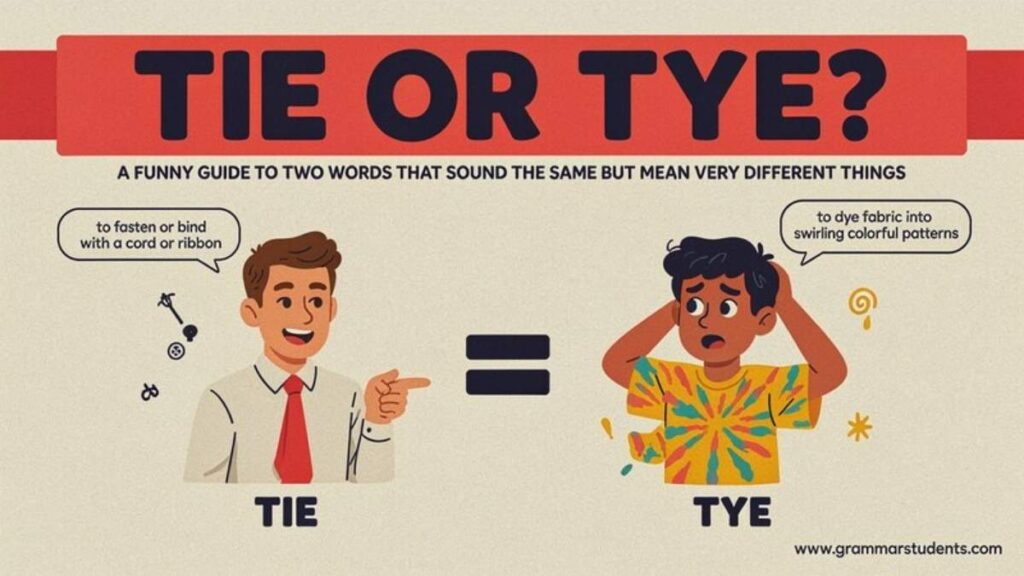
Ever typed tye instead of tie and wondered whether your keyboard was playing a prank on you? Youre not alone! The confusion between tie or tye can make even confident writers pause especially when spelling a necktie describing a knot or writing about a tie in a game. Although tye may appear as a name or in certain historical contexts tie is the standard spelling in modern English. One tiny letter can make a big difference! In this guide youll discover the meanings spelling rules common mistakes and practical examples to help you choose the correct word every time.
Tie or Tye Which Is Correct?
Tie is the correct spelling for ordinary modern English usage. Use it when referring to fastening something a necktie an equal result in a competition or a relationship between people or things.
Tye is not the usual alternative spelling of tie in contemporary writing. Although it appears in historical and specialized contexts its also used as a given name and surname.
Heres a quick comparison:
| Feature | Tie | Tye |
| Standard modern spelling | Yes | No not for ordinary uses of tie |
| Common English word | Yes | Rare in ordinary prose |
| Meaning as a fastening verb | Yes | Not the standard spelling |
| Meaning as a neckwear accessory | Yes | Not the standard spelling |
| Meaning as an equal score | Yes | Not the standard spelling |
| Use as a name | Possible though less common as a name | Yes |
| Historical or specialized use | Yes | May appear in particular contexts |
| Appropriate for most formal writing | Yes | Only when the context specifically calls for it |
The simple rule: If youre writing about tying your shoes wearing a necktie or a tied sports match choose tie. If Tye is someones name or appears in a historical source preserve that spelling when appropriate.
Tie vs Tye Meaning What Does Each Word Mean?
The difference between tie and tye becomes clearer when you examine how each spelling is used.
What Does Tie Mean in English?
The word tie has several meanings. It can function as both a noun and a verb and its meaning depends on the sentence.
As a verb it generally refers to fastening securing connecting or restricting something. As a noun it can refer to a fastening a neckwear accessory an equal score or a relationship.
Consider these examples:
- Fastening: Tie the package with a piece of string.
- Clothing: He wore a blue tie to the interview.
- Sports: The teams finished the match in a tie.
- Relationships: Their family ties remain strong.
- Obligation: She has professional ties to the organization.
These meanings are related through ideas such as connecting fastening or bringing things together. However each meaning has its own context and common expressions.
What Does Tye Mean?
Tye is a rare spelling in present day general English. It isnt the standard spelling for the ordinary meanings of tie but that doesnt mean every appearance of tye is automatically an error.
You may encounter it in several contexts:
- A given name: Tye can be a person’s first name.
- A surname: It may appear as a family name.
- A place name: Some locations use Tye as part of their official name.
- Historical writing: Older documents may contain spelling variants that are uncommon today.
- Specialized terminology: Certain historical or regional sources may use the form in a specific sense.
The important distinction is between a spelling used intentionally in a particular context and a spelling chosen by mistake.
For example if someone named Tye signs an email you should preserve the name exactly as written. If you mean to tell a colleague to fasten a parcel however you should write Please tie the parcel securely.
Is Tye a Word?
Yes Tye can be a valid written form in specific contexts particularly as a proper noun. Historical dictionaries and specialist references may also record uncommon forms or meanings.
However the question Is tye a word? needs a little context. A spelling can exist in a dictionary name database or historical document without being the standard spelling for an everyday English word.
For general writing remember these distinctions:
- Tie is the standard modern word for fastening something.
- Tye may be correct as a person’s name or within a particular historical or specialized context.
- Tye should not ordinarily replace tie in standard contemporary English.
In other words a form can exist without being interchangeable with another form.
Tie or Tye Difference A Closer Comparison

The tie or tye difference is primarily a matter of spelling conventions and context not pronunciation.
Spelling and Grammar
In standard English grammar tie is the conventional spelling used for the familiar noun and verb.
Examples include:
- Tie the ribbon around the box.
- She bought a new tie.
- Strong business ties can help companies cooperate.
Replacing tie with tye in these sentences would generally look like a spelling error.
By contrast a sentence such as Tye will join us after lunch may be perfectly correct if Tye is the person’s name.
Modern Usage vs Historical Usage
English spelling has changed over time. Historical documents may preserve older forms regional spellings or spellings that were never widely adopted as standard forms.
Thats why a reader may encounter tye in a historical source even though modern writing normally uses tie.
Still be careful about calling every historical occurrence of tye an obsolete spelling of tie. The exact meaning can depend on the date region document and subject matter. A historical dictionary or the original source may be needed to establish what a particular occurrence means.
The safest approach is to distinguish the modern standard word from any specific historical or regional form.
Correct Word Choice in Formal Writing
In formal writing the standard spelling is usually the best choice. A report research paper business email or school assignment should use tie for ordinary meanings.
For example:
Correct: The results of the two teams ended in a tie.
Incorrect in ordinary modern usage
The results of the two teams ended in a tye.
However if youre discussing a historical document that uses tye quoting a source or referring to someone named Tye changing the spelling may alter the meaning or introduce an error.
The principle is straightforward: follow standard spelling conventions unless the context gives you a specific reason to preserve another form.
Learn the difference between tricky more English words
To or Too Which One Belongs in Your Sentence?
Tie Spelling in American English vs British English
One common question is whether tie is American English while tye is British English or vice versa.
Neither spelling represents a standard US versus UK spelling difference. American English and British English both use tie for the usual meanings of the word.
| Meaning | American English | British English |
| Fasten something | Tie | Tie |
| A neckwear accessory | Tie | Tie |
| An equal score | Tie | Tie |
| A relationship or connection | Tie | Tie |
| Standard spelling of the ordinary word | Tie | Tie |
There are genuine differences between American and British spelling such as color and colour or organize and organise in common British usage. The word tie does not follow that pattern.
For example:
- American English: Remember to tie your shoes.
- British English: Remember to tie your shoes.
Both sentences use the same spelling.
If you see tye in a British text dont assume its the standard British form. Check whether its a name a historical spelling or a term used in a specific context.
How to Use Tie as a Verb

The verb tie describes the act of fastening securing connecting or restricting something. It appears in everyday instructions descriptive writing sports reporting and figurative expressions.
Tie a Knot
A knot is formed by crossing looping or securing a material such as rope string or fabric.
Examples:
- Tie a knot at the end of the thread.
- He tied a rope around the bundle.
- She tied a ribbon around the gift box.
In each sentence tie refers to securing something by using a knot or a similar fastening method.
Tie Shoelaces
One of the most familiar uses of tie is fastening shoelaces.
Examples:
- I need to tie my shoelaces before running.
- She bent down and tied her child’s shoes.
- Tie your shoes tightly so they don’t come undone.
Notice how the verb changes according to tense. You use tie for the base form ties for the third-person singular and tied for the simple past.
Tie a Ribbon or Secure an Object
The word also applies to fabric packages cords and other objects that need fastening.
Examples:
- Tie the ribbon into a bow.
- They tied the package with twine.
- Please tie the gate closed before leaving.
In each case tie communicates the action clearly. Writing tye would be nonstandard unless it appeared in a special context.
Tie Something to Something Else
You can use tie when one object is attached or secured to another.
Examples:
- The camper tied the tent to a support.
- She tied a tag to the suitcase.
- The gardener tied the young plant to a stake.
The sentence structure often follows this pattern:
Tie + object + to + another object
This construction is useful when you want to explain exactly what is being secured and where it is attached.
How to Use Tie as a Noun
The noun tie has several common meanings. Understanding them helps you recognize the word in different types of writing.
Tie as a Clothing Accessory
A tie is a strip of fabric worn around the neck typically with a shirt and sometimes as part of formal or professional clothing.
Examples:
- He wore a red tie with his white shirt.
- She bought her father a silk tie.
- The dress code requires a tie for the ceremony.
Related terms include necktie and bow tie. A necktie is usually a long strip of fabric worn around the neck while a bow tie is tied into a bow-shaped form.
These terms refer to different styles of clothing accessories but they all use the standard spelling tie.
Tie as an Equal Score
In sports and competitions a tie occurs when two competitors or teams finish with the same score under the applicable rules.
Examples:
- The match ended in a tie.
- Both teams recorded a tie in the final round.
- The game was tied at three points each.
A tie may be a final result in some competitions. In others extra time a playoff or a tiebreaker determines the winner.
A tie-breaker is a method used to separate competitors who would otherwise remain level. Depending on the sport or competition it may involve additional play a special scoring procedure or another established rule.
Tie as a Connection or Relationship
The noun tie can also describe a connection between people groups organizations or places.
Examples:
- The two countries maintain close diplomatic ties.
- Family ties played an important role in the decision.
- The company has strong business ties with local suppliers.
In these sentences ties refers to relationships or connections rather than physical knots.
This figurative meaning is common in journalism academic writing business communication and discussions of social relationships.
Tie as a Restriction or Obligation
A tie can also describe a connection that limits someone’s choices or creates an obligation.
For example:
- Her contract includes financial ties to the project.
- He wanted to move abroad but had family ties at home.
- The agreement created a lasting tie between the two organizations.
The precise meaning depends on the context. A tie can be supportive neutral or restrictive.
Avoid everyday grammar mistakes with simple tips
Boxes or Boxs Correct Spelling Meaning and Usage
Tie vs Tye Examples Correct and Incorrect Usage
Examples make the distinction easier to remember. In ordinary modern English use tie for the standard noun and verb while preserving Tye when it is a proper name or a source-specific form.
| Sentence | Correct? | Explanation |
| Please tie your shoes. | Yes | Tie is the standard verb. |
| He wore a black tie. | Yes | Tie is the standard noun. |
| The match ended in a tie. | Yes | Tie describes an equal result. |
| Strong family ties matter to her. | Yes | Ties refers to relationships. |
| Please tye your shoes. | No in ordinary usage | The standard spelling is tie. |
| She bought a new tye. | No in ordinary usage | Use tie for the clothing accessory. |
| Tye will arrive tomorrow. | Yes if this is the person’s name | Proper names retain their established spelling. |
| The document uses the historical form tye. | Potentially | The spelling is being discussed as a historical form. |
Tie in a Sentence
Here are more examples showing how to use tie naturally:
- Please tie the bag before placing it in the car.
- I need a new tie for the wedding.
- The final score resulted in a tie.
- The research explores ties between education and employment.
- She tied her hair back before starting work.
- The children tied colored ribbons to the fence.
Each example uses tie in a recognizable modern English sense.
Tye in a Sentence
Because tye is uncommon as an ordinary word examples should reflect contexts in which the spelling is intentional.
- Tye joined the meeting a few minutes late.
- The invitation was addressed to Tye and Morgan.
- The historian noted the spelling tye in an old document.
In the first two sentences Tye is a proper name. In the third the word is being discussed as a spelling found in a source. None of these examples establishes tye as the standard replacement for tie.
Tye as a Name Given Name Surname and Place Name
One reason people search for tye or tie is that both spellings may occur in names.
Tye as a Given Name
Tye can be used as a first name. Proper names follow their established spelling which may differ from the spelling of a common English word.
For example:
- Tye is presenting the report.
- I sent the invitation to Tye.
- Tye’s presentation starts at noon.
If a person’s name is spelled Tye changing it to Tie would be incorrect. The fact that tie is the standard common word has no bearing on the correct spelling of an individual’s name.
Tye Surname Meaning
Tye also appears as a surname. Surnames can develop from place names occupations nicknames or older forms of words. Their origins may differ from one family or region to another.
It’s important not to assume that every person with the surname Tye shares the same family history. Establishing a particular surname’s origin may require genealogical records historical documents and regional surname references.
If you’re researching the Tye surname look for evidence connected to a specific family or location rather than relying on a single general explanation.
Tye as a Place Name
Tye may also appear in geographical names. Place names often preserve historical forms long after everyday spelling conventions change.
For instance a map local history or land record may contain a place name that includes Tye. If that is the established spelling retain it when referring to the location.
This is a broader lesson about English spelling: proper nouns don’t always follow the same rules as common nouns. A place person or organization can have a legitimate name that looks unusual when compared with ordinary vocabulary.
Learn how to use confusing more words correctly
Classes or Class’s Meaning Difference and Usage
Tie Word Origin Where Does Tie Come From?
The word tie has a long history in English with connections to the idea of fastening or binding. Its modern meanings extend from physical fastening to figurative relationships and equal results.
The word’s development helps explain why it appears in so many contexts.
From Physical Fastening to Figurative Connections
The most concrete meaning of tie involves fastening one thing to another. You can tie a rope tie a ribbon or tie a knot.
From this physical sense the word also developed broader applications. People speak of family ties political ties business ties and ties between communities. These expressions describe connections rather than literal knots.
The sports meaning is another established use: a tie is an equal result between competitors.
Although these meanings differ they share a broad idea of things being joined connected or brought into a relationship.
Is Tye an Obsolete Spelling of Tie?
You may encounter claims that tye is simply an obsolete spelling of tie. That explanation may fit certain historical examples but it shouldn’t automatically be applied to every occurrence.
A historical spelling can be associated with a particular period region trade or specialized meaning. A name may also have its own independent history.
To establish the meaning of tye in an old document consider:
- Date: When was the document written?
- Location: Where was the writer or subject based?
- Context: Is the word used as a noun verb name or technical term?
- Source: Does a reliable historical dictionary explain the form?
- Spelling conventions: Did the document use other spellings that differ from modern English?
This approach is more reliable than assuming that every unusual spelling is either a mistake or a direct predecessor of a modern word.
Common Mistakes Tie or Tye and Related Spellings
The confusion between tie and tye is part of a broader set of English spelling questions. Some related forms look unusual because they change when suffixes are added.
Tying vs Tieing
The correct spelling is tying not tieing.
When you add ing to tie the final e is dropped and the y remains.
| Base word | Correct form | Incorrect form |
| Tie | Tying | Tieing |
| Die | Dying | Dieing |
| Lie | Lying | Lieing |
Examples:
- She is tying her shoelaces.
- He spent ten minutes tying the package.
- The instructions explain how to tie and secure the rope.
This spelling pattern is worth remembering because tying contains the letters t-y-i-n-g not t-i-e-i-n-g.
Tie Dye Spelling Tie Dye or Tye Dye?
The standard spelling is tie dye.
Tie-dye is a technique for coloring fabric by tying folding twisting or otherwise resisting dye in selected areas. The method creates patterns by limiting where the dye reaches the material.
Examples:
- She wore a colorful tie dye shirt.
- We made tie dye designs during the workshop.
- The store sells tie dye clothing and accessories.
Writing tye dye is generally a spelling error when you mean the fabric-dyeing technique.
The standard term reflects the word tie which describes part of the process used to create the pattern.
Tie Up Meaning
The phrasal verb tie up has several meanings depending on context.
It can mean fastening something keeping someone occupied or completing the final details of a task.
Examples:
- Tie up the package before shipping it.
- The meeting tied me up for most of the morning.
- We need to tie up a few loose ends before launch.
In the last example tie up loose ends is an idiom meaning to finish unresolved tasks or details.
Tie In Meaning
Tie in means to connect one thing with another or show how two things relate.
Examples:
- The final chapter ties in with the opening scene.
- We need to tie the research findings in with the main argument.
- The new campaign ties in with the company’s existing message.
The expression is common in business education storytelling and everyday conversation.
Tie Down Meaning
Tie down can mean securing something physically or restricting someone’s freedom choices or movement.
Examples:
- They tied down the equipment before the journey.
- She didn’t want a contract that would tie her down for years.
- The team secured the load with straps to keep it tied down.
These phrasal verbs use the standard spelling tie. Their meanings depend on the words that follow them.
Synonyms for Tie Words With Similar Meanings
If you’re looking for synonyms for tie the best choice depends on what you mean. No single synonym works in every context.
| Meaning of tie | Possible synonyms | Example |
| Fasten something | Secure fasten bind knot | Secure the package with string. |
| Connect objects | Attach link join | Attach the tag to the bag. |
| Clothing accessory | Necktie | He wore a patterned necktie. |
| Equal score | Draw dead heat level score | The match ended in a draw. |
| Relationship | Connection bond link | They have a close family bond. |
| Restrict choices | Constrain limit bind | The agreement may constrain future decisions. |
These words are related to tie but they aren’t always interchangeable.
For example draw is a common term for an equal result in many British sporting contexts while tie is also widely used in American sports. The best word depends on the sport region and intended meaning.
Similarly fasten works well for securing an object but it doesn’t replace tie naturally in every idiom. You would usually say tie the knot not fasten the knot when referring to the familiar expression about marriage.
Fix common more word mistakes in English
Emigrate or Immigrate Difference Meaning and Usage
Tie or Tye Pronunciation

The standard word tie is pronounced with one syllable. Its pronunciation is represented in the International Phonetic Alphabet as /taɪ/.
The vowel sound is the same one heard in words such as my fly and sky.
Tye when used as a name and pronounced like the common word has the same pronunciation. However personal names can have individual or regional pronunciations so it’s best to follow the preference of the person who uses the name.
A few points are worth remembering:
- Tie has one syllable.
- The final letter e is silent.
- The spelling doesn’t change between American and British English.
- Tye may sound identical when used as a name but its written context differs.
Because the two forms can sound alike pronunciation alone usually won’t tell you which spelling is appropriate. Context does that work.
Which Spelling Should You Use Tie or Tye?
For most everyday writing choose tie. The following examples show how to make the right choice.
| Situation | Recommended spelling | Why |
| Fastening shoelaces | Tie | Standard verb |
| Wearing formal neckwear | Tie | Standard noun |
| Describing an equal score | Tie | Standard sporting term |
| Describing a family connection | Tie or ties | Standard noun |
| Writing a person’s name | Tye if that is the person’s spelling | Proper names retain their established form |
| Quoting an old document | Preserve the original form when appropriate | Historical accuracy matters |
| Writing the fabric technique | Tie dye | Standard spelling of the term |
| Describing the action of fastening | Tying | Correct -ing form |
If you’re unsure ask yourself what you mean.
Are you describing an ordinary action object score or relationship? Use tie. Are you writing a name or reproducing a historical source? Check the established spelling and preserve it when necessary.
A Quick Memory Tip
Remember this simple rule:
Understand confusing English more words simply
Fair or Fare Difference Meaning Usage and Examples
You tie things together but Tye may be someone’s name.
For example you tie a ribbon around a gift tie your shoes before leaving and describe a match as a tie. But if a person introduces himself as Tye use his name exactly as he spells it.
This distinction resolves most everyday questions about tie or tye spelling.
Practice Sessions of Tie or Tye
Fill ine the Blanks.
1. I need to ______ my shoelaces before I go outside.
2. He wore a blue ______ to the wedding.
3. The football match ended in a ______ because both teams scored the same number of goals.
4. My friend’s name is ______ and it is spelled with a y.
5. The correct spelling is ______ not tieing when adding -ing to the word tie.
6. Yesterday I ______ a ribbon around the gift box.
7. Please ______ the gate securely before leaving.
8. Strong family ______ can help people feel connected.
9. The correct spelling of the colorful fabric technique is ______-dye.
10. We need to ______ up all the loose ends before finishing the project.
11. When two competitors have the same score the result is called a ______.
12. She learned how to ______ a knot in the rope.
13. I am ______ my shoes before the race begins.
14. She ______ her hair back with a ribbon.
15. A necktie is an accessory that people often wear with a formal ______.
16. The expression tie the knot means to get ______.
17. The phrase family ties refers to family ______.
18. In standard modern English ______ is the usual spelling for the word meaning to fasten something.
19. ______ can be used as a person’s first name or surname.
20. Please ______ a label to your suitcase so you can identify it easily.
21. Both American and British English generally use the spelling ______ for the clothing accessory worn around the neck.
22. The word tie can be used as both a noun and a ______.
23. The past tense of tie is ______.
24. The phrase tie in can mean to connect one idea with ______.
25. If someone’s name is spelled Tye you should preserve that spelling when writing their ______.
Answer Key
- tie
- tie
- tie
- Tye
- tying
- tied
- tie
- ties
- tie
- tie
- tie
- tie
- tying
- tied
- suit
- married
- connections
- tie
- Tye
- tie
- tie
- verb
- tied
- another
- name
Here’s a trusted source for clear more words Comparison:
Grammar Update
Frequently Asked Questions About Tie or Tye
What does tye mean?
Tye is an uncommon spelling that may appear as a personal name surname place name or historical term. It is not the standard modern spelling when referring to fastening something a necktie or an equal score. In these everyday contexts use tie.
What are two meanings of tie?
Tie has several meanings but two common ones are a fastening and a clothing accessory. As a verb it means to fasten something with a knot or similar method. As a noun it refers to a necktie worn with a shirt or formal outfit.
Is it tye up or tie up?
Tie up is the correct spelling in standard modern English. It can mean to fasten something keep someone occupied or finish outstanding tasks. For example I need to tie up a few loose ends before the meeting.
Is tye a word?
Yes Tye can be a valid name and tye may appear in historical or specialized contexts. However it is not the standard spelling of the everyday English word tie. The correct choice depends on how the word is being used.
Is it spelled tie or tye?
The standard spelling is tie when referring to fastening something neckwear an equal score or a connection. Tye is generally used as a name or in particular historical contexts rather than as a modern alternative spelling.
Is tye in the Oxford dictionary?
To verify whether tye appears as a headword in a particular Oxford dictionary consult that dictionary’s current online or print edition. Dictionary coverage varies by edition and a name or historical form may not be treated the same way as a standard modern English word.
What does tie mean?
Tie means to fasten secure or connect something. As a noun it can refer to a necktie an equal result in a competition or a relationship between people or organizations. For example Tie the ribbon uses the word as a verb while He wore a tie uses it as a noun.
Which is correct tyed or tied?
Tied is the correct past tense and past participle of tie. For example She tied the package with string. Tyed is not the standard spelling for this verb form.
Do you wear a tye or tie?
You wear a tie. A tie is a strip of fabric worn around the neck often with a collared shirt or formal clothing. Tye is not the standard spelling for this clothing accessory.
How do you spell Tye?
When referring to a person whose name is Tye spell it T-y-e. When referring to the common English word for a neckwear accessory or the act of fastening something spell it t-i-e.
How do I tie my tye?
If you mean a necktie the standard spelling is tie. To tie one drape it around your collar with the wider end longer than the narrow end cross the wide end over the narrow end wrap it around and pass it through the front loop. Adjust the knot and slide it toward your collar.
What is a tye?
Tye is an uncommon form that can be used as a name or appear in historical or specialized contexts. If you mean the clothing accessory or the act of fastening something the standard spelling is tie.
Is tye a Scrabble word in the UK?
Whether tye is accepted depends on the official word list used for the game. Scrabble dictionaries can differ by edition and region so check the current UK approved word list before playing. Being a name or appearing in a historical source does not automatically make a spelling valid in Scrabble.
What does Tye mean in English?
Tye does not have one universal meaning in modern English. It may be a person’s given name or surname part of a place name or a form recorded in a particular historical source. Its meaning should be determined from the specific context.
What does tie mean in slang?
In informal English tie can refer to a connection relationship or obligation as in I’ve got ties to the area. The phrase tie the knot is an established idiom meaning to get married. The intended meaning depends on the expression and conversation.
How do you spell tie?
The correct spelling is T-I-E. Use tie when you mean to fasten something a neckwear accessory an equal score or a connection. Its past tense is tied and its ing form is tying.
Why is it called tie?
The word tie developed from the idea of fastening or binding things together. Its meanings later extended to relationships connections neckwear and equal results in competitions. The word’s history reflects these related uses although each modern meaning has its own established context.
How to tie a school tie?
Start by placing the tie around your neck with the wide end longer than the narrow end. Cross the wide end over the narrow end wrap it behind and around then pass it through the loop near your collar. Bring it through the front knot tighten gently and adjust the length. The exact steps depend on the knot you choose and the school’s uniform rules.
Is tieing or tying correct?
Tying is correct. When adding ing to tie remove the final e before adding the suffix. For example He is tying his shoelaces. The spelling tieing is incorrect in standard modern English.
Why is tying a tie so difficult?
Tying a tie can be tricky because you must coordinate several folds and loops while keeping the knot symmetrical and the wide end at the right length. Using a mirror starting with the wide end longer and practicing one knot consistently can make the process easier.
What percentage of men can tie a tie?
There is no widely accepted reliable percentage that establishes how many men can tie a necktie. The answer would depend on the country age group survey method and definition of being able to tie one. Without a credible representative survey giving a percentage would be misleading.
What is the hardest knot to tie for a tie?
There is no objectively established hardest necktie knot because difficulty depends on experience hand coordination and familiarity with the steps. Elaborate knots such as the Eldredge knot or Trinity knot are generally more complex than the four In hand knot because they require additional folds and adjustments.
Why do people no longer wear ties?
Ties are less common in some workplaces because dress codes have become more casual remote work has increased and many companies favor business casual clothing. However ties remain common at formal events weddings ceremonies interviews and in professions or organizations with traditional dress standards.
Conclusions:
The next time you wonder whether to write tie or tye dont let one little letter tie your brain in knots! Tie is the correct standard spelling when you mean a necktie fastening something or describing an equal score. Tye is uncommon as an ordinary English word but it can appear as a personal name or in certain historical contexts. Remember the past tense is tied and the correct ing form is tying not tyed or tieing. Keep these simple rules in mind practice with a few examples and youll avoid this spelling mix up with confidence. After all good grammar should keep your writing together not leave you hanging by a thread!

Jacob AJS is an experienced blogger and English language enthusiast dedicated to making grammar and vocabulary simple, clear, and practical. As a writer for Grammarstudent, he creates insightful word comparisons, easy-to-follow explanations, and useful examples that help learners avoid common mistakes. His passion is to make English easier to understand while helping readers communicate with confidence, clarity, and accuracy.