Have you ever typed honored or honoured and stared at the screen as if the dictionary had suddenly gone on vacation You’re not alone. These two spellings often create confusion especially when you’re trying to make your writing look polished and grammatically correct. The good news is that the difference is simpler than it appears. Honored and honoured carry the same meaning but their spelling follows different English conventions. Understanding when each form appears can help you avoid awkward mistakes in emails essays articles and professional writing. In this guide you’ll learn their meanings differences usage examples and easy ways to remember the correct spelling.
Honoured or Honored Quick Answer
The short answer is simple:
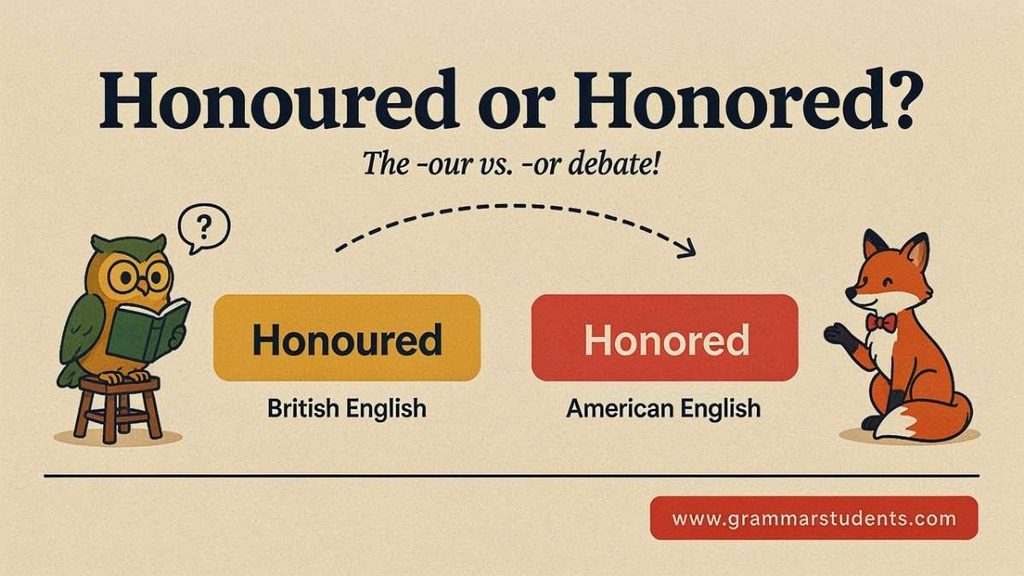
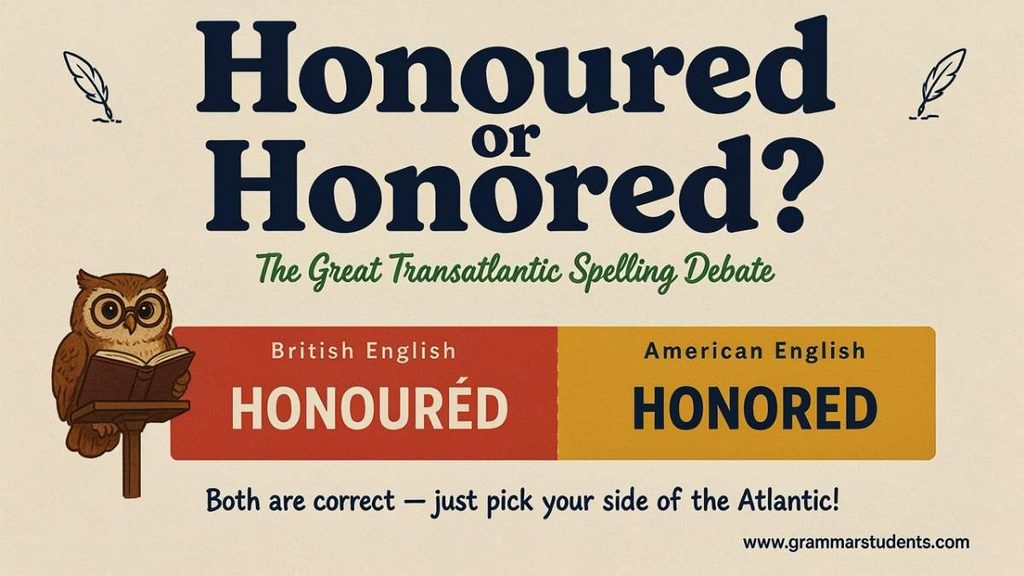
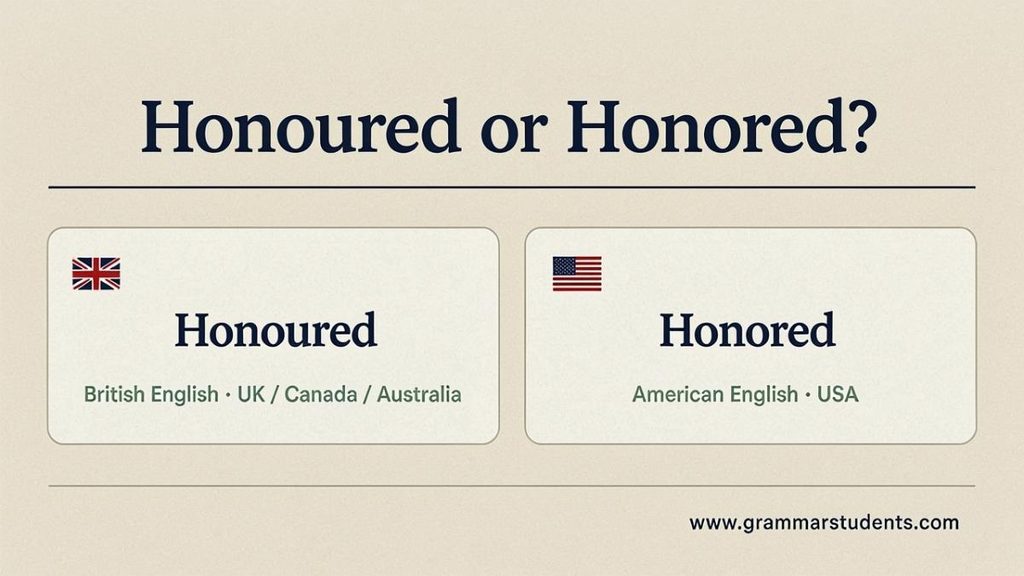
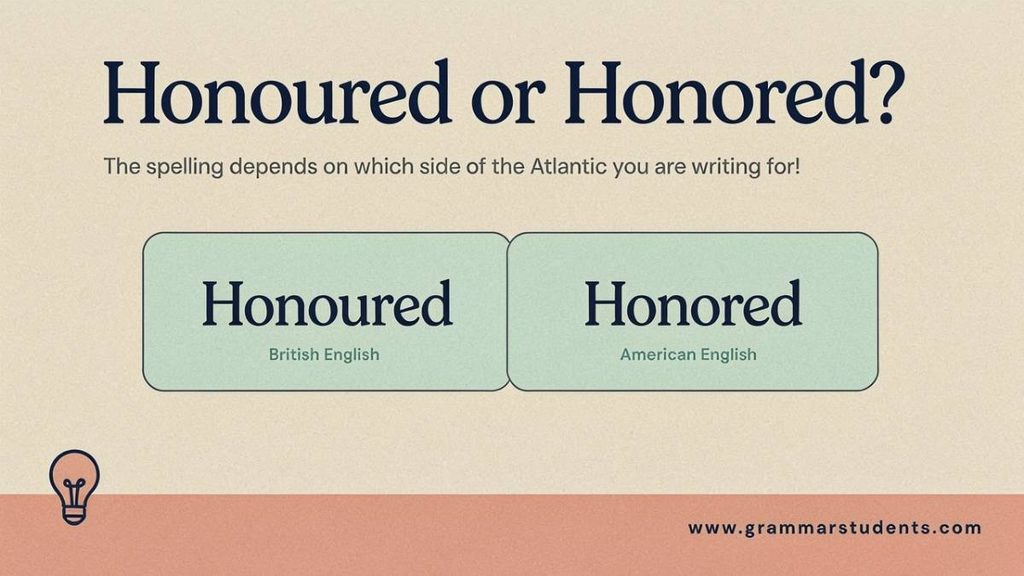
- Honored is the standard American English spelling.
- Honoured is the standard British English spelling.
- Both have the same meaning.
- Both function as the past tense and past participle of the verb honor/honour.
- Their pronunciation is generally the same.
- The difference is primarily a matter of regional spelling.
- You should choose the form that matches your target audience and style guide.
| Form | Common English variety | Example |
| honored | American English | I am honored to receive this award. |
| honoured | British English | I am honoured to receive this award. |
| honor | American English | We honor her achievements. |
| honour | British English | We honour her achievements. |
So if you’re writing for readers in the United States honored is normally the right choice. If you’re following British spelling use honoured.
Learn the difference between tricky more English words
Amateur vs Amatuer Which Spelling Is Correct
Honored vs Honoured at a Glance
The honoured vs honored difference is only one letter but that one letter tells readers something about the variety of English you’re using.
For example:
US English: The university honored the professor.
UK English: The university honoured the professor.
The meaning hasn’t changed. In both sentences the university gave recognition or showed respect to the professor.
Examples of Honored and Honoured
Here are several everyday examples:
- She felt honored by the recognition.
- She felt honoured by the recognition.
- The organization honored his achievements.
- The organization honoured his achievements.
The important point is consistency. Pick the spelling that fits your form of English and keep using it.
What Does Honored or Honoured Mean?
The honored meaning and honoured meaning are essentially identical.
The word can describe a feeling of respect or privilege. It can also describe the act of recognizing someone or fulfilling an obligation.
Honored or Honoured as a Verb
As a verb form honor/honour means to show respect, recognize someone’s achievement keep a promise or treat something as worthy of respect.
The past tense is:
- honored in American English
- honoured in British English
For example:
The committee honored the scientist for her research.
In British spelling:
The committee honoured the scientist for her research.
Here, the word means that the committee formally recognized the scientist’s achievement.
Avoid everyday grammar mistakes with simple tips
Repast vs Repass Meaning Difference Correct Usage
Honored or Honoured as an Adjective
Honored and honoured can also describe someone’s emotional state.
For example:
This means the speaker feels privileged or deeply pleased because of the opportunity.
The British version is:
Again the meaning remains the same.
This adjective use is extremely common in speeches interviews acceptance messages professional announcements and social media posts.
Learn the difference between confusing more English words
Maxxed or Maxed Which Spelling Is Correct
Common Meanings in Context
The word can carry several closely related meanings.
1. Feeling privileged
I feel honored to meet you.
The speaker considers the meeting a special privilege.
2. Receiving recognition
The person received formal recognition.
3. Showing respect
The ceremony honored the country’s veterans.
The ceremony recognized and respected them.
4. Keeping an agreement
The company honored its commitment.
Here honor means to fulfill or keep a promise agreement or obligation.
5. Commemorating someone or something
The word expresses respect and remembrance.
Fix common more word mistakes in English
Inact or Enact Which Spelling Is Correct
Examples by Meaning
| Meaning | American English | British English |
| Feeling privileged | I feel honored. | I feel honoured. |
| Receiving recognition | She was honored for her work. | She was honoured for her work. |
| Showing respect | We honor their service. | We honour their service. |
| Keeping a commitment | They honored the agreement. | They honoured the agreement. |
| Commemorating someone | The event honors his memory. | The event honours his memory. |
Why Are Honored and Honoured Spelled Differently?
The mystery is mostly about the spelling traditions of different English-speaking regions.
The One Letter Difference
The central difference is:
honor or honored
versus
honour or honoured
American English generally removes the u found in the traditional British form.
That creates:
- honor or honour
- honored or honoured
- honoring or honouring
This isn’t unique to honor. English contains many similar regional spelling differences.
How the Spelling Pattern Works
American English often uses or where British English uses our.
For example:
| American English | British English |
| color | colour |
| favor | favour |
| behavior | behaviour |
| labor | labour |
| neighbor | neighbour |
| honor | honour |
This pattern explains why American spelling honored contains no u while British spelling honoured does.
Neither form is automatically more correct. The appropriate choice depends on the English variety you’re using.
Other Words With the Same Pattern
Once you understand honor/honour other spelling differences become easier.
Consider:
color or colour
favor or favour
behavior or behaviour
neighbor or neighbour
labor or labour
These are examples of English spelling differences that developed through different spelling conventions.
Think of them like regional accents in writing. The underlying language is the same but certain details look different.
Understand confusing English more words simply
Maxxed or Maxed Which Spelling Is Correct
Honored vs Honoured in American and British English
The clearest way to understand honored vs honoured is to look at regional usage.
American English Honored
In American English honored is the standard spelling.
Examples include:
- I am honored to accept this award.
- We honored the winners at the ceremony.
- She was honored for her achievements.
- It was an honor to work with the team.
If you’re writing for a US audience use honor and honored unless a quotation, proper name, or official title requires another spelling.
British English Honoured
In British English the usual forms are honour and honoured.
Examples include:
- I am honoured to accept this award.
- We honoured the winners at the ceremony.
- She was honoured for her achievements.
- It was an honour to work with the team.
Therefore the phrase honoured British English refers to the British spelling convention.
Canadian Australian and Other English Varieties
English isn’t divided into only two varieties.
Canadian English Australian English and New Zealand English have their own spelling practices. Many commonly use forms associated with British spelling including honour and honoured although actual usage can vary by institution publication context and style guide.
That’s why it’s better to think in terms of English varieties rather than assuming every English speaking country follows exactly the same spelling rules.
Regional Spelling Comparison
| Region/variety | Common form |
| US English | honored |
| British English | honoured |
| Canadian English | often honoured |
| Australian English | commonly honoured |
| New Zealand English | commonly honoured |
For formal writing always check the relevant style guide if an organization or institution specifies one.
Honored or Honoured in Different Grammatical Forms
Knowing the base word makes the whole spelling pattern much easier.
Present Form Honor vs Honour
The base verb is:
- honor is American English
- honour is British English
Example:
We honor those who contributed to the project.
British spelling:
We honour those who contributed to the project.
Past Tense and Past Participle Honored vs Honoured
The past tense and past participle follow the same regional pattern:
- honored
- honoured
Example:
The school honored its graduates.
The British version:
The school honoured its graduates.
She has honored her promise.
She has honoured her promise.
Present Participle Honoring vs Honouring
The difference continues in the present participle:
- honoring is American English
- honouring is British English
For example:
The city is honoring local volunteers.
British spelling:
The city is honouring local volunteers.
Notice that the British form keeps the u.
Related Nouns and Adjectives
The noun follows the same regional distinction:
- honor is American English
- honour is British English
Common expressions include:
- a great honor
- a great honour
- an honored guest
- an honoured guest
- an honorable mention
- an honourable mention
The same pattern can appear in related words.
When Should You Use Honored?
Use honored when you’re writing in standard American English.
This applies to:
- US academic writing
- American business communication
- US websites
- American news writing
- Professional emails for US audiences
- Applications intended for American institutions
- General US English content
Examples in American English
The organization honored her dedication.
It was an honor to participate.
If your document otherwise uses American spelling switching to honoured can make the writing look inconsistent.
Learn the difference between tricky more English words
Handle or Handel Correct Spelling Meaning and Usage
When Should You Use Honoured?
Use honoured when you’re following British English spelling conventions.
This is common in:
- UK academic writing
- British publications
- UK professional documents
- British websites
- Formal writing following British conventions
- Organizations that specify British spelling
Examples in British English
I am honoured to accept this award.
We were honoured to welcome the guests.
The organization honoured her dedication.
He was honoured for his achievements.
It was an honour to participate.
The spelling fits naturally with other British forms such as colour favour and behaviour.
Honored or Honoured in Common Expressions
Certain phrases appear frequently enough that they’re worth learning as complete patterns.
I’m Honored/Honoured to
This expression usually communicates gratitude and privilege.
American
I’m honored to be part of this event.
British
I’m honoured to be part of this event.
We Are Honored/Honoured to
This is common in professional announcements.
American
We are honored to announce the winners.
British
We are honoured to announce the winners.
Honored/Honoured With an Award
When someone receives an award or formal recognition you can write
She was honored with an award for her achievements.
Or:
She was honoured with an award for her achievements.
Honor/Honour a Commitment
Here the meaning isn’t about receiving an award.
To honor a commitment means to keep or fulfill it.
American
The company promised to honor a commitment made to its customers.
British
The company promised to honour a commitment made to its customers.
In Honor/In Honour Of
This expression means something is done to show respect, recognition, or remembrance.
American:
The scholarship was created in honor of her teacher.
British:
The scholarship was created in honour of her teacher.
Avoid everyday grammar mistakes with simple tips
Emerse or Immerse Correct Spelling and Use
Common Mistakes With Honored and Honoured
Even though the difference looks tiny several mistakes occur regularly.
Treating Honoured as an Incorrect Spelling
A US writer may see honoured and assume it contains a spelling error.
It doesn’t.
Likewise a British reader shouldn’t automatically treat honored as incorrect. It is the standard American form.
Mixing American and British Spellings
A bigger problem is inconsistency.
For example:
The school honored students for their behaviour and colourful projects.
This combination may be perfectly understandable but it mixes spelling conventions.
If you’re writing standard US English you would generally use:
The school honored students for their behavior and colorful projects.
If you’re following British English you would generally write:
The school honoured students for their behaviour and colourful projects.
Fix common more word mistakes in English
Gos or Goes Which One Is Right
Choosing the Spelling Without Considering Your Audience
Your target audience matters.
A US marketing page will usually benefit from American spelling. A UK academic paper should normally follow British conventions if that’s what the institution requires.
Confusing Spelling With Meaning
Another common mistake is assuming the two forms have different meanings.
They don’t.
Honored and honoured have the same meaning and grammatical role.
The spelling changes. The core meaning does not.
Confusing Honored With Similar Words
Honored can be confused with words such as:
- respected
- recognized
- celebrated
- appreciated
- admired
- commemorated
These words overlap in meaning but aren’t always interchangeable.
For example:
She was honored for her research.
This suggests formal recognition.
She was respected for her research.
This emphasizes the esteem others had for her.
Context determines the best word.
Using Honored When Honor Is Required
Remember that honor and honored aren’t interchangeable in every sentence.
Incorrect:
We honored our tradition every year.
If you’re describing a regular present action you may need:
We honor our tradition every year.
Past action:
We honored the tradition last year.
The difference here is grammatical tense rather than regional spelling.
Learn the difference between tricky more English words
Employees or Employee’s Which One Is Correct
Honored vs Honoured in Real World Writing
The spelling question becomes especially important when you’re producing polished content.
Emails and Professional Messages
For an American audience:
I am honored to accept the invitation.
For a British audience
I am honoured to accept the invitation.
Neither version is inherently more formal. The surrounding spelling convention determines which one fits.
Awards and Recognition
Awards frequently use this word:
She was honored for her outstanding contribution.
British version
She was honoured for her outstanding contribution.
The word communicates recognition appreciation and distinction.
Invitations and Formal Events
Formal invitations may contain phrases such as:
It would be an honor to have you join us.
British spelling:
It would be an honour to have you join us.
The choice should match the rest of the invitation.
News and Editorial Writing
Professional publications usually follow an established writing style or editorial guide.
A publication using American English will generally prefer honored. A publication using British English will generally prefer honoured.
Consistency matters because readers expect a publication to maintain its chosen spelling conventions.
Social Media and Personal Writing
Casual writing gives you more flexibility.
Still, if you’re building a professional profile or brand consistent spelling creates a more polished impression.
Avoid everyday grammar mistakes with simple tips
Inconsolable or Unconsolable Which Is Correct?
Honored vs Honoured Side by Side Comparison
| Feature | Honored | Honoured |
| Main variety | American English | British English |
| Base form | honor | honour |
| Past tense | honored | honoured |
| Past participle | honored | honoured |
| Present participle | honoring | honouring |
| Core meaning | Recognition/respect/privilege | Recognition/respect/privilege |
| Pronunciation | Generally the same | Generally the same |
| Formal usage | Correct in US English | Correct in UK English |
| Main difference | No u | Includes u |
The table reveals the central point: this is a spelling variation not a difference in meaning.
How to Choose the Right Spelling
Still wondering should I use honored or honoured?
Use this simple decision process.
Use Honored When
Choose honored if:
- You’re writing for a US audience.
- Your document follows American English.
- Your style guide uses American spelling.
- Your institution requires US English.
- The surrounding text uses color favor and behavior.
use Honoured When
Choose honoured if:
- You’re writing for a UK audience.
- Your document follows British English.
- Your institution requires British spelling.
- Your style guide uses British conventions.
- The surrounding text uses colour favour and behaviour.
What If Your Audience Is International?
An international audience doesn’t mean you should randomly switch between spellings.
Instead choose one consistent variety.
For example if your website mainly targets American readers, use American English throughout. If it primarily targets British readers use British English.
Consistency is usually more important than trying to satisfy every regional convention simultaneously.
Learn how to use confusing more words correctly
Grayscale or Greyscale Which Is Correct
Honored or Honoured for Students and Academic Writing
Students often encounter both spellings online. That can make the honored spelling question especially confusing.
Which Spelling Should Students Use?
Students should generally follow the English variety required by their school university teacher or assignment instructions.
American vs British Academic Contexts
American academic writing generally uses:
Honor honored honoring
British academic writing generally uses:
Honour honoured honouring
Always follow your institution’s requirements if they specify a particular variety.
Practice Session Honored or Honoured
Fill in the Blanks
- I felt __________ when I was selected to receive the award.
- The school decided to __________ the top-performing students.
- It was a great __________ to meet such an inspiring writer.
- She was __________ for her years of dedicated service.
- We were __________ to have the opportunity to attend the ceremony.
- The award was a great __________ for the entire team.
- He showed great __________ for his former teacher.
- The organization wanted to __________ her achievements publicly.
- I would be __________ to accept your invitation.
- She received an __________ for her outstanding performance.
- He felt __________ by the recognition he received.
- The ceremony was held to __________ the achievements of local students.
- It was an __________ to represent our school at the event.
- The committee __________ the volunteers for their hard work.
- She was deeply __________ by the kind words of her mentor.
- Receiving the scholarship was a great __________ for him.
- The community gathered to __________ the achievements of the young artist.
- He felt __________ to be chosen for such an important role.
- The teacher expressed her __________ for the student’s dedication.
- I am __________ to be part of this memorable occasion.
- The organization __________ its long-serving employees every year.
- She considered it a great __________ to work with the talented team.
- He was __________ to receive recognition for his efforts.
- Good writers choose the correct form and remain __________ throughout their work.
- The main difference between honored and honoured is their __________.
Answer Key
- honored
- honor
- honor
- honored
- honored
- honor
- respect
- honor
- honored
- honor
- honored
- honor
- honor
- honored
- honored
- honor
- honor
- honored
- respect
- honored
- honors
- honor
- honored
- consistent
- spelling
Here’s a trusted source for clear more words Comparison:
Grammar Update
Honored or Honoured FAQs
How do you spell honored in Canada?
In Canada honoured is commonly used following the British style our spelling. Canadian English has its own conventions however so usage can vary depending on the word context and style guide. For formal writing follow the spelling rules required by your school employer publisher or organization.
What does honored mean?
Honored means feeling respected privileged or grateful because of a special opportunity achievement or recognition. It can also mean formally recognizing someone or fulfilling a promise or obligation.
For example:
I was honored to receive the award.
Here honored expresses a feeling of privilege and appreciation.
Is I would be honored correct?
Yes. I would be honored is grammatically correct in American English. It politely expresses that you would feel pleased or privileged to accept an invitation opportunity or responsibility.
In British English the equivalent is:
I would be honoured.
Can I say I am honored?
Yes. I am honored is a natural and grammatically correct expression in American English. It commonly shows gratitude respect or a feeling of privilege.
For example:
I am honored to be part of this celebration.
In British English write:
I am honoured to be part of this celebration.
How do British people spell honor?
British English spells honor as honour. The related forms follow the same pattern:
- honor or honour
- honored or honoured
- honoring or honouring
- honorable or honourable
This is one of the familiar regional spelling differences between American and British English.
Which spelling is used in Canada?
Honoured is commonly used in Canadian English. Canada often follows British style spellings in words such as honour and colour although Canadian English has its own spelling system and doesn’t follow British conventions in every case.
Is it honored or honoured?
Both are correct. Honored is the standard spelling in American English while honoured is standard in British English and commonly used in several other English varieties.
The difference is spelling rather than meaning.
| English variety | Preferred spelling |
| American English | honored |
| British English | honoured |
| Canadian English | commonly honoured |
| Australian English | commonly honoured |
What should I reply to I am honored?
Your response depends on the situation and how formal you want to sound. Natural replies include:
- Thank you. That means a lot.
- We’re delighted to have you here.
- We appreciate your kind words.
- It’s wonderful to have you with us.
- The feeling is mutual.
For professional situations, keep your response warm but appropriate to the relationship.
Is an honor grammatically correct?
Yes. An honor is grammatically correct in American English. The article an is used because honor begins with a vowel sound.
For example:
It was an honor to meet you.
British English uses:
It was an honour to meet you.
What’s a better word for honored?
The best alternative depends on the meaning you want to express.
- Privileged emphasizes a special opportunity.
- Grateful emphasizes appreciation.
- Pleased emphasizes happiness.
- Respected emphasizes esteem.
- Recognized emphasizes formal acknowledgment.
For example instead of saying:
You could write:
The two expressions are similar but they don’t always carry exactly the same emphasis.
Is it I feel honored or I feel honoured?
Both are correct. Use I feel honored in American English and I feel honoured in British English.
For example
I feel honored to receive this recognition.
I feel honoured to receive this recognition.
The meaning and grammatical structure remain the same.
Which is correct in India honor or honour?
For formal or academic writing in India follow the spelling required by your institution publication or style guide. Most importantly keep your spelling consistent throughout the document.
How do you use honored in a sentence?
Use honored in American English when you want to express respect privilege gratitude or formal recognition.
Examples:
He felt honored by the recognition.
British English uses honoured in the same sentences.
What is another way to say I’m honored?
You can replace I’m honored with several expressions depending on the context:
- I’m privileged.
- I’m grateful for the opportunity.
- I’m very pleased to be here.
- I’m thankful for the recognition.
- I deeply appreciate the opportunity.
If the situation is formal I’m privileged is a particularly natural alternative.
What does so honored mean?
So honored means feeling especially pleased grateful or privileged because of an opportunity or recognition.
For example:
I’m so honored to receive this award.
The word so adds emotional emphasis. It makes the statement stronger than simply saying I’m honored.
Do Australians say honor or honour?
Australian English commonly uses honour honoured and honouring following the British style spelling for these words.
For example:
It was an honour to meet you.
When should you say It’s my honor?
For example:
It’s my honor to welcome you to the event.
The British English version is:
It’s my honour to welcome you to the event.
The expression is common in formal speeches ceremonies introductions and professional situations.
Which is correct 1st honor or 1st honors?
Neither expression is universally correct because the terminology depends on the educational system or institution.
If you’re referring to a specific academic distinction use the official name of the award or honor provided by the school or university. Don’t change the wording simply because one version sounds more familiar.
For general academic writing terms such as first class honors first honors or honors can have different meanings depending on the educational system.
Is honourable the correct spelling?
Yes. Honourable is the standard British English spelling while American English normally uses honorable.
Examples:
British English an honourable decision
American English an honorable decision
This is another example of the broader our/or spelling pattern.
Is it honourary or honorary?
The correct spelling is honorary in both American and British English.
Honourary is not the standard spelling.
For example:
She received an honorary degree.
Notice that honorary does not follow the usual British honour spelling.
Should I use honor or honour?
Use honor when writing in American English and honour when following British English conventions.
The same distinction applies to related forms:
| American English | British English |
| honor | honour |
| honored | honoured |
| honoring | honouring |
| honorable | honourable |
The key is consistent spelling. Don’t switch between American and British forms without a specific reason.
What is another word for honored?
Depending on the context alternatives include privileged respected recognized appreciated grateful pleased admired and esteemed.
However these words aren’t interchangeable in every sentence.
For example recognized emphasizes acknowledgment while privileged emphasizes the special nature of an opportunity. Choose the word that matches the exact meaning you want.
How do I reply to I’m honoure?
A polite response could be:
Thank you. We’re delighted to have you here.
Other suitable replies include:
- That means a lot to us.
- We appreciate that.
- We’re grateful to have you with us.
- It’s wonderful to hear that.
Because honoured is the British spelling using British spelling in the rest of the message can help maintain consistency.
How do you use honoured in a sentence?
Use honoured in British English when describing respect recognition privilege or the fulfillment of an obligation.
Examples:
The organization honoured his achievements.
American English uses honored in these sentences.
How do you say honored?
Honored and honoured generally have the same pronunciation despite their different spellings.
The word has two syllables with the main stress on the first syllable. The extra u in honoured doesn’t normally create a different pronunciation.
What can I say instead of honour?
The best alternative depends on the context. Possible choices include:
- respect
- recognition
- esteem
- dignity
- privilege
- admiration
- appreciation
For example if honour means respect esteem may be a suitable replacement. If it refers to formal acknowledgment recognition may be more precise.
What’s another word for blessed or honored?
Depending on the context privileged grateful fortunate or thankful can express a similar idea.
For example:
I feel privileged to have this opportunity.
This expresses gratitude for a special experience without directly using honored or blessed.
Conclusion
The honored or honoured debate may look like a tiny spelling mystery but it’s really just English doing what English does best giving writers two ways to keep things interesting. Both forms have the same meaning and are grammatically correct in the appropriate spelling convention. The key is knowing your audience and staying consistent throughout your writing. Once you understand the difference between honor and honour along with forms such as honored honoured honoring and honouring the confusion quickly disappears. So before your next essay email or article sends your spell checker into panic mode choose your preferred spelling use it consistently and write with confidence.

Jacob AJS is an experienced blogger and English language enthusiast dedicated to making grammar and vocabulary simple, clear, and practical. As a writer for Grammarstudent, he creates insightful word comparisons, easy-to-follow explanations, and useful examples that help learners avoid common mistakes. His passion is to make English easier to understand while helping readers communicate with confidence, clarity, and accuracy.