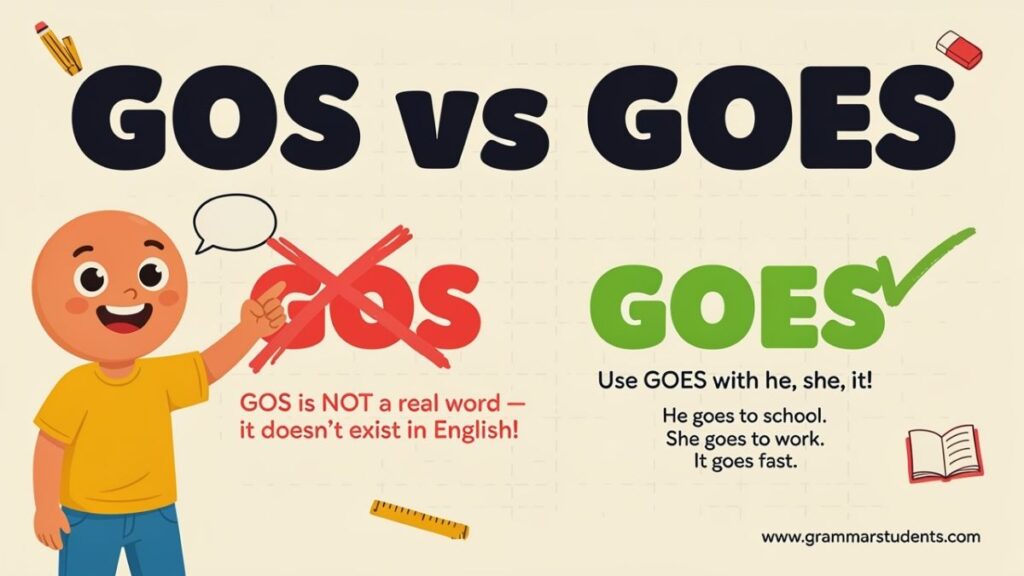
Ever stared at gos or goes and wondered why English decided one tiny letter could cause so much trouble You’re definitely not alone This common grammar confusion can turn a simple sentence into a mini spelling mystery. The good news is that the answer is much easier than it looks goes is the correct third person singular form of go while gos is usually a spelling mistake. In this guide you’ll learn when to use go and goes how subject verb agreement works and why words like does can and will change the verb pattern. Let’s clear up the confusion and make your grammar go smoothly.
Gos or Goes Which One Is Right?
The short answer is simple:
Go or goes
Goes is the standard third-person singular form of the verb go in the simple present tense.
For example:
- He goes to school every morning.
- She goes to work by bus.
- The train goes through the city.
- My brother goes to the gym after school.
- The dog goes outside every morning.
By contrast use go with I you we and they:
- I go to work early.
- You go to school every morning.
- We go there together.
- They go to the store on Saturdays.
Go vs Goes at a Glance
| Subject | Correct form | Example |
| I | go | I go home. |
| You | go | You go there. |
| We | go | We go to school. |
| They | go | They go to work. |
| He | goes | He goes home. |
| She | goes | She goes to work. |
| It | goes | It goes fast. |
| Singular noun | goes | Sarah goes there. |
The easiest rule to remember is:
I/you/we/they or go
He/she/it or goes
Gos or Goes Meaning What Do These Forms Mean?
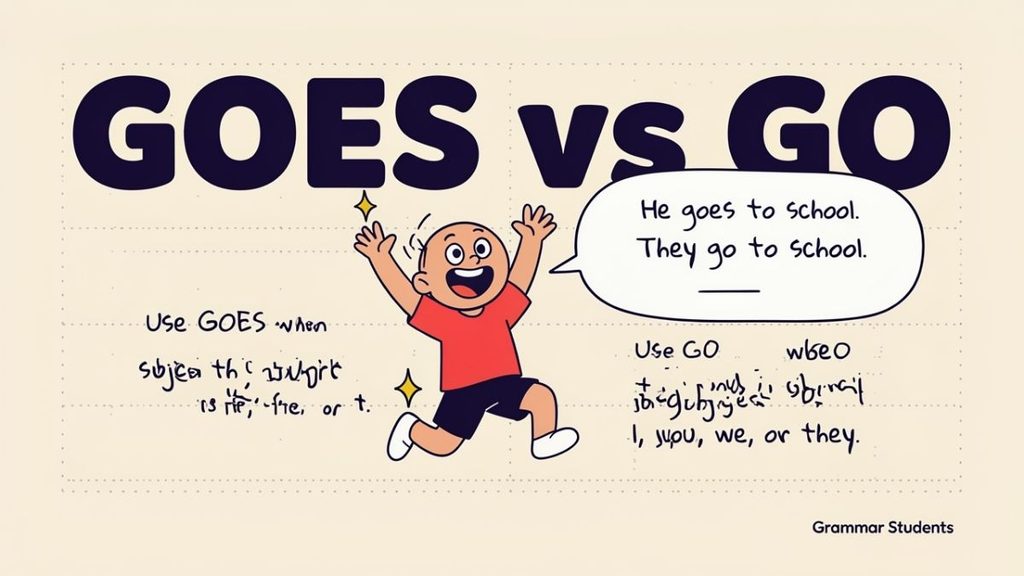
Understanding the gos or goes meaning starts with understanding the verb go.
Go Meaning
Go is the base form of the verb. It commonly describes movement travel or leaving for a particular place or activity.
Examples:
- I go to school every day.
- We go to the park on Sundays.
- They go to the store after lunch.
- You can go now.
Goes Meaning
Goes is the third-person singular present form of go.
Examples:
- He goes to school.
- She goes to work.
- The bus goes downtown.
- My sister goes there every weekend.
Therefore the basic relationship is:
go or goes
The word doesn’t change because its meaning changes. It changes because its grammatical form must agree with the subject.
Gos or Goes Which Is Correct in Standard English?
If you’re asking about the ordinary verb go goes is the correct standard spelling when the subject is third-person singular in the simple present.
For example:
He gos to school every day.
He goes to school every day.
She gos to work at eight.
She goes to work at eight.
The bus gos there every hour.
The bus goes there every hour.
The mistake involves both grammar and spelling. The writer needs the correct verb form and that form is spelled goes not gos.
Is Gos a Word?
A common search is is gos a word?
For ordinary English verb usage gos is not the standard third person singular form of go. If you want to write:
He _______ to school every day.
The standard answer is:
He goes to school every day.
That said letter combinations can appear as abbreviations names acronyms or specialized terms. So it would be too broad to claim that the sequence gos can never appear in any English language context.
For the normal verb however remember:
go or goes not go or gos
Learn how to use confusing more words correctly
Amateur vs Amatuer Which Spelling Is Correct
Is Gos Correct?
If you’re asking whether gos is correct in a sentence such as:
He gos to school every day.
The standard form is goes:
He goes to school every day.
This mistake often happens because many English verbs form their thirdperson singular by adding s:
- walk or walks
- play or plays
- run or runs
- read or reads
It’s natural to think:
go + s = gos
But English spelling has another pattern here:
go + es = goes
Is Goes Correct?
Yes. Goes is the standard third person singular present form of go.
Use goes with:
- he
- she
- it
- a singular person’s name
- a singular noun
Examples:
- He goes to college.
- She goes to the library.
- Ali goes home early.
- The car goes very fast.
- My sister goes to the store.
These examples demonstrate subject verb agreement. The subject and verb need to match in the appropriate grammatical form.
Gos vs Goes Why Does Go Become Goes?
The key to understanding gos vs goes is the third person singular rule.
In the simple present tense English generally changes a verb when the subject is third person singular.
Compare:
- I work.
- You work.
- They work.
- He works.
- She works.
With go the form is:
- I go.
- You go.
- We go.
- They go.
- He goes.
- She goes.
So the spelling change isn’t random. It is part of English verb conjugation.
Adding s and es
Many verbs simply take s:
- work or works
- play or plays
- read or reads
- run or runs
Other verbs take es:
- go or goes
- do or does
- watch or watches
- wash or washes
- fix or fixes
- pass or passes
This is why the gos or goes spelling question has a clear answer the standard third person form is goes.
Learn the difference between tricky more English words
Repast vs Repass Meaning Difference Correct Usage
When to Use Go or Goes
If you’re wondering when to use go or goes start by identifying the subject.
Use go with:
- I
- you
- we
- they
- plural nouns
Use goes with:
- he
- she
- it
- singular nouns
Examples
I go to work every morning.
You go to school by bus.
We go to the park on weekends.
They go to the store together.
He goes to school every day.
She goes to work by train.
The bus goes downtown.
My brother goes there every weekend.
When to Use Go
Use the base form go with first person and second person subjects as well as plural third person subjects.
First person
I go to work at eight.
Second person
You go to school every day.
First person plural
We go there together.
Third person plural
They go to school together.
Plural nouns also use go:
The students go home after class.
My friends go to college nearby.
When to Use Goes
Use goes with a singular third person subject.
He
He goes to school every morning.
She
She goes to work by bus.
It
It goes very slowly.
Singular noun
The train goes through the city.
My sister goes there every weekend.
A useful memory trick is:
He she it goes.
Learn how to use confusing more words correctly
Maxxed or Maxed Which Spelling Is Correct
Go or Goes Grammar After Auxiliary Verbs
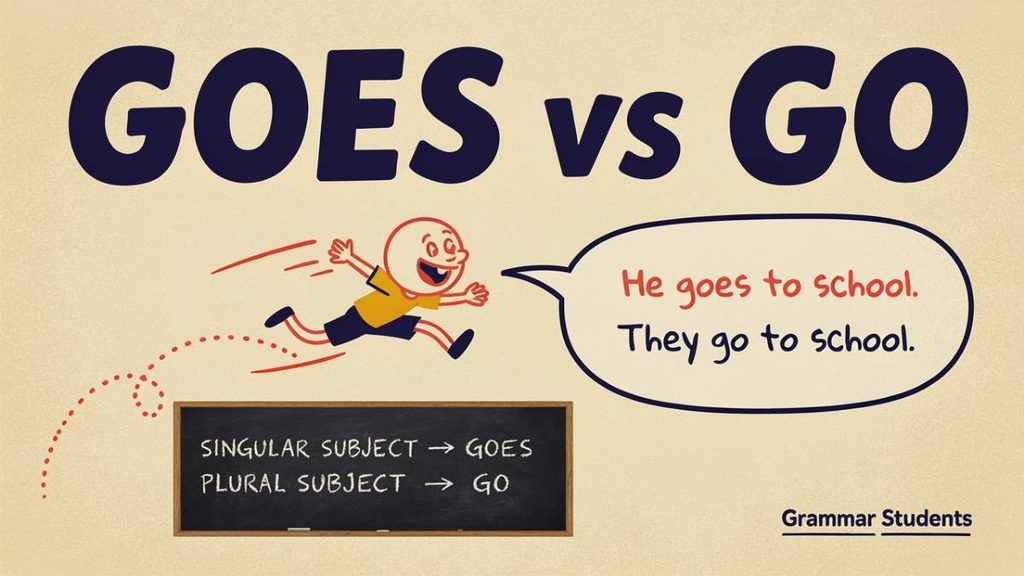
One of the most common mistakes occurs when people use goes after an auxiliary or helping verb.
When an auxiliary verb already carries the tense or grammatical information the main verb normally returns to its base form.
For example:
He goes to school.
But:
Does he go to school?
Not:
Does he goes to school?
The auxiliary does already marks the third person singular present tense. Therefore, the main verb stays as go.
Does He Go or Does He Goes?
The correct question is:
Does he go to school?
Not:
Does he goes to school?
The same rule applies to does she go.
Does she go to work every day?
Not:
Does she goes to work every day?
More examples:
- Does he go there?
- Does she go home early?
- Does Ali go to college?
- Does the bus go downtown?
- Does your brother go to work by car?
This is an important part of go or goes grammar.
Doesn’t Go Why Doesn’t Goes Is Wrong
Negative sentences follow the same pattern.
Use:
doesn’t go
Not:
doesn’t goes
Examples:
- He doesn’t go to school on Sunday.
- She doesn’t go there often.
- The bus doesn’t go that way.
- My brother doesn’t go to work on weekends.
Compare the three structures:
Affirmative:
She goes to school.
Negative:
She doesn’t go to school.
Does she go to school?
Question:
This pattern is worth learning because it applies to many English verbs not just go.
Learn the difference between confusing more English words
Inact or Enact Which Spelling Is Correct
Modal Verbs Use Go Not Goes
A modal verb is a type of helping verb. Common modal verbs include:
- can
- could
- may
- might
- must
- should
- will
- would
After a modal verb use the base form go.
Examples:
- He can go.
- She will go.
- They should go.
- We might go.
- You could go.
- I must go.
Avoid these forms:
He can goes.
She will goes.
They should goes.
Use:
He can go.
She will go.
They should go.
The modal verb controls the grammatical structure so the main verb remains in its base form.
Gos or Goes in a Sentence Correct Examples
If you’re looking for gos or goes in a sentence these examples show the correct usage.
Correct examples
- He goes to school every morning.
- She goes to work by bus.
- The train goes through the city.
- My father goes to the store after work.
- The dog goes outside every morning.
- Sarah goes home at five.
- The machine goes very slowly.
- My brother goes there every weekend.
Incorrect vs correct
| Incorrect | Correct |
| He gos to school. | He goes to school. |
| She gos home. | She goes home. |
| The bus gos there. | The bus goes there. |
| My sister gos to work. | My sister goes to work. |
| The dog gos outside. | The dog goes outside. |
Go in a Sentence Examples With Different Subjects
Here are practical examples of go in a sentence:
- I go to work every morning.
- You go to school by bus.
- We go to the park on weekends.
- They go to the store together.
- My friends go to college nearby.
- The students go home after class.
The important detail is the subject.
For example:
They go to school.
Not:
They goes to school.
Because they is a plural third person pronoun.
Goes in a Sentence Examples With Singular Subjects
Here are several examples of goes in a sentence:
- He goes to school every day.
- She goes to work early.
- It goes very fast.
- The teacher goes home at five.
- My mother goes to the market.
- The bus goes downtown.
- The child goes to bed early.
Each sentence has a singular third person subject.
He Goes vs They Go
A quick comparison makes the rule obvious.
Singular
He goes to school.
Plural
They go to school.
Another example:
She goes to the store.
But:
They go to the store.
The subject determines the grammatical form of the verb.
Learn the difference between often confused words
Handle or Handel Correct Spelling Meaning and Usage
First Person Second Person and Third Person Pronouns
Pronouns make it easier to identify the correct form.
| Person | Pronouns | Verb |
| First person singular | I | I go |
| Second person | you | You go |
| First person plural | we | We go |
| Third person plural | they | They go |
| Third person singular | he | He goes |
| Third person singular | she | She goes |
| Third person singular | it | It goes |
The simplest pattern is:
I / you / we / they → go
he / she / it → goes
Once this becomes familiar you can choose the correct form almost automatically.
Go or Goes or Went or Gone or Going

If you want to master the correct form of go you also need to know its other common forms.
The main forms are:
go or goes or went or gone or going
Go
The base form:
I go to school.
Goes
The third-person singular present form:
She goes to school.
Went
The past tense:
She went to school yesterday.
Gone
The past participle:
She has gone to school.
Going
The present participle or ing form:
She is going to school.
Unlike regular verbs such as walk or walked go is an irregular verb.
You don’t say:
She goed home.
You say:
She went home.
Learn the difference between tricky more English words
Emerse or Immerse Correct Spelling and Use
Go Goes Went Gone and Going
| Verb form | Example |
| go | I go to school. |
| goes | She goes to school. |
| went | She went to school yesterday. |
| gone | She has gone to school. |
| going | She is going to school. |
Learning the full set helps prevent confusion between the present form of go past tense of go, and past participle of go.
Why Do People Write Gos?
If goes is correct why does gos appear?
A few simple explanations can help.
People apply a familiar spelling pattern
Learners often know that many verbs simply add s:
- work or works
- play or plays
- read or reads
They may therefore assume:
go or gos
But the standard form is:
go or goes
Pronunciation can cause confusion
The spoken form of goes doesn’t make its spelling immediately obvious to every learner. Someone who relies heavily on sound may spell it incorrectly.
Fast typing creates errors
People often type quickly especially in messages and social media posts. A missing letter can easily slip through unnoticed.
Avoid everyday grammar mistakes with simple tips
Inconsolable or Unconsolable Which Is Correct?
Grammar and spelling work together
This isn’t only a spelling issue. You need to recognize that the sentence requires the third person singular form in the first place.
English Spelling Rules Why Goes Uses es
English uses several patterns when forming third-person singular verbs.
Many verbs add s:
- eat or eats
- sleep or sleeps
- read or reads
- work or works
Others use es:
- go or goes
- do or does
- watch or watches
- wash or washes
- fix or fixes
- pass or passes
This is why the gos or goes spelling question has a straightforward answer.
go or goes
The form gos isn’t the standard third person singular spelling of the verb.
Subject and Verb A Simple Way to Choose
When you’re unsure whether to use go or goes don’t start by looking at the verb.
Start with the subject.
Ask:
Who or what performs the action?
Then determine whether that subject is singular or plural.
Example
My sister ___ to school every day.
Who performs the action?
My sister.
Is she singular?
Yes.
Is she third person?
Yes.
Therefore:
My sister goes to school every day.
This simple technique prevents many subject verb agreement errors.
Common Gos or Goes Grammar Mistakes
Using gos
He gos to work.
He goes to work.
Using goes with they
They goes to school.
They go to school.
Using goes after does
Does she goes there?
Does she go there?
Using goes after will
She will goes home.
She will go home.
Using goes after can
He can goes with us.
He can go with us.
Using goes after should
You should goes now.
You should go now.
Using goes with I
I goes to work.
I go to work.
Learn how to use confusing more words correctly
Employees or Employee’s Which One Is Correct
A Three Step Rule for When to Use Go or Goes
When deciding when to use go or goes use this quick method.
Find the subject
Identify who or what performs the action.
Check the subject
Use:
I you we they or go
Use:
He she it singular noun or goes
Check for a helping or modal verb
If the sentence contains does doesn’t can could will would should may might or must the main verb generally stays as go.
For example:
She goes there.
There’s another use of go that occasionally appears in grammar searches.
The word go can function as a noun meaning an attempt or turn. In that context its plural can be goes.
For example:
Give it another go.
Here go is a noun meaning an attempt.
You might also see:
She had three goes at the puzzle.
Here goes is the plural noun not the third person singular verb.
Compare the two uses
Verb:
She goes to school.
Noun:
She had two goes at the puzzle.
The spelling is identical but the grammatical function is different.
This is a secondary use so it shouldn’t distract from the main gos or goes grammar rule.
Quick Memory Trick He She It Goes

Need a fast way to remember the rule?
Think:
I you we they or go
He she it or goes
Then remember the auxiliary pattern:
Does or go
Doesn’t or go
Will or go
Can or go
Should or go
So:
- He goes.
- Does he go?
- He doesn’t go.
- He will go.
- He can go.
- He should go.
The more you see this pattern the more natural it becomes.
Gos or Goes Correct Spelling Final Comparison
| Form | Correct? | Use |
| go | Yes | Base form |
| goes | Yes | Third person singular present |
| gos | wrong for standard verb usage | Not the standard third person form |
| went | Yes | Past tense |
| gone | yes | Past participle |
| going | Yes | ing form |
If your sentence says:
He ___ to school.
Choose:
goes
If it says:
They ___ to school.
Choose:
go
If it says:
Does he ___ to school?
Choose:
go
If it says:
He will ___ to school.
Choose:
go
Practice Session Go or Goes
Fill in the Blanks
- She ___ to school by bus every morning.
- I ___ to the library after class.
- They ___ to the park every weekend.
- He ___ to work at 8 o’clock.
- We ___ shopping on Saturdays.
- My sister ___ to college every morning.
- You ___ to the gym after work.
- The bus ___ to the city center every hour.
- My friends ___ to the same school.
- Ahmed ___ to the market with his father.
- Does she ___ to school every day?
- Does your brother ___ to work by train?
- He doesn’t ___ to the office on Fridays.
- She doesn’t ___ there very often.
- I will ___ to the store later.
- They will ___ home after dinner.
- He can ___ with us if he wants.
- She should ___ to the doctor tomorrow.
- We usually ___ to the beach during summer.
- The train ___ through several towns.
- My parents ___ to work early every morning.
- The car ___ very slowly on this road.
- Does your sister ___ to the library after school?
- You should ___ home before it gets late.
- The dog ___ outside every afternoon.
Answer Key
- goes
- go
- go
- goes
- go
- goes
- go
- goes
- go
- goes
- go
- go
- go
- go
- go
- go
- go
- go
- go
- goes
- go
- goes
- go
- go
- goes
Here’s a trusted source for clear more words Comparison:
Grammar Update
Frequently Asked Questions About Gos vs Goes
When should you use go or goes?
Use go with I you we and they. Use goes with he she it or a singular third person noun in the simple present tense.
- I go to school every day.
- They go to work together.
- She goes to school every morning.
- The bus goes downtown.
Is go’s a word?
Go’s is not the standard spelling of goes. If you mean the third person singular form of the verb go write goes without an apostrophe.
She goes to work every morning.
The apostrophe in go’s changes the construction and isn’t needed for the ordinary verb form.
What does goes mean?
Goes is the third person singular present form of the verb go. Depending on context it can describe movement travel progress operation or the way something happens.
The train goes through the city.
Here, goes describes movement from one place to another.
Is goes a proper word?
Yes. Goes is a standard English word and the third person singular present form of go. It follows normal subject verb agreement in the simple present.
For example:
My sister goes to college every day.
What is a sentence for goes?
A simple example is:
She goes to the library after class.
The subject she is singular and third person so goes is the appropriate verb form.
What does goes mean in English?
Goes can mean moves travels proceeds operates or happens depending on the context. It is the third person singular form of go.
For example:
The car goes very fast.
Here goes refers to movement or operation.
What is the meaning of gos?
In ordinary English grammar gos is not the standard third person singular form of go. The correct form is goes.
For example:
He gos to school.
He goes to school.
The spelling gos is therefore usually a spelling or grammar error when the intended word is the verb form goes.
Is GOS a valid Scrabble word?
GOS is not generally accepted in the standard English Scrabble word lists. However Scrabble dictionaries can differ depending on the edition language and official word list being used so players should check the specific dictionary for their game.
How do you spell goes in English?
The correct spelling is G O E S goes.
It is the third person singular present form of go:
go or goes
For example:
He goes to school every day.
What is the plural of goes?
If goes is being used as a verb it doesn’t have a plural form. The verb changes according to its subject:
She goes to school.
They go to school.
However go can also be a noun meaning an attempt or turn. In that use its plural can be goes:
She had three goes at the puzzle.
Here, goes means three attempts.
Which is correct Does she go or goes?
Does she go is correct. When does acts as the auxiliary verb the main verb stays in its base form, go.
Correct:
Does she go to school?
Incorrect:
Does she goes to school
Which is correct I go to school or I goes to school?
I go to school is correct. The first person pronoun I takes the base form go.
I go to school every day.
I goes to school every day.
The form goes is used with singular third-person subjects such as he she and it.
How do you use goes?
Use goes with he she it or another singular third-person subject in an affirmative simple-present sentence.
Examples:
- He goes to work early.
- She goes to school by bus.
- It goes very slowly.
- The train goes downtown.
After words such as does doesn’t can will and should use the base form go instead:
She doesn’t go there.
He will go tomorrow.
What’s the saying goes?
The phrase so it goes is an expression used to acknowledge that something has happened or that events have unfolded in a particular way. It can convey acceptance that certain things are simply part of how life or circumstances work.
Another common expression is
How does it go
This can mean How does the story song process or sequence continue
What does it goes mean?
It goes can have several meanings depending on the context. It may describe movement operation progress or the way something happens.
For example:
- The car goes fast. — The car moves quickly.
- The machine goes quietly. — The machine operates quietly.
- That’s how the story goes. — That’s how the story unfolds.
- So it goes. — That’s how things happen.
What does goes mean?
Goes is the third person singular present form of go. Its exact meaning depends on the sentence.
It can refer to:
- movement — The train goes north.
- travel — She goes to work.
- progress — The project goes well.
- operation — The machine goes smoothly.
- unfolding — That’s how the story goes.
What does goes mean in slang?
The meaning of goes in informal English depends heavily on the expression around it. For example Here she goes can introduce an action someone is about to perform while How does it go can ask someone to recall how something is said or happens.
Because goes has several informal uses the surrounding phrase is usually more important than the word by itself.
Conclusion
Confused by gos or goes You can officially let that grammar headache go The correct spelling is goes when you’re using the third person singular form of go with he she it or a singular noun. Use go with I you we and they. Remember though after does doesn’t can will and other helping or modal verbs the base form go comes back into action. So She goes to school is correct but Does she go to school is also correct. English may love its little tricks but once you know the rule go or goes becomes a piece of cake.

Jacob AJS is an experienced blogger and English language enthusiast dedicated to making grammar and vocabulary simple, clear, and practical. As a writer for Grammarstudent, he creates insightful word comparisons, easy-to-follow explanations, and useful examples that help learners avoid common mistakes. His passion is to make English easier to understand while helping readers communicate with confidence, clarity, and accuracy.